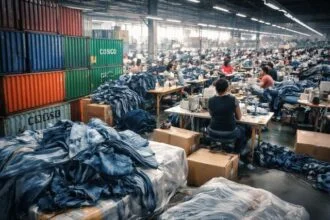


Mexico is broadening the range of countries supplying its apparel market as imports from China lose ground, reflecting shifting global supply chains, tariff anxieties and growing links with Asian and Latin American garment exporters.
Data for the first quarter of 2025 show overall apparel imports to Mexico fell year-on-year, but China still led suppliers with a reduced share, while Bangladesh, Vietnam, Cambodia and India rose as important sources of clothing and textile products. The trend is part of a wider reshuffle in which buyers and distributors seek alternative manufacturing hubs amid trade frictions and rising costs.

Also Read: Cotton Tops 2025 Global Survey as the World’s Favourite Fibre
Industry analysts say several factors are driving the change. Rising production and labour costs in China, the maturation of factory capacity in Southeast Asia and South Asia, plus improvements in logistics and compliance capabilities in countries such as Bangladesh and Vietnam, have encouraged Mexican apparel importers to diversify. At the same time, political pressure and policy moves in Mexico targeting imports from nations without trade agreements are reshaping sourcing decisions.
Mexican government trade statistics and international databases show China remains a large supplier in dollar terms — imports from China to Mexico totaled tens of billions of dollars in 2024 — but apparel-specific shares have been slipping as market participants adjust sourcing strategies. Companies that once relied on China for large-volume, low-cost items are increasingly splitting orders across multiple countries to reduce concentration risk and avoid potential tariff shocks.
Also Read: Process for Partial Exporters to Import Duty-Free Raw Materials
The policy backdrop has added urgency. Proposals in Mexico to raise tariffs on certain imports from countries without free-trade agreements, and recent investigations and trade frictions with Beijing, have prompted some buyers to accelerate diversification to avoid future disruptions or higher duties. Beijing has formally protested certain Mexican measures, underscoring the geopolitical dimension of what might otherwise be commercial supply-chain choices.
For Mexican retailers and wholesalers, diversification brings both opportunities and challenges. New supplier relationships can reduce reliance on a single source and—when managed well—deliver price and lead-time advantages. But shifting production also requires greater capacity for supplier vetting, quality control and compliance checks, and can expose importers to unfamiliar logistical and regulatory hurdles. Logistics providers and sourcing agents report increased demand for multi-country sourcing strategies and support services across Central America and Asia.
Market watchers say the longer-term picture will depend on how trade policy and tariff proposals evolve, whether Chinese exporters respond by adjusting pricing or moving production abroad, and how rapidly alternative suppliers scale up higher-value and compliance-sensitive production. For now, Mexico’s apparel import mix is becoming more geographically diverse — a shift that mirrors wider global trends in the garment trade as buyers weigh cost, risk and geopolitics in sourcing decisions.