
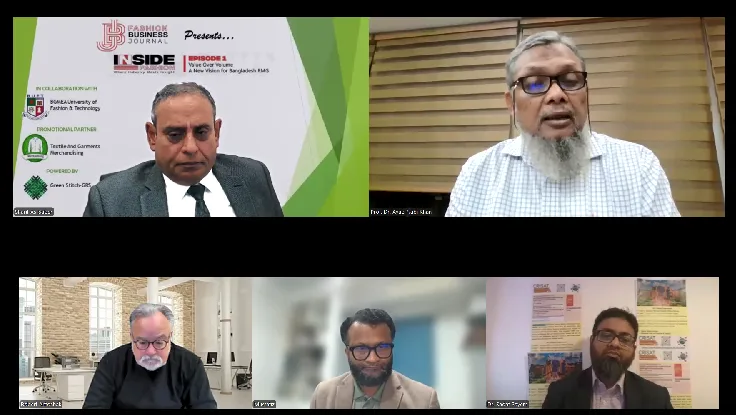
Fashion Business Journal successfully launched its exclusive industry talk show series ‘Inside Fashion’ on November 6. The inaugural episode, titled “Value Over Volume – A New Vision for Bangladesh RMG,” brought together leading voices from the textile, apparel, and fashion sectors to discuss emerging business trends, sustainability challenges, and innovations shaping the global fashion industry.
The opening episode was jointly organized with the BGMEA University of Fashion & Technology, powered by Green Stitch (GRS), and supported by the Textile and Garments Merchandising Blog as the promotional partner.

Held as a live webinar, the session attracted a diverse audience of professionals, academics, and students, both in Bangladesh and internationally. The discussion emphasized bridging the gap between business, creativity, academia, and sustainability, providing actionable insights for a responsible and resilient fashion ecosystem.
Prof. Dr. Engr. Ayub Nabi Khan, Vice Chancellor (Acting), BGMEA University of Fashion and Technology, said, “Inside Fashion creates a vital platform where academia and industry can collaborate, fostering solutions for sustainable growth in Bangladesh’s RMG sector.”
Also Read: From Modest Beginnings to Global Ambitions — BUFT’s Evolution through the Eyes of Dr. Khan

He said, “Since revising a university curriculum is often a bureaucratic process that requires approval from the UGC, we introduced several short courses to quickly adapt to industry needs. These include 3D fashion design, AI-based courses related to R&D, machinery, and robotics. Our students are now gaining hands-on experience with modern technologies widely used in the RMG sector.”
“Currently, Bangladesh’s apparel industry mainly focuses on basic garments such as T-shirts, shirts, and trousers. However, it is essential to diversify into high-value products like medical textiles, military textiles, aeronautical textiles, and other technical textiles. To address this, we are gradually revising our curriculum to include these emerging areas so that our graduates are well prepared for future industry developments.|

Robert Antoshak, VP, Global Strategic Sourcing & Development, Grey Matter Concepts, said, “Shifting from volume to value is not just a strategy—it’s essential for long-term competitiveness and responsible supply chain management.”
He also said, “Bangladesh has made strong progress in garment manufacturing, but the next step is diversification and self-sufficiency. The country should strengthen its domestic supply chain by producing more of its own yarns, fabrics, and synthetic fibers. This vertical integration would reduce import dependence and improve efficiency.”
“Beyond garments, Bangladesh should expand into higher-value sectors such as home textiles, industrial fabrics, and technical textiles. These areas offer better margins and less price pressure than basic apparel. To achieve this, investment in education and technical training is essential. Developing local expertise will support innovation and long-term competitiveness.”
Dr. Abu Sadat M. Sayem, Lead, Digital Fashion Innovation Research Project, Manchester Fashion Institute, said, “Digital innovation and technology can empower local producers to optimize efficiency and create a more sustainable industry globally.”

He emphasized the importance of adopting digital technologies in Bangladesh’s fashion industry. He highlighted tools such as 3D design, digital prototyping, and AI-based systems that can help local manufacturers move from simple production to original design and innovation.
He noted that while Bangladeshi factories are using foreign digital tools like CLO3D and Optitex, they are not yet exploring their full creative and analytical potential. He urged collaboration between the IT sector and the garment industry to develop local software solutions tailored to Bangladesh’s needs.
Sayem also pointed out a key challenge—the “buyer-driven” mindset, where innovation only happens when buyers demand it. He called for a shift toward independent, proactive innovation, encouraging universities and manufacturers to lead in digital design, virtual sampling, and sustainable product development.
Also Read: Global Experts Unite at Wuhan to Shape the Future of Sustainable Fashion

Sheikh H M Mustafiz, Director, BGMEA & Managing Director, Cute Dress Industry Ltd. discussed how sustainability can align with profitability in the apparel industry. He shared his own experience as a manufacturer, showing that investing in solar energy, water recycling, and waste reduction not only benefits the environment but also reduces costs and adds marketing value.
He emphasized changing the mindset from focusing solely on cost of production to understanding the value of production—including product quality, reliability, compliance, and brand reputation.
Mustafiz also highlighted new opportunities arising from EU regulations such as due diligence laws and digital product passports, which could help Bangladesh position itself as a responsible, value-driven supplier.
He concluded by urging the industry to act ahead of buyer pressure, adopt sustainable practices voluntarily, and build long-term partnerships based on innovation, trust, and value creation.

The discussion was moderated by Prof. Sharif As-Saber, Editor-in-Chief of Fashion Business Journal, President of the Governance and Administration Innovation Network (GAIN International) and International Adviser of BGMEA, who highlighted the role of media in connecting local insights with international trends. Panelists emphasized the need for responsible production, technology-driven innovation, and collaborative approaches to promote sustainable growth in the apparel sector.