

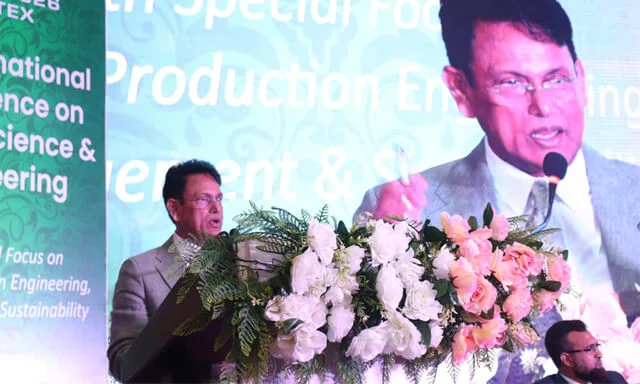
Bangladesh must accelerate innovation, adopt advanced technologies and strengthen sustainability practices to retain its global leadership in textiles and garments, Education Minister Dr A.N.M. Ehsanul Hoque Milon said on Saturday. Read Here
Speaking at the opening of the 4th International Conference on Textile Science and Engineering (ICTSE-2026) at the Bangladesh University of Textiles (BUTEX) in Dhaka’s Tejgaon industrial area, the minister underscored the need for research-driven growth in the country’s key export sector.

The conference, organised by BUTEX, brought together academics, researchers, policymakers and industry professionals to exchange ideas on emerging technologies, sustainability and future challenges in the textile industry.
“Bangladesh must invest more in research and innovation to remain competitive in the global textile market,” Milon said, warning that rival manufacturing hubs such as China, Vietnam and India are rapidly advancing in technology and value-added production.
The South Asian nation is the world’s second-largest garment exporter, with the ready-made garment (RMG) and textile sector serving as the backbone of its economy. The industry employs millions of workers, the majority of them women, and accounts for the bulk of export earnings.
Also Read: H&M Reaffirms Bangladesh’s Sourcing Role Amid Industry Concerns
However, the minister highlighted structural challenges, particularly the sector’s reliance on imported raw materials, which continues to limit competitiveness and value addition.
Industry transformation through technology was a central theme of the conference, with Milon stressing that artificial intelligence (AI) and digitalisation should be seen as opportunities rather than threats.
“AI will enhance productivity, improve product quality and open new avenues in design and marketing,” he said, adding that technology adoption would help Bangladesh move up the global value chain instead of competing solely on low-cost manufacturing.
The ICTSE-2026 conference focuses on areas such as Industry 5.0, smart textiles, sustainable production systems and supply chain optimisation, reflecting the global shift toward high-tech and environmentally responsible manufacturing.
Participants discussed innovations in textile engineering, including advanced materials, circular economy practices and green production methods aimed at reducing environmental impact.
Milon urged stakeholders to prioritise sustainability, noting that global buyers are increasingly demanding environmentally compliant products.
He called for wider adoption of eco-friendly technologies, recycling systems and resource-efficient production processes to address climate challenges and align with international sustainability standards.
Bangladesh has already made progress in green manufacturing, hosting many of the world’s top LEED-certified garment factories, but experts say further investment in innovation and waste management is needed to sustain long-term growth.
The minister also pointed to the importance of strengthening collaboration between academia and industry, a key objective of the ICTSE platform.
The conference aims to bridge knowledge gaps by enabling researchers and industry leaders to share insights and develop solutions for real-world challenges facing the textile sector.
“Strong academia-industry linkages are essential to develop skilled human resources and foster innovation,” Milon said.
Bangladesh University of Textiles, the country’s only specialised public institution dedicated to textile education and research, plays a central role in this effort by producing skilled graduates and supporting industrial development.
Beyond modernisation, the minister also highlighted the importance of preserving traditional textile heritage while integrating modern science.
He referred to the historic muslin industry of Dhaka, once globally renowned, and stressed the need to revive it using advanced research and technology.
In addition, Milon emphasised the role of jute as a sustainable alternative to plastic, noting ongoing government initiatives to promote biodegradable jute-based products.
Analysts say Bangladesh is at a critical juncture as it seeks to transition from a volume-driven apparel exporter to a value-added, innovation-led manufacturing hub.
While the country has built a strong foundation in garment production, future competitiveness will depend on its ability to adopt advanced technologies, diversify products and improve supply chain resilience.
The ICTSE-2026 conference, experts say, reflects this shift by providing a platform to explore next-generation solutions for the textile industry.
As global competition intensifies and sustainability requirements tighten, Bangladesh’s push for innovation and technological transformation could determine its position in the evolving global apparel market.