
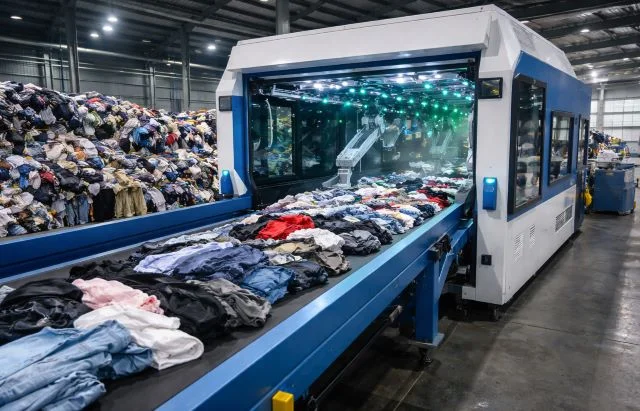
In an innovative leap for the textile recycling industry, AI-driven technology is beginning to transform the way used clothes are processed, accelerating recycling efforts and reducing waste. One such system, Fastsort-Textile, has been making waves in Zhangjiagang, China, where it is revolutionizing how synthetic textiles are sorted for recycling.
Fastsort-Textile, a machine developed by the Chinese company DataBeyond, uses advanced artificial intelligence to sort textiles at an unprecedented speed, cutting down labor costs and enhancing the accuracy of recycling processes. Unlike human workers who typically require several hours to sort through a load of textiles, Fastsort-Textile can process up to 100 kilograms in just two to three minutes.

This means the machine works about 120 times faster than a human, who would take approximately four hours to sort the same amount of clothes. The machine’s impressive processing capacity allows it to sort a staggering two tons per hour, a task that would take a human team two full days to complete with reduced precision.
DataBeyond, founded in 2018, has been at the forefront of AI innovation in recycling. The company designed the Fastsort-Textile machine with the aim of tackling one of the most pressing issues in the textile industry: the overwhelming amount of synthetic textile waste.
Synthetic fibers like polyester and nylon, which are derived from fossil fuels, account for a large portion of global textile production. Yet, these fibers are notoriously difficult to recycle, contributing to the growing problem of textile pollution.
With the textile industry being a key player in global pollution, especially in China, the world’s leading textile exporter, AI solutions like Fastsort-Textile are seen as crucial for mitigating environmental harm.
According to the nonprofit Circle Economy, synthetic textiles make up around 70% of the world’s textile production, making it vital to find efficient ways to manage waste.
Also read: Circ Joins Xinxiang Bailu to Boost Recycled Viscose in China
The Fastsort-Textile machine uses an AI scanner that reads the composition of fabrics in real time, sorting them according to their fiber content. Once sorted, textiles are directed to recycling areas, while items deemed unsuitable for recycling are sent to be incinerated or disposed of in landfills.
The machine’s AI system can read the composition of each item in under one second, providing accurate data that human workers may struggle to achieve, especially when distinguishing between materials like polyester and nylon.
Shanhesheng Environmental Technology Ltd., a textile recycling facility in Zhangjiagang, installed the Fastsort-Textile machine in 2025. According to sales director Li Bin, the use of AI sorting has already led to a significant reduction in the amount of textile waste sent to landfills.
Previously, up to 50% of the processed textiles were deemed unrecyclable and discarded, but with the Fastsort-Textile machine, that figure has decreased to just 30%. This means that a greater proportion of textile waste is being processed for reuse rather than contributing to the growing global pollution crisis.
The AI sorting system is more than just a technological advancement; it represents a shift toward automation in the recycling industry. While human workers can’t operate for extended hours without fatigue, robots and AI systems like Fastsort-Textile are capable of working 24/7 without interruption. This opens up the possibility for what some experts call a “dark factory,” where machines handle operations around the clock, drastically improving efficiency in recycling plants.
The introduction of AI into textile recycling is not only helping to combat the environmental impact of synthetic fibers but is also bringing about economic benefits. By reducing labor costs and increasing processing speeds, the technology makes textile recycling more profitable. At the same time, it enables more accurate sorting, ensuring that valuable materials are recovered while less recyclable waste is minimized.
Despite its current presence in a single location in China, the success of the Fastsort-Textile machine has garnered attention from global companies and governments seeking to address textile waste. With its potential to scale and revolutionize recycling practices worldwide, AI-driven machines like Fastsort-Textile could become the cornerstone of a more sustainable future for the textile industry.
As the world continues to confront the environmental consequences of fast fashion and textile waste, innovations in AI and recycling technologies hold promise for reducing pollution, conserving resources, and creating a more sustainable circular economy. The Fastsort-Textile machine is a prime example of how cutting-edge technology can play a crucial role in addressing some of the planet’s most urgent environmental challenges.