

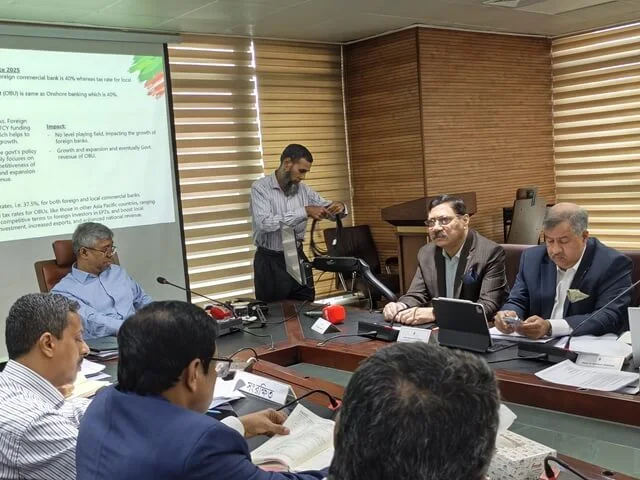
The American Chamber of Commerce in Bangladesh (AmCham) has urged the government to prioritise tax harmonisation and regulatory reforms to create a more attractive and predictable investment environment in Bangladesh.
At a key pre-budget dialogue with the National Board of Revenue, Syed Ershad Ahmed, President of the American Chamber of Commerce in Bangladesh, emphasized the urgent need for tax harmonisation and structural reform, warning that Bangladesh’s current revenue framework is increasingly out of sync with its investment ambitions.

Highlighting the country’s economic progress, he noted that the tax system has not evolved at the same pace. A major concern remains the low level of active tax compliance, with only a fraction of registered taxpayers regularly filing returns. At the same time, Bangladesh continues to rely heavily on indirect taxation, placing a greater burden on consumption rather than income—an imbalance that raises concerns around equity and long-term sustainability.
Syed Ershad Ahmed stressed that a predictable, transparent, and simplified tax regime is essential to attract and retain investment. According to him, fragmented policies, overlapping taxes, and inconsistent implementation continue to create uncertainty for businesses, ultimately affecting investor confidence and long-term planning.
He called for a more harmonised system that eliminates inefficiencies and ensures clarity across tax structures. Such reforms, he noted, would not only reduce the cost of doing business but also encourage voluntary compliance by building trust between taxpayers and authorities.
Also Read : EU–Mercosur Deal Set for May Launch
The discussion comes at a critical time as Bangladesh prepares for LDC graduation and faces growing pressure to strengthen domestic revenue mobilisation. For key sectors such as textiles and apparel, tax-related inefficiencies—ranging from delayed VAT refunds to complex customs procedures—remain significant barriers to competitiveness in global markets.
Ahmed also underscored the importance of digital transformation within the tax system, pointing out that expanding electronic payments and modernising tax administration could significantly improve transparency, reduce informality, and broaden the tax base.
The overarching message from AmCham’s leadership is – tax reform is no longer optional—it is central to Bangladesh’s economic future.
Without a coherent, business-friendly fiscal framework, sustaining investment growth and export competitiveness will remain a challenge.
Reaffirming its commitment to constructive engagement, AmCham expressed its willingness to work closely with policymakers to advance practical, growth-oriented reforms that align Bangladesh’s revenue system with its broader economic ambitions.