
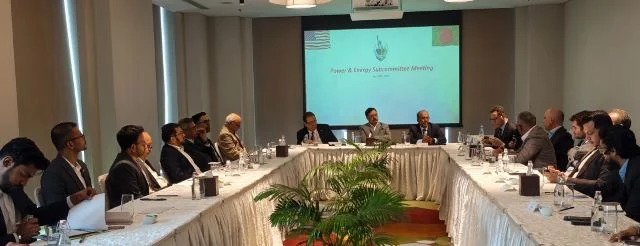
The American Chamber of Commerce in Bangladesh has called for a diversified and forward-looking energy strategy as the country braces for a sharp rise in demand, warning that delays in policy reform and investment could strain economic growth and energy security.
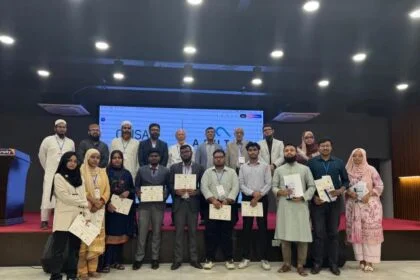
The call came during a focused group discussion organized by AmCham’s Energy and Power Subcommittee at a hotel in Banani on April 8, where industry leaders, policymakers and analysts gathered to assess Bangladesh’s evolving energy landscape and identify practical pathways for sustainable development.

AmCham President Syed Ershad Ahmed stressed the importance of aligning short, medium, and long-term strategies to address systemic challenges in the sector. He said the chamber would consolidate stakeholder feedback and submit policy recommendations to relevant ministries, emphasizing that a consultative approach is essential to building a resilient and efficient energy framework.
Energy demand in Bangladesh is expected to grow rapidly over the next two decades, driven by industrial expansion, urbanization and rising living standards. Eric Walker, Vice President of AmCham and President of Chevron Bangladesh, said demand could double or even triple within the next 15 to 20 years.
He urged the government to accelerate exploration activities and support renewed drilling efforts, while also investing in diversified energy sources including liquefied natural gas (LNG), solar power and offshore reserves.
Mr. Walker highlighted the need for additional LNG import infrastructure and expanded onshore and offshore exploration to ensure supply stability, noting that strong collaboration between government and industry would be critical to implementing long-term solutions.
Concerns over rising energy costs were also raised during the discussion. Habib Bhuyian, Country Manager of Excelerate Energy, warned that prolonged dependence on high-priced spot LNG purchases could have significant economic repercussions.
He suggested a range of demand-side management measures, including standardizing electric rickshaws, introducing solar-powered interchangeable battery systems and adjusting office and school hours seasonally to optimize energy use.
Mr. Bhuyian also called for incentives to promote energy-efficient household appliances, arguing that reducing demand growth could be as important as increasing supply in maintaining system balance.
Experts underscored the urgency of boosting domestic energy production to reduce reliance on imports. M Tamim, Vice Chancellor of Independent University Bangladesh, said increasing output from existing gas fields could take between two and five years, while new exploration projects would require even longer timelines.
He recommended engaging international reservoir management firms to optimize production and called for clear policy decisions on domestic coal development.
Also Read: Global Energy Crisis Puts Pressure on Bangladesh’s RMG Engine
Mr. Tamim identified renewable energy as the fastest route to expanding capacity, suggesting that Bangladesh could add around 3,000 megawatts of solar power by 2030, alongside an additional 2,000 megawatts through rooftop installations. Such expansion, he noted, could reduce reliance on costly oil-based power generation during daytime hours and lower import bills.
The role of private sector innovation in accelerating the energy transition was also highlighted. Sebastian Groh, Managing Director of SOLshare, called for rationalizing duties on solar and energy storage technologies to remove market distortions that favor fossil fuel-based alternatives.
He emphasized the need to ensure effective disbursement of green finance and to formalize electric three-wheelers through licensing and regulation, which could unlock financing opportunities and support grid stability through distributed energy systems.
Participants broadly agreed that scaling up renewable energy, particularly rooftop solar, would require improved access to financing, higher loan limits and fewer regulatory barriers. They also called for modernization of the national grid to enable net metering and electricity buyback mechanisms, which could incentivize private investment in clean energy.
The discussion further highlighted the need for a comprehensive energy strategy encompassing fuel supply, power generation and transmission infrastructure. Experts recommended diversifying energy sources, including LNG, liquefied petroleum gas (LPG), domestic coal and emerging options such as geothermal energy, while expanding infrastructure through greater private sector participation.
Strengthening transmission and distribution networks, enhancing governance and promoting regional energy cooperation were also identified as critical priorities to ensure long-term system reliability.
Representatives from leading companies, including Energypac Power Generation Ltd., Omera Petroleum Ltd., United Power, Infrastructure Development Company Limited, GE Vernova and Delta LPG attended the session, alongside analysts from LightCastle Partners and PwC Bangladesh.
Officials from the United States Embassy in Bangladesh, including Commercial Counselor Paul Frost, were also present, along with business leaders such as Fazlul Haque.
Participants concluded that stronger public–private collaboration, targeted policy reforms and sustained investment in cleaner technologies will be essential for Bangladesh to secure its energy future while supporting economic growth in the decades ahead.