
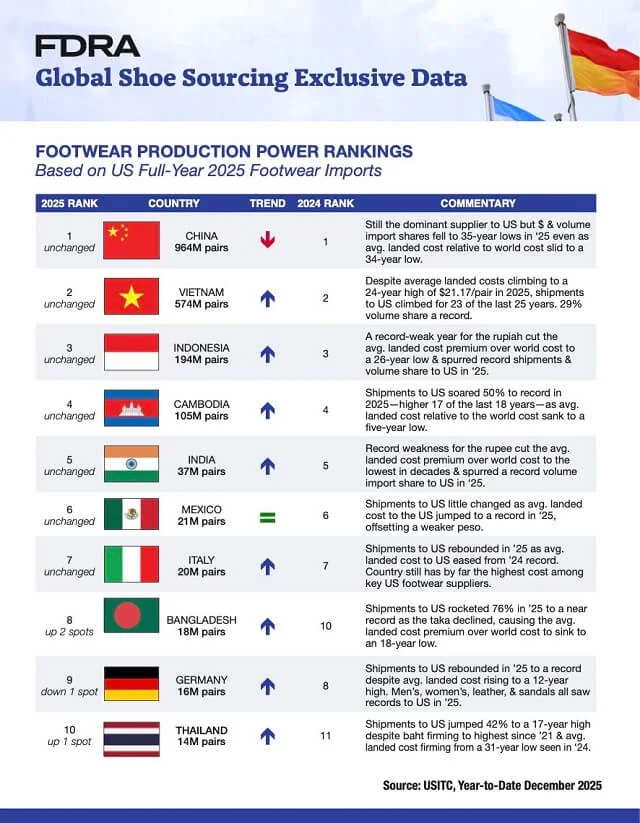
Bangladesh has emerged as one of the fastest-growing footwear sourcing hubs for the United States, climbing to eighth place in 2025 from tenth a year earlier, as global buyers accelerate efforts to diversify away from China, according to data from the Footwear Distributors and Retailers of America (FDRA).
U.S. footwear imports, valued at roughly $25 billion annually, continue to be dominated by China, though its market share has dropped to multi-decade lows amid tariff pressures and shifting geopolitical dynamics. While China remains the top supplier, countries across Southeast and South Asia are rapidly gaining ground.

Bangladesh’s rise stands out among the top exporters. Shipments to the United States surged sharply in 2025, with export value increasing to approximately $388 million from around $255 million the previous year, marking growth of more than 50%. In volume terms, shipments expanded even faster, reflecting strong demand for competitively priced products.
Industry analysts attribute Bangladesh’s gains largely to the “China-plus-one” sourcing strategy adopted by major global brands and retailers, who are spreading production across multiple countries to reduce risk. Competitive labor costs, a weaker local currency and expanding manufacturing capacity have further strengthened Bangladesh’s position.
Also Read: Kizik Powers New Balance Into Hands‑Free Footwear Market
However, structural challenges remain. Compared with regional competitors such as Vietnam and Indonesia, Bangladesh continues to lag in lead times, logistics efficiency and backward linkages for raw materials. Buyers often still rely on China for faster turnaround, even at higher costs, limiting Bangladesh’s ability to capture higher-value orders.
The broader sourcing landscape is undergoing a significant transformation. Vietnam has consolidated its position as a premium, large-scale supplier, while Indonesia and Cambodia are seeing strong growth driven by cost competitiveness and improving infrastructure. India is also expanding its footprint, supported by policy incentives and a large domestic base.
China’s declining share does not signal an abrupt exit but rather a gradual rebalancing. Its exports to the United States have fallen sharply in recent years, yet it remains deeply embedded in global supply chains due to its scale, efficiency and integrated ecosystem.
Looking ahead, analysts expect sourcing to become increasingly fragmented, with no single country dominating the market. Bangladesh is well positioned to benefit from this shift, particularly if it can address infrastructure bottlenecks, reduce lead times and develop stronger local supply chains.
If current growth trends continue, Bangladesh could move further up the rankings in the next few years. But failure to improve speed and efficiency may see future orders diverted to more agile competitors in Southeast Asia or even to nearshore markets closer to the United States.
The shift underscores a broader industry transition where reliability, speed and diversification are becoming as critical as cost, reshaping the global footwear supply chain for the decade ahead.