
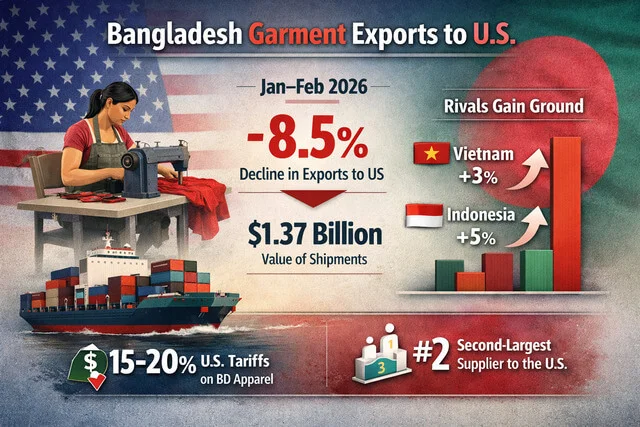
Bangladesh’s apparel exports to the United States fell by 8.5% year-on-year in the first two months of 2026, as key competitors including Vietnam and Indonesia posted growth despite a broader contraction in the U.S. import market, industry data showed.
The United States, Bangladesh’s largest single export destination, imported garments worth around $11.5–$11.7 billion in January–February, marking a sharp decline of over 13% compared to the same period last year, according to data from the Office of Textiles and Apparel (OTEXA).

Bangladesh exported roughly $1.37 billion worth of garments during the period, reflecting an 8.53% drop, driven by both lower shipment volumes and declining unit prices.
In contrast, Vietnam strengthened its position as the top apparel exporter to the U.S., recording growth of nearly 3%, while Indonesia also expanded its shipments, highlighting intensifying competition for market share.
The decline comes amid the impact of U.S. reciprocal tariffs introduced in 2025, which increased costs for exporters and dampened consumer demand. Industry leaders say the additional duties have reduced purchasing power in the U.S., ultimately lowering import volumes.
“Consumption has decreased due to higher costs passed on to consumers, leading to lower imports,” a senior industry official said, pointing to tariffs as a key factor behind the slowdown.
Also Read: AmCham Calls for Tax Harmonisation to Strengthen Investment Climate
While exports from major suppliers such as China and India dropped even more sharply—by as much as 58% and 24% respectively—the shift has not fully benefited Bangladesh. Instead, countries like Vietnam, Indonesia and Cambodia have captured a larger share of redirected orders.
Analysts say Bangladesh missed an opportunity to capitalize on the steep decline in Chinese exports, citing challenges in logistics, lead times and product diversification.
Despite the downturn, Bangladesh remains the second-largest apparel exporter to the U.S., underscoring its continued importance in global sourcing. However, the latest figures signal growing competitive pressure and the need for strategic upgrades in efficiency and value-added production.