
Bangladesh has secured a landmark trade concession today from the United States that will allow zero-tariff access for ready-made garments manufactured using American cotton, a development expected to significantly reshape the country’s export landscape and deepen bilateral economic ties. The agreement, approved by Bangladesh’s Council of Advisers and signed on Monday evening, marks a major shift in trade relations between the two nations.
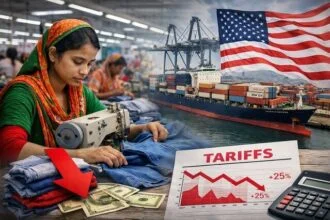
Under the new arrangement, garments produced in Bangladesh incorporating U.S.-sourced cotton will enter the American market without reciprocal tariffs, government officials confirmed. This change abolishes the substantial tariff barriers — at times effectively exceeding 30 percent — that Bangladeshi apparel exporters previously faced unless they met strict criteria for foreign-content thresholds.

After the signing, Commerce Adviser Sheikh Bashir Uddin, who led the Bangladesh side in negotiations, said that the agreement marked a historically new level in our bilateral economic and trade relations. “It will provide substantially enhanced access of Bangladesh and the US to each other’s respective markets”, he said.
The US will further reduce reciprocal tariff to 19%, which was originally set at 37% and later reduced to 20% in August last year. In addition, the US committed to establishing a mechanism for certain textile and apparel goods from Bangladesh using US produced cotton and man-made fiber to receive zero reciprocal tariff in the US market.
“The reduction of reciprocal tariff will grant further advantage to our exporters, while zero reciprocal tariff on specific textile and apparel exports from Bangladesh using US inputs will give substantial added impetus to our garments sector”, said NSA Rahman who was Bangladesh’s chief negotiator.
Cotton Import Patterns and Economic Context
The ready-made garment sector in Bangladesh is heavily dependent on imported raw cotton, because domestic production contributes only a small fraction of total consumption. According to the National Board of Revenue and the U.S. Department of Agriculture, Bangladesh imported about 7.82 million bales of cotton in 2025, down slightly from the previous year, with value terms around $3.52 billion. Projections suggested the country could continue as one of the world’s largest cotton importers due to strong demand from its apparel industry.
Over the past five years (2020–2024), Bangladesh spent roughly $20.29 billion on cotton imports from around the globe, importing nearly 40 million bales from 36 different countries. The United States, historically one of the world’s largest cotton exporters, supplied close to 2.84 million bales worth about $1.87 billion during that period, making it a significant source despite fluctuating annual trade shares.
However, recent trends showed that the share of U.S. cotton in Bangladesh’s total imports had declined, partly because of higher cost and longer transit times compared with cotton from other suppliers. In the 2023–24 marketing year, U.S. cotton accounted for approximately 9 percent of imported bales, with this share slipping in the subsequent period amid broader shifts in sourcing patterns.
In 2024 alone, U.S. exports of cotton to Bangladesh — including raw cotton as the dominant category — were valued at around $251.7 million, reflecting the ongoing but modest role of American cotton in Bangladesh’s raw materials mix.
Also Read: EU–India FTA: A Game Changer for Apparel Sourcing in Europe
Implications for Bangladesh’s RMG Industry
With roughly three-quarters of Bangladesh’s garment exports being cotton-based, duty-free access tied to U.S. cotton could materially influence sourcing decisions, production planning, and long-term investment strategies across the sector. Industry leaders believe the agreement will enhance Bangladesh’s competitiveness, support higher order volumes from U.S. buyers, and offer predictable trade terms at a time when global apparel demand remains price-sensitive.
The decision also reinforces diplomacy and economic cooperation between Dhaka and Washington, reflecting shared interests in expanding bilateral trade while supporting U.S. agricultural exports.
Background to the Agreement
The trade concession follows sustained negotiations between Bangladesh’s government, industry representatives, and U.S. trade officials. Concerns over high reciprocal tariffs imposed on Bangladeshi exports in recent years had prompted urgent dialogues, with Bangladesh’s garment associations and policymakers advocating for better market access tied to American sourcing.
Trade groups, including the Bangladesh Textile Mills Association (BTMA), had long pushed for preferential access linked to U.S. cotton use, arguing that such a framework would benefit both nations by boosting imports of high-quality American agricultural products while preserving Bangladesh’s export competitiveness.
Economic and Diplomatic Significance
Experts say the agreement’s economic effects will play out over time, as exporters and buyers adjust their strategies. While U.S. cotton typically carries a higher unit cost than alternative sources, the tariff exemption could offset these upward pressures, especially for high-volume producers serving premium U.S. brands. At the same time, the arrangement may encourage further investment in logistics, bonded warehousing, and streamlined import processes to make U.S. cotton a more attractive input.
Md Sala Uddin, advisor to the Textiles and Garments Merchandise Blog Bunon , said the zero-tariff facility offers a major commercial opportunity for Bangladesh, particularly in the US market. “At present, Bangladeshi garments face around 15 to 20 percent duty in the US. Using American cotton to access the market at zero tariff could significantly increase buyer demand, as it allows brands to source at more competitive prices while maintaining quality,” he noted.
However, he cautioned that the benefits come with operational challenges. “American cotton is more expensive than regional alternatives such as Indian yarn, and longer shipping times can affect lead time, which is critical in the fashion industry. While the tariff rebate can offset higher costs in the long run, exporters will need better logistics solutions and faster shipping to fully capitalise on the opportunity,” he added.
Looking Ahead
Government officials indicated that details about implementation timelines, eligibility criteria, and certification procedures would be released soon. As exporters reassess sourcing plans and buyers recalibrate procurement strategies, the full impact of duty-free access for garments made with American cotton is expected to unfold over the coming months.
With this agreement in place, Bangladesh has taken a significant step toward strengthening its largest export sector while deepening economic ties with the United States, potentially setting a new course for future trade cooperation.