
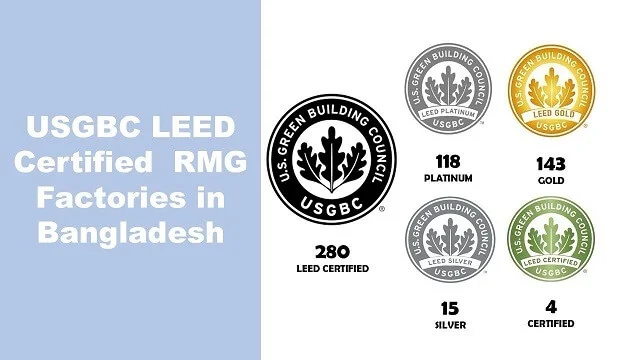
Bangladesh has reached a major sustainability milestone in its ready-made garment (RMG) sector, with 280 factories now certified under the globally recognized LEED green building standard, cementing its position as the world’s leading hub for environmentally responsible apparel manufacturing.
The certification, awarded by the U.S. Green Building Council, underscores the country’s accelerating shift toward energy-efficient and resource-conscious industrial operations. Bangladesh now accounts for the largest concentration of LEED-certified garment factories globally, far ahead of competing manufacturing hubs.

Of the total, more than 118 factories have achieved the highest Platinum rating, while over 140 hold Gold certification, reflecting deep adoption of advanced sustainability practices such as solar energy integration, water recycling systems, and low-emission construction materials. Industry data also shows that over 50 Bangladeshi factories rank among the world’s top 100 LEED-rated industrial facilities, reinforcing the country’s dominance in green manufacturing.
Also Read: HAMS Garments Ltd Sets Global LEED Platinum Record
The growth has been rapid. Bangladesh had fewer than 100 LEED-certified garment factories a decade ago, but the number has surged in recent years as manufacturers invested heavily in sustainable upgrades. In 2025 alone, dozens of new factories joined the list, and the figure has continued to rise steadily in 2026, highlighting strong momentum across the sector.
This transition is being driven largely by evolving sourcing strategies from global apparel brands, which are increasingly prioritizing suppliers that meet strict environmental, social, and governance (ESG) criteria. Buyers from Europe and North America are placing greater emphasis on carbon footprint reduction, energy efficiency, and traceable supply chains—areas where LEED-certified factories offer a competitive edge.
Industry stakeholders say green-certified facilities are better positioned to secure long-term orders, command improved pricing, and maintain resilience against tightening environmental regulations, particularly in key export markets such as the European Union. Sustainable factories also benefit from lower operating costs over time due to reduced energy and water consumption.
Bangladesh’s garment sector, which contributes more than 80% of the country’s export earnings, is now undergoing a structural transformation—from a cost-driven manufacturing base to a sustainability-focused sourcing destination. The rise of green factories is playing a critical role in reshaping the industry’s global image following years of scrutiny over workplace safety and environmental compliance.
With dozens more factories currently in the pipeline for certification, Bangladesh is expected to further expand its lead in sustainable apparel manufacturing. Industry leaders say continued investment in green technology, renewable energy, and compliance standards will be essential to maintaining competitiveness as global brands accelerate their climate commitments.