
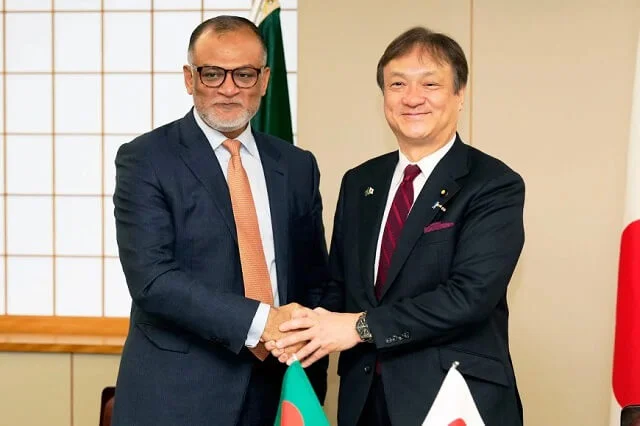
Bangladesh and Japan signed a landmark Economic Partnership Agreement (EPA) on 6 February 2026 in Tokyo, marking the first comprehensive economic deal Bangladesh has concluded with a developed country.
The pact was signed by Japan’s State Minister for Foreign Affairs HORII Iwao and Bangladesh’s Commerce Adviser Sk Bashir Uddin during a ceremony at the Japanese Ministry of Foreign Affairs attended by senior officials from both sides.

The EPA gives Bangladesh duty-free access for 7,379 products, including ready-made garments (RMG), to the Japanese market from the date it enters into force, while Bangladesh will offer duty-free or preferential access to 1,039 Japanese products in a phased approach, enhancing imports of technology-intensive goods and industrial inputs.
A key feature of the agreement is the single-stage transformation rule of origin for apparel, allowing Bangladeshi garments to enter Japan tariff-free without complex raw material rules.
The EPA goes beyond tariff elimination to cover trade in goods and services, investment, labour mobility and legal certainty for investors. The deal opens up roughly 120 service sub-sectors in 16 categories in Japan for skilled Bangladeshi professionals including IT, engineering, education, caregiving and nursing while Bangladesh will open 98 sub-sectors in 12 categories for Japanese service providers.
Also Read : Bangladesh Secures $8.02m Apparel Orders at Texworld
It also contains provisions on trade facilitation, government procurement participation and digital trade cooperation, aimed at simplifying business procedures and boosting investor confidence.
Business groups and economists have hailed the EPA as a transformative step for Bangladesh’s trade diplomacy, especially as the country prepares to graduate from Least Developed Country (LDC) status later this year.
Without the EPA, Bangladesh would have faced loss of preferential access under Japan’s LDC duty-free regime, exposing exporters to higher Most-Favoured-Nation tariffs.
The Bangladesh Garment Manufacturers and Exporters Association (BGMEA) described the deal as a historic milestone that will help secure uninterrupted market access for RMG and other exports, narrow the existing trade deficit with Japan and support export diversification.
Bangladesh currently exports garments worth around $1.4 billion to Japan, about 3 % of its total garment shipments, even though Japan is one of the world’s largest apparel importers. Industry leaders are targeting increasing Japan’s share to at least 10 % of Bangladesh’s garment exports by 2035, aligning with the country’s $100 billion export goal.
Economists and business leaders also see the EPA as a catalyst for Japanese foreign direct investment (FDI) into Bangladesh, particularly in manufacturing, infrastructure, energy, logistics and technology sectors. There is strong hope that the agreement will attract close to $1 billion in new Japanese investment, especially in designated special economic zones such as the Japanese Economic Zone in Araihazar, Narayanganj.
The EPA is expected to deepen economic cooperation, strengthen supply-chain linkages and support Bangladesh’s post-LDC transition by anchoring long-term trade and investment engagement with one of Asia’s most advanced economies.