
Bangladesh has emerged as the second-largest apparel supplier to the United States in early 2026, but the shift reflects global market disruptions rather than a surge in the country’s export performance.
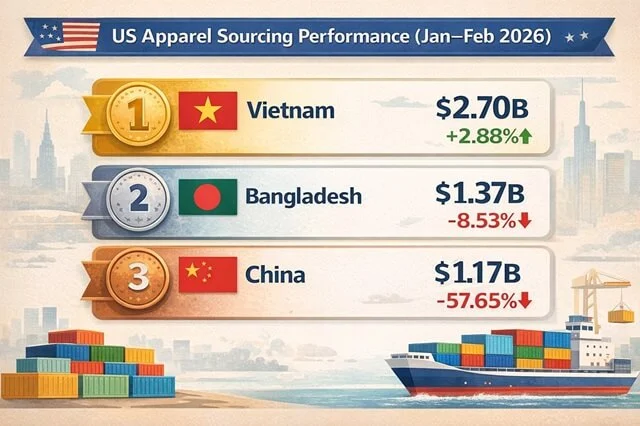
According to data from the Office of Textiles and Apparel (OTEXA), Bangladesh exported apparel worth $1.37 billion to the US during January and February 2026, marking an 8.53% decline compared to the same period last year. Despite the drop, the country moved up one position in the rankings.

The change was largely driven by a steep contraction in China’s exports. Chinese apparel shipments to the US fell by 57.65% to $1.17 billion, significantly altering the competitive landscape. Industry analysts attribute this sharp decline primarily to elevated US tariffs on Chinese goods, which in some categories approach 40%, making them less competitive in price-sensitive retail markets.
Vietnam continues to hold the top position, exporting $2.7 billion worth of apparel to the US in the same period, with a modest growth of 2.88%. Its steady performance is supported by a more diversified product mix and a relatively resilient supply chain structure.
Also Read : BGBA Wins Legal Recognition as Mandatory Trade Body for Registration
The broader context shows weakening demand in the US apparel market. Total US apparel imports declined by approximately 13.5% during the first two months of the year, as retailers focused on clearing excess inventory accumulated in late 2025. This slowdown has impacted sourcing volumes across all major supplier countries, including Bangladesh.
While Bangladesh has managed to maintain its position better than some competitors, the data suggests that the country is not yet fully capitalizing on the ongoing global sourcing shift.
Many international buyers continue to adopt a “China plus one” strategy, diversifying their supplier base to reduce dependency on China. However, Bangladesh’s heavy reliance on basic cotton garments limits its ability to capture higher-value orders.
Industry observers note that Vietnam’s continued growth highlights the importance of product diversification, value addition, and supply chain efficiency. In contrast, Bangladesh faces ongoing challenges related to infrastructure, lead times, and limited penetration into synthetic and technical textile segments.
The latest ranking therefore presents a mixed picture. Bangladesh’s rise to second place signals relative resilience in a declining market, but it also underscores missed opportunities to drive growth amid shifting global trade dynamics.
As sourcing patterns continue to evolve, experts suggest that Bangladesh will need to invest in product innovation, expand into man-made fiber categories, and improve operational efficiency to convert this positional gain into sustainable export growth.