

Bangladesh’s garment accessories and packaging sector has quietly emerged as one of the country’s most promising export-oriented industries. Once dependent on imports, the sector is now close to self-sufficiency and is establishing itself as a competitive global supplier. Today, with an incremental investment of around Tk 40,000 crore, the sector has the capacity to meet the domestic demand of export-oriented industries.
Bangladesh Garments Accessories & Packaging Manufacturers & Exporters Association (BGAPMEA) President & Managing Director of Adzi Trims Ltd., Md. Shahriar, said that if existing policy barriers are removed, Bangladesh can increase direct exports of accessories to $5 billion within the next three years, including exports to pharmaceuticals, agriculture, footwear, electronics, home textiles, and non-apparel manufacturing sectors.

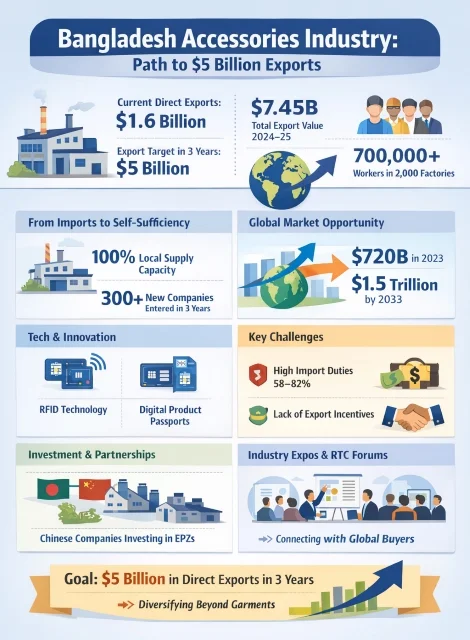
This growth potential is in line with global market trends. The global fashion accessories market is expected to reach $1.5 trillion by 2033. As manufacturing hubs gradually shift away from China, especially for basic and mid-range products, Bangladesh is well-positioned to capture a growing share of this market.
China’s industrial strategy is increasingly shifting towards high-tech manufacturing, creating opportunities for countries like Bangladesh to expand production of mass-market, mid-price, and compliance-driven accessories and packaging products. This shift has already attracted foreign investors.
In the past two years, at least eight Chinese companies, including Baida Industrial, Jijin Bangladesh, and Tianhui Button, have proposed investments or started operations in Bangladesh’s export processing zones (EPZs). According to BGAPMEA, about 300 new accessories companies have entered the Bangladesh market in the past three years.
Local companies are also expanding rapidly. RSS Thread and Accessories Limited, for example, has doubled its production capacity in the past three years and now produces 35 different types of accessories. The company is currently a listed supplier to Spanish retail giant Inditex Group, reflecting the growing global trust in Bangladeshi suppliers.
The accessories sector is rapidly embracing digital technology, with over 100 factories preparing to invest in RFID systems for automated tracking and inventory management. With digital product passports now mandatory under EU rules, RSS threads and accessories companies are embedding chips in labels to ensure traceability, authenticity and compliance. This shift marks a move from volume-driven production to transparent, technology-enabled production.
Despite strong growth potential, the sector faces major policy hurdles, including the absence of export incentives and high import duties on raw materials such as paper, which can reach 58-82 percent. Limited access to bonded facilities, banking services and customs support further weakens competitiveness. Industry leaders have warned that without urgent policy reforms and political stability, Bangladesh risks being left out of the fast-growing global accessories and packaging market.
It is against this backdrop of industrial maturity, global opportunity, technological transformation, and policy constraint that Bangladesh hosted three major international trade expos in January 2026 at the International Convention City Bashundhara (ICCB) in Dhaka:
- Garment Technology Bangladesh (GTB) 2026
- Garments Accessories & Packaging Expo (GAPEXPO) 2026
- International Yarn & Fabrics Sourcing Show 2026
Together, these expos formed the country’s largest and most comprehensive industrial platform, bringing together machinery suppliers, accessories manufacturers, raw material producers, exporters, policymakers, financiers, and global technology providers.
Organised by ASK Trade & Exhibitions Pvt. Ltd. in collaboration with BGAPMEA, the events featured more than 350 exhibitors from over 15 countries, nearly 1,500 booths, and over 450 global brands, attracting more than 100,000 visitors.
These expos were not merely commercial exhibitions, but also became strategic forums reflecting the industry’s transition toward higher value addition, sustainability, digitalisation, and global market integration.
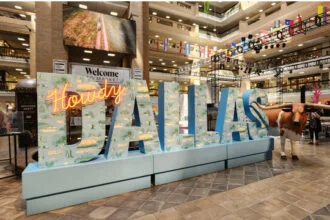
Also Read: Dallas Apparel & Accessories Market 2026: Where Trends Take Shape
GTB 2026 demonstrated technology as the engine of industrial upgrading
The 23rd edition of Garment Technology Bangladesh (GTB) 2026 showcased advanced machinery and smart manufacturing solutions across cutting, sewing, finishing, embroidery, washing, printing, digitalisation, energy efficiency, and automation.
Factory owners, engineers, sourcing managers, and compliance professionals crowded the exhibition halls, reflecting a growing urgency to invest in productivity-enhancing technologies, reduce waste, improve quality, and meet evolving buyer requirements.
Exhibitors reported strong on-site business inquiries, particularly for automation systems, AI-driven production tools, and energy-efficient machinery. Overseas technology providers observed a clear shift in Bangladeshi manufacturers’ mindset, from short-term cost minimisation to long-term productivity, sustainability, and resilience.
Former commerce minister and BNP standing committee member Amir Khasru Mahmud Chowdhury stressed that while Bangladesh’s apparel industry has grown into a global powerhouse, sustaining this position requires a new governance mindset — one that avoids over-regulation and promotes self-regulation, innovation, and industrial expansion.
National Board of Revenue (NBR) Chairman Md Abdur Rahman Khan highlighted the importance of policy transparency, digital governance, and reduced business hurdles, stating that Bangladesh has the potential to become a fully industrialised nation if institutional bottlenecks are removed.
BGMEA Acting President Salim Rahman underscored the importance of product development and innovation, arguing that Bangladesh must move beyond volume-based manufacturing and invest in higher value segments.
GAPEXPO 2026 showcased Bangladesh’s Growing Accessories Power
Organisers reported that the 2026 edition was approximately 80% more successful than the previous one, reflecting rising confidence, stronger buyer engagement, and increasing export-oriented production.
At the closing ceremony, former commerce and home minister Altaf Hossain Chowdhury expressed optimism after witnessing the sector’s scale and sophistication, stating that with proper policy support, the accessories and packaging sector could surpass even the RMG sector in export earnings.
Export Promotion Bureau (EPB) Director Abu Mokhles Alamgir Hossain highlighted the $700 billion global packaging market and said EPB would organise seminars, designate the sector as a “Product of the Year,” and engage with the NBR to ensure access to bonded facilities and other forms of policy support.
The government’s decision to declare paper packaging products as the “Product of the Year” for 2026 was widely welcomed as a historic milestone, expected to attract new domestic and foreign investment, promote sustainable industrial growth, create jobs, and boost export earnings.
Yarn & Fabrics Expo 2026 highlighted upstream strength and policy challenges
The 12th International Yarn & Fabrics Sourcing Show 2026 completed the apparel value chain by bringing together spinners, weavers, knitters, textile mills, fibre producers, and material innovators from more than 15 countries.
The expo showcased a wide range of products, including cotton, polyester and blended yarns, recycled fibres, functional fabrics, technical textiles, and sustainable materials. This made it a one-stop sourcing platform for garment manufacturers seeking reliable and diversified raw material solutions.
However, the sector remains at a critical policy crossroads. The exhibition took place amid an ongoing national debate over yarn imports under bonded warehouse facilities. After more than five months of discussions, the Bangladesh Tariff Commission had yet to finalise its decision, although officials indicated that a report was imminent.
Local spinners have called for a 20% safeguard duty on yarn imports, citing declining orders, subsidised foreign competition, especially from India, and rising gas prices. A senior textile executive noted that demand typically drops by 25–30 percent during election periods and that consecutive months of negative apparel export growth have further weakened the spinning sector.
Apparel exporters, however, warned that restricting yarn imports could raise production costs, disrupt supply chains, and weaken Bangladesh’s competitiveness in global markets. Many international buyers nominate Indian spinners due to lower costs, and exporters fear that supply constraints could divert orders to competing sourcing destinations.
As a middle-ground solution, exporters have proposed restoring the earlier 4 percent cash incentive for using locally produced yarn, which has since been reduced to 1.5 percent. BKMEA Executive President Fazlee Shamim Ehsan cautioned that excluding yarn from bonded facilities or imposing safeguard duties would increase production costs and weaken apparel exports. He also highlighted the complexity and cost of Bangladesh’s duty drawback system, pointing to a production cost gap of 30 to 50 cents between Indian and Bangladeshi yarn.
A few clear themes emerged from all three expos. Sustainability is now at the heart of industry strategy, with energy-efficient machinery, recycled materials, eco-friendly fabrics, and paper-based packaging at the center. Technology is no longer optional, as automation, digitalization, and smart manufacturing have become standard business requirements. At the same time, Bangladesh is strengthening backward linkages and reducing import dependency, creating a more resilient and integrated value chain. However, industry leaders agreed that policy reform remains the biggest missing link, with calls for export incentives, simplified regulations, easier access to banking and customs facilities, and more transparent governance.
Bangladesh’s accessories, packaging, yarn, fabrics, and apparel ecosystem is entering a decisive phase. The industry has already built strong capabilities, generated billions in export revenue, and employed millions of workers. The 2026 editions of GTB, GAPEXPO, and Yarn & Fabrics Show do more than showcase products.