
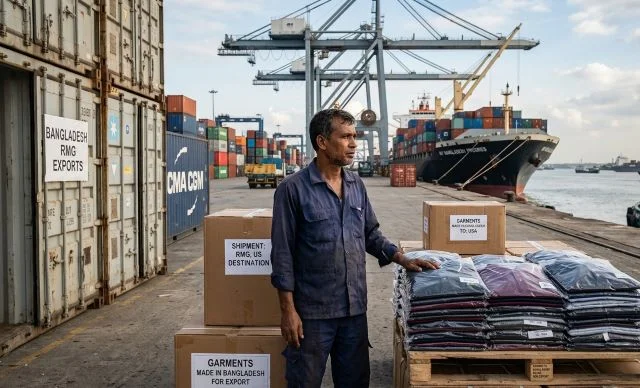
Bangladesh’s garment exports to the United States fell by 2.54% in the July-March period of the current fiscal year, according to recent data published by the Bangladesh Garment Manufacturers and Exporters Association (BGMEA).
Shipments to the US, which represent around 20% of Bangladesh’s total apparel exports, dropped to $5.59 billion during this period, a significant decline amidst a turbulent global supply chain. The latest figures reflect broader challenges faced by the country’s readymade garment (RMG) sector, which is experiencing slowing growth after a decade of robust performance.

Along with the US, exports to other key markets, including the United Kingdom and Canada, also saw declines. Exports to the UK, which holds the third-largest market share for Bangladesh’s garment products, dropped by 1.61% to $3.30 billion.
Shipments to Canada decreased slightly by 0.26% to $961.34 million. While these declines are relatively modest compared to the US, they point to a weakening demand for Bangladesh’s products in traditional markets.
However, the real blow came in the form of a sharp 8.05% decline in shipments to non-traditional markets. Overall, Bangladesh’s total RMG exports during the July-March period amounted to $28.58 billion, marking a 5.51% year-on-year decrease, according to the data compiled by the Export Promotion Bureau (EPB).
The downturn in exports to major global markets such as the US and the EU, which together account for nearly 70% of Bangladesh’s total garment exports, has raised concerns over the resilience of the sector. The European Union (EU), which represents 49% of Bangladesh’s RMG exports, recorded a 6.99% decline in exports, falling to $14.02 billion during the period.
As Bangladesh’s RMG sector faces these challenges, the BGMEA has defended its growth model amidst increasing scrutiny from the US. The United States Trade Representative (USTR) recently launched an investigation into Bangladesh, examining labor practices and trade policies in the country’s garment industry.
The probe, part of a broader inquiry into 60 economies, focuses on whether Bangladesh has effectively enforced bans on forced labor, as required by US trade laws.
In response to the investigation, BGMEA President Mahmud Hasan Khan emphasized that the country’s RMG sector has expanded in line with global demand, rather than excess capacity or market distortion. The growth trajectory, he argued, has been gradual and aligned with evolving buyer sourcing strategies, with Bangladesh’s share of the global garment market remaining modest compared to larger competitors such as China and Vietnam.
Also Read: Bangladesh Apparel Exporters Face Mounting Cash Flow Pressures
“The expansion of production capacity has remained closely aligned with global demand trends, without any sudden surge that could be interpreted as overproduction,” Khan stated in a position paper submitted to the relevant government authorities. He further explained that Bangladesh’s garment exports have been driven by labor-intensive, low- to mid-priced products, which are generally not produced in the US, thereby offering affordable alternatives to US consumers, especially those in the low- and middle-income brackets.
The BGMEA’s defense highlights ongoing structural issues within the country’s garment industry, which remains heavily reliant on exports, particularly to a few dominant markets. While the US and the EU represent major outlets for Bangladesh’s garments, the country is struggling with sluggish growth in non-traditional markets. Additionally, the sharp decline in shipments to these regions is concerning for Bangladesh, which has long sought to diversify its export destinations.
Despite these challenges, the sector continues to benefit from policy incentives such as cash subsidies, which aim to address challenges such as inadequate infrastructure and long lead times. The government has reduced these subsidies by about 60% over the past three years in anticipation of the country’s graduation from Least Developed Country (LDC) status.
With the US investigation underway, industry experts are closely monitoring how the sector adapts to shifting demand patterns, evolving global trade regulations, and the need for modernization in manufacturing. The latest export figures indicate that while Bangladesh remains a major player in the global garment industry, its dependence on a few key markets leaves it vulnerable to external shocks.
As the US investigation continues, the BGMEA has called for greater understanding and cooperation, asserting that the sector operates under a strong legal framework, in full compliance with both national labor laws and international standards. The USTR hearings are scheduled for April 28, 2026, and are expected to shed more light on the challenges facing Bangladesh’s garment industry in the context of global trade.
The ongoing scrutiny from the US, along with the decline in export growth, underscores the need for strategic reforms in the sector, including enhanced diversification, better infrastructure, and improvements in labor conditions, to maintain Bangladesh’s position as a global textile manufacturing hub.