
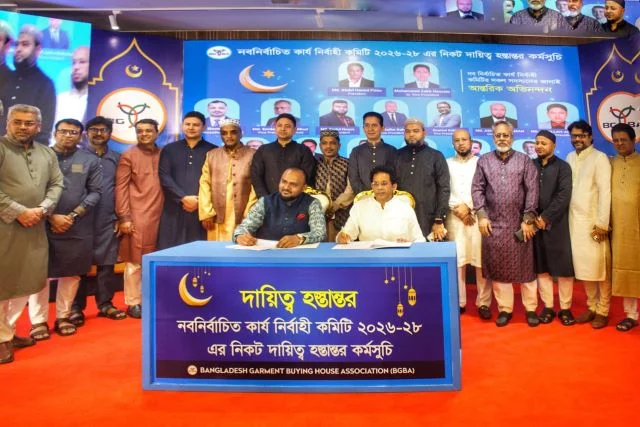
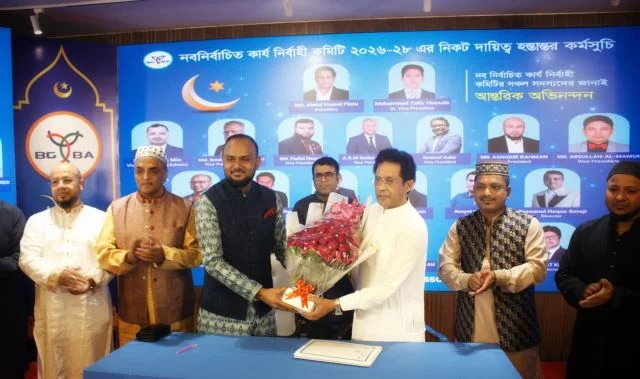
Bangladesh Garment Buying House Association (BGBA) officially announced Md. Abdul Hamid Pintu as the newly elected president for the 2026–2028 term during an Iftar Mahfil held in Dhaka, bringing together key figures from Bangladesh’s apparel supply chain.
The announcement was made during a gathering organized by BGBA at Uttara Club in the capital, where members of the buying house community, garment industry leaders and invited guests attended the Iftar and dinner event during the holy month of Ramadan.

The program also marked the formal handover of responsibilities from the outgoing executive committee led by Md. Mofazzal Hossain Pavel to the newly elected board.
Md. Abdul Hamid Pintu, a prominent leader in the garment buying house sector, was elected president following BGBA’s election held on Jan. 10, 2026. The election was conducted under the supervision of an independent election board to ensure transparency and democratic continuity within the organization.
Also read: BGBA Flags Mounting Challenges in Bangladesh’s RMG industry
Industry insiders said the leadership transition reflects BGBA’s ongoing effort to strengthen governance within the association and enhance its role in supporting Bangladesh’s export-oriented apparel sector.
Speaking at the event, outgoing president Md. Mofazzal Hossain Pavel expressed gratitude to BGBA members and stakeholders for their support during his tenure and welcomed the newly elected leadership.
He said the association had taken several steps in recent years to reinforce organizational structure, improve coordination among members and ensure democratic practices within the trade body.
Pavel also expressed optimism that the new committee under the leadership of Md. Abdul Hamid Pintu would continue to work for the development of the buying house sector and strengthen its contribution to Bangladesh’s garment export industry.
“BGBA has always aimed to represent the interests of buying houses while maintaining transparency, accountability and democratic values within the organization,” he said during the event.
Industry leaders attending the gathering said the new leadership would play an important role in addressing the evolving challenges facing Bangladesh’s apparel supply chain.
Faruque Hassan, former president of the Bangladesh Garment Manufacturers and Exporters Association (BGMEA), also shared his views at the event and highlighted the critical role buying houses play in the country’s apparel export ecosystem.
He noted that buying houses act as an essential bridge between global fashion brands and local manufacturers, facilitating product development, sourcing, quality assurance and communication throughout the production process.
According to Hassan, stronger collaboration between garment manufacturers and buying houses will be essential for maintaining Bangladesh’s competitiveness in the global apparel market.
“The buying house sector is a vital component of Bangladesh’s garment industry. Strengthening coordination between manufacturers and buying houses will help improve efficiency, compliance and product development,” he said.
He also emphasized the need for the industry to work together to address challenges such as rising production costs, sustainability demands, compliance requirements and increasing global competition.
BGBA was established in 2006 with only a small number of members and has gradually grown into one of the key trade bodies representing Bangladesh’s garment buying house sector.
Over the years, the association has expanded significantly and now represents more than 1,000 registered members operating across the country.
These buying houses play an important role in connecting international apparel brands and retailers with Bangladeshi garment factories, helping coordinate sourcing, production planning, product development and shipment management.
Industry analysts say buying houses facilitate a significant portion of Bangladesh’s ready-made garment export orders each year, making them an integral part of the country’s apparel supply chain.
Bangladesh is currently the world’s second-largest exporter of apparel products, with the sector generating more than $47 billion in export earnings annually and employing millions of workers across the country.
Speakers at the event emphasized that maintaining strong relationships with global buyers and ensuring high standards of compliance and sustainability will be critical for the future growth of Bangladesh’s garment sector.
They also noted that buying houses can play an important role in supporting innovation, product diversification and supply chain transparency as global brands increasingly focus on responsible sourcing.
Participants at the Iftar Mahfil expressed hope that the new BGBA leadership will focus on strengthening member services, promoting ethical business practices and enhancing collaboration between industry stakeholders.
They also discussed the importance of preparing the industry for upcoming challenges such as changes in global trade policies, sustainability requirements and technological transformation in the apparel supply chain.
The gathering also provided an opportunity for industry professionals to exchange views on the future of Bangladesh’s garment trade and explore ways to further strengthen the country’s position in the international apparel market.
The event concluded with prayers, networking among industry leaders and discussions about the future direction of BGBA under the new leadership.
According to the BGBA invitation notice, the program included the official responsibility handover ceremony for the newly elected executive committee along with the Iftar Mahfil and dinner session.