

Bangladesh’s readymade garment (RMG) industry is facing mounting pressure from rising production costs, policy instability, and declining buyer confidence, the Bangladesh Garment Buying House Association (BGBA) said at a press conference, warning that one of the country’s most important export sectors is now in a fight for survival.
Bangladesh remains the world’s second-largest apparel exporter, with buying houses playing a critical role in linking local manufacturers to international markets. BGBA, a licensed trade body under the Ministry of Commerce and a Class-1 member of the Federation of Bangladesh Chambers of Commerce and Industry (FBCCI), represents around 1,800 registered members and estimates that its members contribute between USD 12 billion and USD 15 billion annually in export earnings.

The association said the sector is under strain due to a combination of global economic slowdown, domestic policy shifts, and escalating operational costs. One of the most pressing challenges highlighted was the recent withdrawal of bonded warehouse facilities for importing 10–30 count yarn used in export-oriented garment production. The directive, issued earlier this month, has intensified uncertainty across the export supply chain, particularly as domestic yarn prices remain high despite a decline in global prices.
Speaking at the press conference, BGBA President Mohammad Mofazzal Hosen Pabel stressed the urgency of restoring policy support mechanisms.
“Reinstate bonded warehouse facilities for importing 10–30 count yarn and ensure policy decisions are made in consultation with all stakeholders of the RMG sector, along with appropriate incentives,” he said.
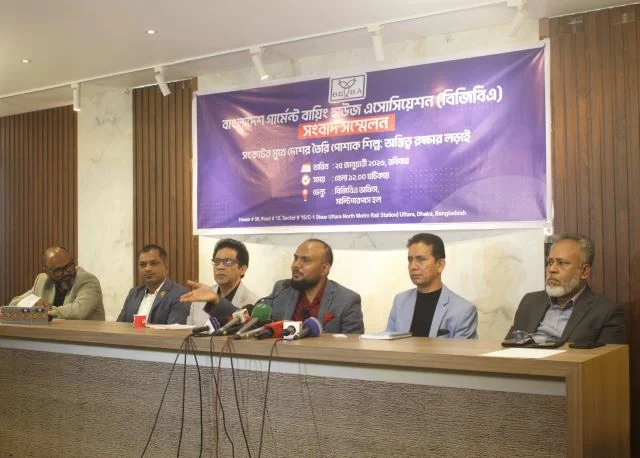
Mr. Pabel also highlighted the need for entrepreneur-friendly policies to stabilize investment and production.
“We need policy that supports entrepreneurs and creates a stable business environment for exporters,” he said.
Security concerns and political uncertainty surrounding the national election have further weakened foreign buyer confidence, the association said. Reduced buyer visits have led to a slowdown in new orders, while the absence of visible measures to ensure buyer safety and uninterrupted production has raised concerns about Bangladesh’s reliability as a sourcing destination.
The BGBA warned that Bangladesh is gradually losing competitiveness in the international market. Rising electricity, gas, and energy prices, coupled with infrastructure limitations and a lack of effective incentives, have pushed up production costs, making it increasingly difficult for exporters to compete with regional rivals.
Banking sector inefficiencies were also highlighted, particularly delays in processing letters of credit (L/Cs) and limited access to working capital. These challenges have disrupted timely payments to suppliers, disproportionately affecting small and medium factories and contributing to delivery delays, financial losses, and reputational risks in overseas markets.
The association observed a visible decline in exports across both traditional and non-traditional markets over the past six months and cautioned that without immediate, coordinated policy intervention, Bangladesh risks losing further market share to competing countries.
Newly elected BGBA President Md Abdul Hamid Pintu echoed these concerns, emphasizing Bangladesh’s heavy dependence on imported raw materials. “We have to depend on imported raw materials because we do not have the capacity to meet cotton and fiber demand locally,” he said.

Mr. Pintu also called for more inclusive policymaking under the next government.
“We expect the new government not to take decisions in isolation. All stakeholders must be included in every policy decision related to the RMG sector,” he said.
Also read: How BGBA Is Shaping Bangladesh’s Role in the Global Garment Market
BGBA reiterated its call for policy stability, improved access to finance, targeted energy support, and renewed efforts to restore buyer confidence. The association also stressed the importance of strategic initiatives to support small and medium factories and to expand Bangladesh’s presence in international trade fairs to safeguard export growth and employment.
The association urged the government to take immediate and pragmatic measures to protect the garment sector, warning that further delays could have serious consequences for employment, export earnings, and Bangladesh’s position in the global apparel supply chain.