
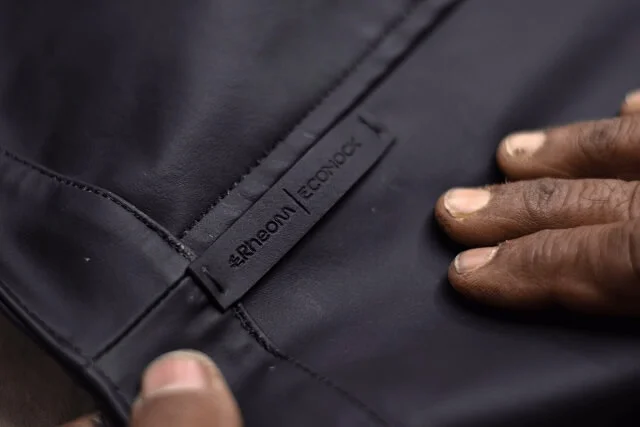
Bio-based materials developer Rheom Materials has launched its first apparel and accessories capsule using its Shorai material in collaboration with design and manufacturing studio Econock, as the company moves to scale bio-based alternatives to fossil-fuel-based plastics and synthetic leather.
The collection showcases garments and accessories made from Shorai, a leather-like material composed of about 91% bio-based content, developed as a lower-impact substitute for conventional plastics and polyurethane-based synthetic leather widely used in the fashion industry.

Based in Houston, Texas, United States, Rheom Materials focuses on creating high-performance materials derived largely from renewable inputs that can be produced at industrial scale. The company says its materials are designed to work with existing manufacturing infrastructure, allowing brands to adopt bio-based alternatives without major changes to production processes.
Also Read: Sustainable Fashion Market Projected To Reach $39.7 billion By 2031
The debut capsule collection, developed with Econock, was created to demonstrate the versatility of Shorai across fashion applications, ranging from outerwear pieces to accessories. The collaboration combines Rheom’s material technology with Econock’s design and manufacturing capabilities to test the performance of the material in real-world products.
Industry interest in next-generation materials has been rising as fashion brands seek alternatives to both animal leather and fossil-fuel-derived synthetics. Bio-based materials are increasingly viewed as a potential solution to reduce carbon emissions and dependence on petrochemicals in the global textile and apparel supply chain.
To support commercialization, Rheom has also been building partnerships with industrial manufacturers capable of producing the material at scale. The company’s strategy centers on combining laboratory innovation with existing extrusion and sheet-manufacturing technologies to accelerate adoption across apparel, footwear and accessories markets.
The Shorai capsule launch signals a broader push by materials startups to move beyond prototypes and demonstrate scalable solutions that can integrate into the fashion industry’s supply chains. As brands intensify efforts to meet sustainability goals, collaborations between material innovators and design studios are emerging as a key pathway to bring new materials from development to commercial use.