
Every few years, the global fashion industry releases a new wave of glossy sustainability commitments. Reports are published, supplier lists get longer, and words like transparency, ethics, responsibility appear prominently across corporate websites. But a new study from the Berlin School of Business and Innovation (BSBI) has peeled back the polished language to reveal a far more uncomfortable truth: beneath the marketing lies a system built on the systematic denial of a living wage.
The study, based on data from FashionChecker published recently, analysed 219 fashion companies across 28 countries. The findings are not simply troubling — they are damning. Out of 219 brands, 213 were found to pay less than a living wage to the workers who keep their supply chains running. That is 97 percent of global fashion brands, including some of the most profitable and influential names in the world — H&M, Inditex, Mango, Gap, Nike, Primark and many others.

This is not a small blind spot. It is a global ethical failure.
The United States — home to some of the industry’s biggest players — leads the ranking, with 68 companies failing to ensure decent wages for their supply-chain workers. Even in Europe, where labour standards are often touted as higher, almost no major fashion company has achieved a wage level that allows workers to meet the basic cost of living. Only six companies — from the US, UK, Germany and the Netherlands — barely reached the minimal threshold of paying even 1–25 percent of workers a living wage. And not a single company reached the higher categories of wage provision.
Also Read: Materials Market Report: Are We Really Making Progress?
Brands love to talk about commitment. But commitment without action is just PR. The BSBI study proves exactly that. 58 companies publicly “promised” to introduce living wages, but only five brands actually have concrete action plans—Zeeman, Hema, Patagonia, PVH and OVS. Five companies, out of 219, in a trillion-dollar global industry.
That is not progress. That is neglect.
And where there is no fair pay, there is rarely genuine freedom. Only 20 companies reported any data on workers’ rights to collective bargaining or freedom of association — the very mechanisms that enable workers to negotiate better wages. Without bargaining power, without representation, and without financial security, millions of garment workers remain trapped in a cycle where their labour enriches brands but barely feeds their families.
The industry often responds by blaming manufacturers. But the truth is far more straightforward: brands create the pricing structures that suffocate factories, especially in producing countries like Bangladesh. Manufacturers are constantly pushed into accepting lower margins, shorter lead times, and unstable orders — all while being told to comply with new audits, new standards, new sustainability demands. Factories are expected to upgrade, invest in safety, run green operations, ensure worker wellbeing — but when workers’ wages rise or costs increase, the same brands resist price adjustments.
This is the contradiction that sits at the heart of modern fashion. Brands speak the language of ethics, but buy at the price of exploitation.
Read Exclusive Analysis by Fashion Business Journal
You cannot pay workers a living wage when your costing formula is built around squeezing the supplier. You cannot demand world-class compliance when you negotiate down the per-piece price to below-sustainable levels. You cannot claim human-rights leadership when you reward suppliers who bid the lowest, rather than those who treat workers fairly.
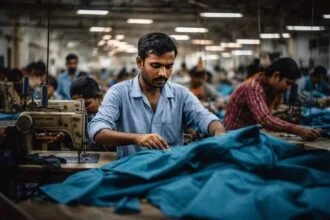
Bangladesh’s garment industry has done more than most producing countries to modernise, invest in safety, and embrace transparency. Yet brands keep expecting manufacturers — not themselves — to absorb the cost of these improvements. Workers feel that pressure directly. When brands push for lower prices, it is not the CEO of a factory who suffers; it is the sewing operator on the floor whose salary stays stagnant, whose overtime increases, whose job security evaporates.
The BSBI study also showed that companies scored an average of just 2.69 out of 5 for supply-chain transparency. Some countries — Switzerland, Sweden, Norway, Denmark, Belgium and Hong Kong — perform better, while firms tied to production in China, India, Korea, Poland, Singapore, Turkey and the UAE scored the lowest. But transparency without wage improvement is meaningless. A transparent supply chain that still pays poverty wages is simply a well-documented injustice.
Read Exclusive Interview by Fashion Business Journal
Dr. Gemma Vallet of BSBI summarized it bluntly, “Paying a living wage is not a luxury; it is the baseline of ethical business practice.” She is right. And brands know it — they simply choose to ignore it.
What makes this moment especially critical is the growing demand from consumers themselves. A recent study cited in the report found that 40 percent of German consumers want greater transparency about supply-chain wages. People are no longer satisfied with recycled polyester claims or carbon-neutral marketing. They want to know whether the person who stitched their shirt can afford rent and food.
And it is time brands gave them an honest answer. If global fashion companies truly believe in the values they promote, they must start where it matters most – fair pricing and living wages.
That means reshaping procurement strategies, adjusting costing models, supporting long-term partnerships, and respecting countries’ wage-setting processes. It also means accepting that ethical production will cost more — and that the burden should not fall on the most vulnerable segment of the supply chain.
The fashion industry cannot continue hiding behind voluntary commitments, glossy pledges and carefully curated transparency portals. Ethical sourcing begins with economic fairness. It begins with acknowledging that the price negotiations happening in boardrooms in Stockholm, London, New York or Barcelona directly determine whether a woman on a sewing line in Gazipur can afford three proper meals a day.
Fair Price — The Missing Link in Bangladesh’s Garment Success Story
The BSBI study is more than a warning — it is an invitation for brands to rethink their role.
Stop pushing manufacturers into impossible margins. Stop treating living wages as an optional aspiration. Stop making workers pay the hidden cost of fast fashion.
The future of fashion must be built on dignity — not discounts. And the responsibility lies with brands, not workers, to make that shift real.