
Carrefour has become the first major retailer to roll out France’s new national environmental labelling scheme for textiles, marking a significant step toward greater transparency in the fashion sector as regulators and consumers push for clearer sustainability information.
The French retail giant said it has begun displaying environmental scores on around 70 garments from its Tex private-label clothing range, including T-shirts, underwear, and bodysuits. The pilot, launched in January 2026, comes ahead of the wider voluntary rollout of the scheme across France from October 2025, with a view to broader adoption by 2026.

The initiative, known as the “Environmental Cost” (Coût Environnemental), is a state-backed, government-mandated labelling framework designed to show the environmental impact of clothing on a standardized point-based scale. The labels are intended to provide consumers with clear, comparable information on how garments perform across a range of environmental indicators, similar to the Nutri-Score system used on food products.
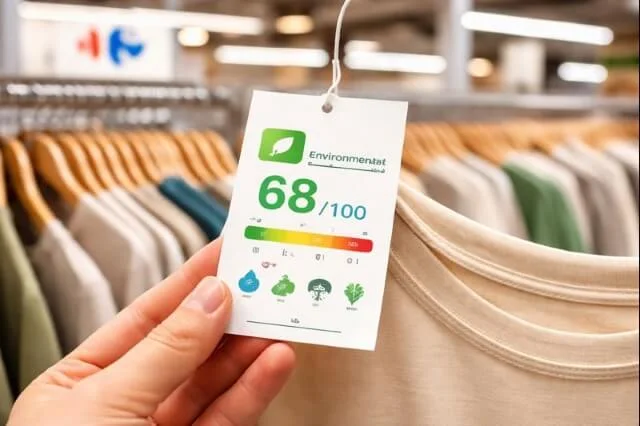
Carrefour said it is working with sustainability data firm Clear Fashion to implement the pilot. For now, customers can access the scores by scanning product barcodes using the Clear Fashion mobile application, which displays an environmental rating out of 100 based on life-cycle analysis.
“This first step aims to inform our customers and demonstrate the technical feasibility of large-scale textile labelling,” Carrefour said in a statement. “It is part of the government’s national rollout of environmental labelling and our ongoing commitment to transparency.”
The Environmental Cost label is based on the official Ecobalyse methodology developed by French public authorities after several testing phases. The tool assesses the full life cycle of a garment across 16 environmental indicators, including greenhouse gas emissions, biodiversity impact, natural resource use, durability, pollution, transport, and microplastic fiber release.
Scores are expressed in “impact points,” with higher values indicating greater environmental harm. According to Carrefour, the average environmental cost of the Tex garments evaluated so far is 542.91 points per 100 grams. For comparison, an organic cotton Tex T-shirt scores around 510 impact points per 100 grams, while a comparable non-organic fast fashion T-shirt can exceed 1,000 points per 100 grams, nearly double the impact.
French authorities see the scheme as a key tool in steering consumer behavior toward lower-impact fashion and encouraging brands to improve their sourcing and production practices. The voluntary phase begins on Oct. 1, 2025, and by October 2026, third parties will be allowed to publish scores on behalf of brands, potentially accelerating adoption across the industry.
France is one of the first countries in Europe to introduce a standardized, government-backed environmental label for textiles, as part of its broader push to curb the fashion sector’s environmental footprint. The clothing and footwear industry is among the most resource-intensive globally, contributing significantly to carbon emissions, water consumption, chemical pollution, and textile waste.
Also read: EU Urged to Member States Clamp Down on Fashion Overproduction
Carrefour’s early move positions it as a first mover in a regulatory environment that is likely to tighten. European policymakers are increasingly targeting the fashion industry through eco-design rules, digital product passports, and extended producer responsibility schemes, while consumers are demanding more credible sustainability information.
Carrefour has a long track record of transparency initiatives. The retailer previously rolled out the Nutri-Score label across its entire food range, both online and on packaging for own-brand products, helping standardize nutritional information for consumers. The company said it aims to make the Environmental Cost label a similar reference point for clothing.
“At the end of this initial trial, Carrefour will decide on the most suitable and accessible tools for rolling out environmental labelling across all its textile collections,” the company said, indicating that the current app-based system may be expanded to in-store labels, online product pages or packaging.
Industry analysts say the move could put pressure on other retailers and fashion brands operating in France to follow suit, particularly as consumers grow more sensitive to environmental claims and regulators crack down on greenwashing.
“Standardized labelling frameworks like this reduce the room for vague sustainability marketing and create a level playing field,” said a Paris-based sustainability consultant. “They also make it easier for consumers to compare products and reward brands that invest in cleaner supply chains.”
Carrefour, which operates more than 15,000 stores in over 40 countries and generated €94.6 billion in revenue in 2024, is the first major food retailer to voluntarily roll out the Environmental Cost label for textiles. While the current pilot focuses on its private-label Tex brand, the company said the methodology could be extended to national and international brands in the future.
The development comes as global fashion brands and retailers face increasing scrutiny over the environmental and social impacts of their supply chains, including labor conditions, carbon emissions, and resource use. Transparency initiatives are seen as a critical step in aligning the sector with climate and sustainability targets.