
China’s leading sportswear brands are accelerating the adoption of Merino wool for technical athletic applications, as consumer demand for advanced, natural performance fabrics reshapes the country’s fast-growing sportswear market.
ANTA GUANJUN’s recent launch of a 100% Merino wool trail running T-shirt series marks a notable milestone in this shift. The collection debuted at the Hong Kong 100 Ultra Trail Race (HK100), a grueling 100-kilometre endurance event featuring more than 5,000 metres of elevation gain, where elite athletes tested the garments under prolonged, high-intensity conditions.

The race environment, steep climbs, rocky descents, fluctuating temperatures, and sustained humidity provided a real-world proving ground for the fibre’s technical capabilities. Elite runners wore the Merino wool garments across extended distances and changing altitudes, offering performance validation in one of Asia’s most demanding endurance competitions.
The launch comes amid strong growth in wool-based performance wear in China. According to the 2025 Wool Material Consumption Trends Insight White Paper, released by the Tmall Innovation Center (TMIC) in partnership with Woolmark, wool sportswear has emerged as one of the fastest-growing segments in the market. Merino wool sportswear products recorded growth of 119%, reflecting rising consumer interest in natural fibre alternatives within technical apparel categories.
Industry analysts say the growth highlights a broader transformation in China’s sportswear sector. As participation in outdoor sports such as trail running, hiking, and ultra-distance racing increases, consumers are seeking garments that combine comfort, durability, and performance across extended periods of wear.
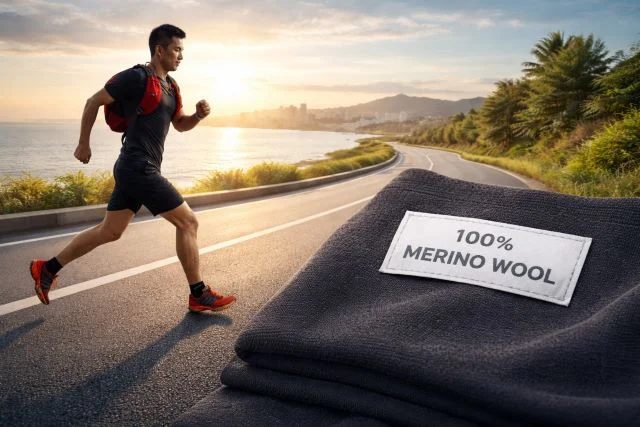
ANTA GUANJUN’s 100% Merino wool T-shirt series integrates the fibre’s natural properties — temperature regulation, breathability, moisture management, and odour resistance- into garments engineered for endurance sports. Unlike many synthetic performance fabrics that rely on chemical treatments, Merino wool’s performance characteristics are inherent to the fibre itself.
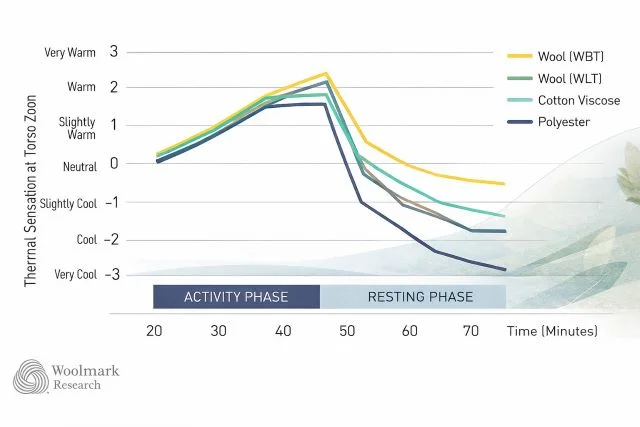
Research from The Woolmark Company supports the technical positioning of Merino wool in high-intensity sport. Studies on dynamic breathability show that the fibre’s unique structure allows it to respond to changing environmental and physical conditions by adjusting airflow and moisture transport. This adaptive response helps maintain a stable microclimate against the skin, even as exertion levels fluctuate.
For ultra-trail runners, maintaining a consistent body temperature and managing moisture build-up can be critical to comfort and performance over long distances. Merino wool’s ability to absorb moisture vapour while remaining breathable reduces the sensation of dampness and helps regulate heat during both ascents and descents.
Over extreme distances and shifting altitudes at the HK100, the garments were tested across varied terrain and weather exposure. Industry observers say such endurance environments provide more meaningful validation than controlled laboratory tests, demonstrating how natural fibres perform under sustained stress.
“I was deeply impressed by the natural properties of Australian Merino wool – its combined features of moisture absorption, temperature regulation, and anti-odour capabilities are highly aligned with our positioning of creating professional equipment for elite outdoor scenarios,” said Xiaofei Lin, General Manager of ANTA GUANJUN.
Also read: Australian Wool Prices Surge on Strong Chinese Demand
The collection is Woolmark-certified, with each garment carrying the Woolmark logo as a mark of fibre quality and compliance with performance standards. In a market increasingly focused on technical credibility, third-party certification is becoming an important differentiator, particularly in the premium sportswear segment.
China’s sportswear industry has expanded rapidly over the past decade, driven by rising health awareness, urban fitness culture and government support for sports participation. Domestic brands such as ANTA have invested heavily in research and development to compete with global players in the high-performance category.
While synthetic materials such as polyester and nylon have traditionally dominated technical sportswear due to their lightweight and engineered properties, brands are now exploring fibre diversification. Natural materials like Merino wool are being evaluated not only for performance advantages but also for sustainability credentials.
Merino wool is renewable and biodegradable, aligning with broader industry conversations around responsible sourcing and environmental impact. As global consumers become more conscious of material origins and lifecycle impacts, natural fibres are gaining traction in categories once dominated by petrochemical-based textiles.
Market experts say the 119% growth in wool sportswear signals a maturing consumer base that is becoming more knowledgeable about fibre functionality. Rather than focusing solely on branding, buyers are increasingly evaluating garments based on composition, breathability, comfort and long-term wear performance.
By integrating 100% Merino wool into elite-level trail running gear, ANTA GUANJUN is positioning natural fibre innovation at the centre of its performance strategy. The HK100 debut underscores how material science and endurance sport are converging to redefine what constitutes technical apparel.
As competition intensifies in China’s sportswear market, fibre innovation is emerging as a key battleground. Merino wool’s demonstrated dynamic breathability and adaptive comfort may help natural performance wear secure a larger share of the high-intensity sports segment in the years ahead.