
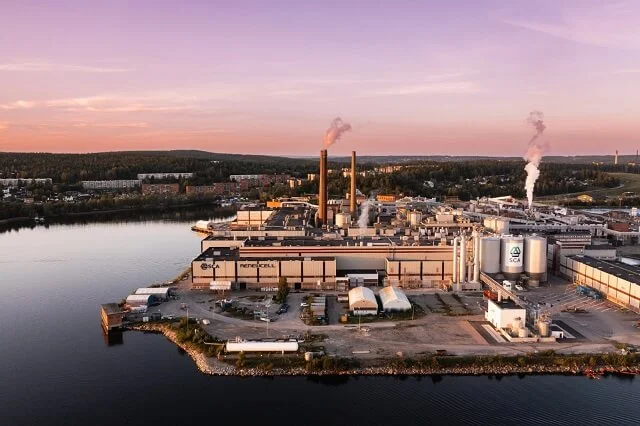
Swedish textile recycling innovator Circulose has confirmed plans to restart commercial-scale production at its Ortviken facility in Sweden later this year, marking a major milestone for chemical textile recycling after early financial challenges and restructuring.
The company, which closed the plant in 2024 amid bankruptcy proceedings as Renewcell and reorganised under new ownership, is now gearing up to resume output of CIRCULOSE a pulp made entirely from discarded cotton and other textile waste that can be spun into recycled fibers and used by global brands.

CEO Jonatan Janmark said preparations are “in full swing,” with production expected to restart in the fourth quarter of 2026. The move comes after securing commitments from 11 major fashion brands to use Circulose materials, aligning industrial operations with confirmed demand a key shift from past commercial strategies.
The Swedish recycling site originally belonged to Renewcell, once heralded as a breakthrough in textile-to-textile recycling. However, Renewcell filed for bankruptcy in early 2024 after struggling to secure long-term financing and sufficient orders.
Following acquisition by private equity firm Altor, the business was renamed Circulose and restructured with a revised strategy focused on locking in brand partnerships before full production restarts.
This approach aims to ensure a clear market pathway for recycled pulp — a historically challenging pivot point for textile recyclers.
Also Read : The 2026 Fashion Manifesto: Strategic Humanity in a Machine Age
Industry observers have described this pivot as critical to proving the commercial viability of chemical textile recycling, encouraging broader adoption of circular materials across supply chains.
While the restart itself is a headline moment, Circulose has also been active in building strategic alliances – Mango was among the first major brands to sign on under the new model, committing to integrate Circulose into its sustainability roadmap and support the restart efforts.
Circulose has announced partnerships with major fibre producers including Tangshan Sanyou, Aditya Birla, and Jilin Chemical Fiber, aimed at strengthening supply chains and helping scale recycled viscose and filament yarn products.
Fashion houses such as Bestseller, Reformation, and John Lewis have also been linked to Circulose through broader industry initiatives to shore up recycled viscose supply.
Also Read : Fakir Knitwears Ltd’s Integrated Model Spurs Global Buyer Confidence
Earlier collaboration with H&M Group has helped anchor recycled fibre adoption in mainstream fashion sourcing strategies. These partnerships reflect a broader trend in the circular fashion space where innovative materials and recycling technologies are increasingly integrated into global supply chains.
Chemical textile recycling like that pursued by Circulose remains a high-stakes frontier: it promises to reduce dependence on virgin fibres such as cotton and man-made-cellulosic fibres (MMCFs), which are resource-intensive and environmentally impactful.
Scaling such technology has historically proven difficult due to cost, complexity, and inconsistent brand demand. Circulose’s brand-first production strategy may serve as a model for how emerging recyclers can secure sustainable business pathways while expanding market access.
The restart of the Ortviken plant could signal a turning point in industrial textile recycling, helping divert discarded clothing from landfills and enabling a more circular materials ecosystem.