
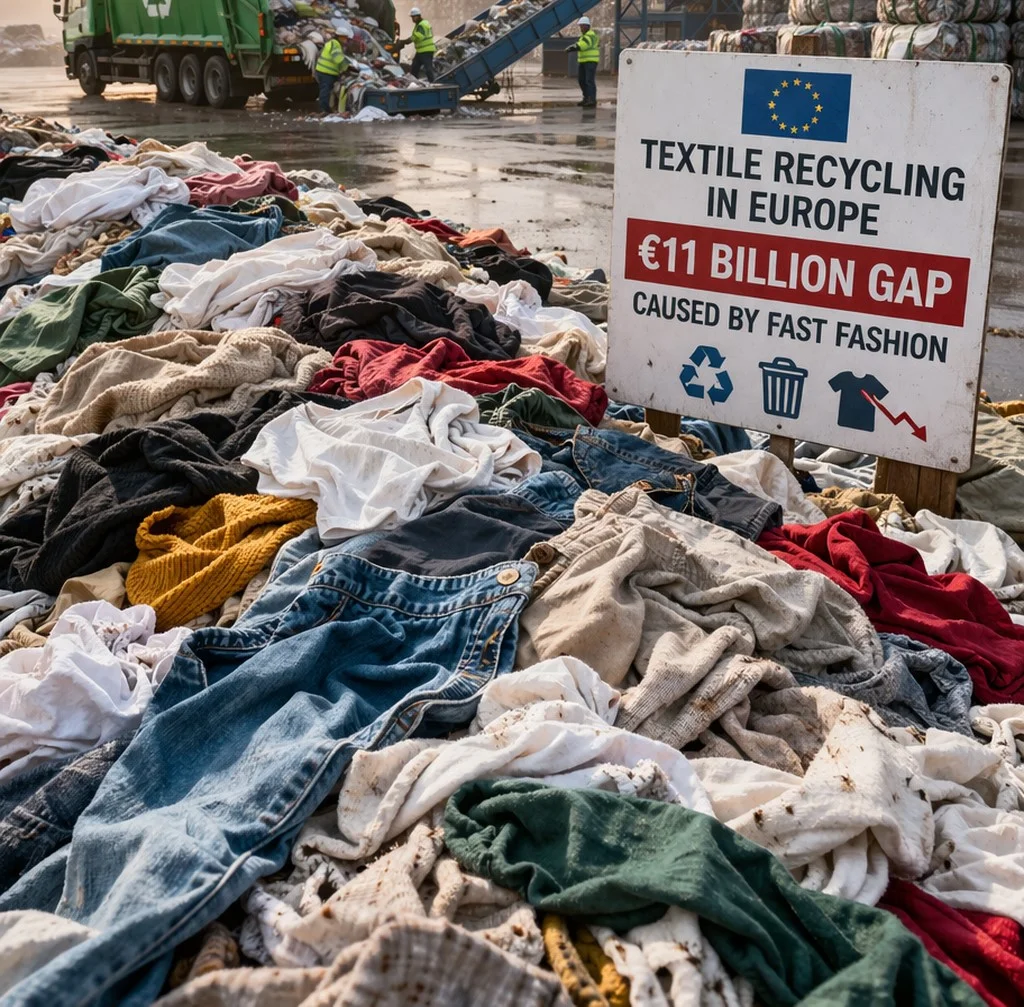
Europe’s ambition to build a circular textile economy is facing mounting financial and structural challenges, with industry estimates suggesting that up to €11 billion in investment will be required to scale textile recycling systems across the region.
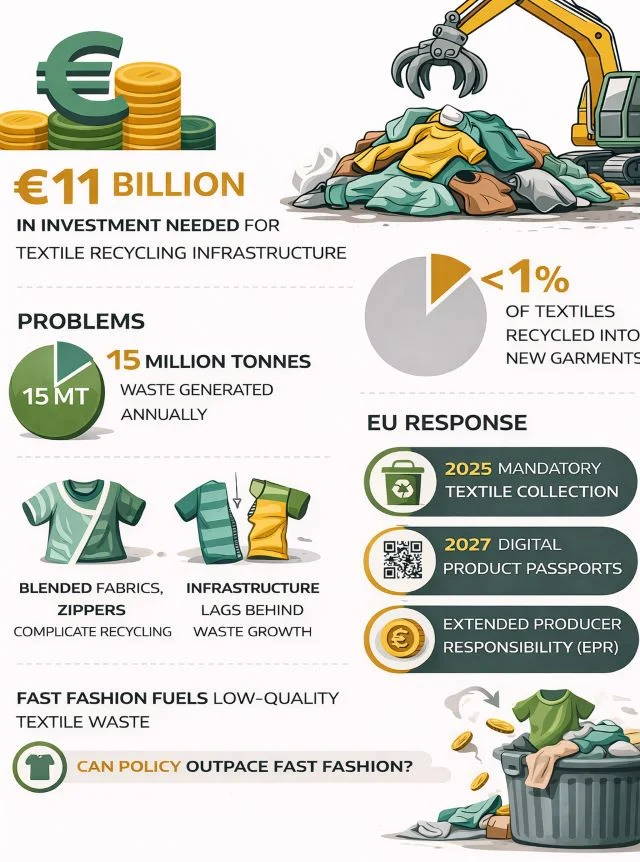
The figure, highlighted in a recent industry report by Boston Consulting Group and ReHubs, reflects the cost of building the infrastructure needed to process growing volumes of textile waste, much of it driven by fast fashion consumption patterns.

Europe generates more than 15 million tonnes of textile waste annually, the majority of which comes from post-consumer garments. However, less than 1% of this waste is currently recycled into new textiles, underscoring the gap between policy ambitions and industrial capacity.
The scale of the challenge is expected to grow. Clothing consumption continues to rise, fuelled by fast fashion business models that emphasise low-cost, high-volume production and rapid turnover. Analysts estimate that demand for clothing in Europe is increasing steadily, while consumer behaviour shows limited signs of shifting towards more sustainable patterns.
At the same time, the economics of textile recycling remain difficult. According to the report, scaling textile-to-textile recycling to a viable level would require not only capital investments of between €8 billion and €11 billion, but also ongoing operating costs of up to €6.5 billion annually.
One of the key barriers is the cost competitiveness of recycled fibres. Industry experts note that recycled textile materials currently struggle to compete with cheaper virgin fibres or alternative recycled inputs, particularly in a price-sensitive fashion market.
“Textile-to-textile recycled fibres represent a new product category with higher structural processing costs,” the report noted, highlighting the need for economies of scale to improve viability.
To reach that scale, Europe would need to process around 2.7 million tonnes of textiles annually by 2035, a level considered critical for making recycling systems economically sustainable.
However, the infrastructure required to achieve this target remains underdeveloped. Sorting facilities, recycling plants, and collection systems are not yet equipped to handle the volume and complexity of modern textile waste.
Also read: India’s Textile Recycling Market Could Reach $3.5 Billion By 2030
A major technical challenge lies in the composition of garments. Many items are made from blended fibres, such as polyester-cotton mixes, or include components like zippers and coatings, making them difficult to recycle efficiently. These complexities increase processing costs and limit the scalability of recycling technologies.
Policy developments are adding both urgency and pressure to the transition. Under the European Union’s revised Waste Framework Directive, textile producers will be required to finance the collection, sorting and recycling of their products through extended producer responsibility (EPR) schemes.
While these measures are designed to accelerate investment and shift responsibility from municipalities to brands, they also introduce significant financial burdens for companies already operating in a highly competitive market.
At the same time, mandatory textile waste collection across EU member states, coming into force from 2025, is expected to increase the volume of collected waste, raising concerns about whether recycling capacity can keep pace.
Industry observers warn that without parallel expansion in sorting and recycling infrastructure, increased collection rates could simply lead to more waste being exported, incinerated or landfilled rather than effectively recycled.
The situation highlights a broader tension at the heart of Europe’s circular economy ambitions. While policymakers are pushing for sustainability and waste reduction, the continued growth of fast fashion is generating volumes of low-quality textiles that are difficult and costly to recycle.
Some analysts argue that recycling alone cannot solve the problem. Reducing overproduction, improving product design and extending garment lifecycles are increasingly seen as essential components of a sustainable textile system.
There are also calls for stronger incentives to stimulate demand for recycled materials, including mandatory recycled content targets and clearer regulatory frameworks to support investment.
Despite the challenges, the potential economic opportunity remains significant. Europe’s textile waste stream could support a multi-billion-euro recycling industry if the right infrastructure and policies are put in place.
However, the transition will require coordinated action across the entire value chain, from manufacturers and recyclers to brands and policymakers.
As the European Union moves forward with its circular textiles strategy, the success of its recycling ambitions will depend not only on technological innovation but also on the industry’s ability to align economic incentives with sustainability goals in a rapidly evolving market.