
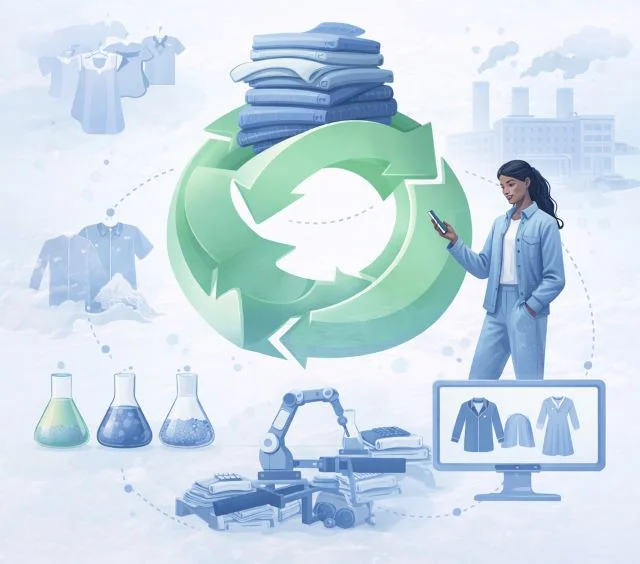
The global fashion industry is beginning to confront its mounting waste crisis as innovators and designers push circular solutions that treat discarded clothing not as rubbish, but as a valuable raw material for the future.
At the center of this shift is Evrnu, a US-based textile innovation company founded in Seattle in 2014 by Stacy Flynn, which is now building what it describes as the nation’s first 100% garment-to-garment recycling plant. The move comes as clothing waste continues to surge, with the United States alone discarding close to 20 million metric tons of textiles each year, up more than 40% from a decade ago.

Flynn, a textile specialist turned entrepreneur, says the idea behind Evrnu was born from witnessing both the beauty of nature and the environmental damage caused by fashion’s fast-paced production model. After years working with global brands and supply chains, she became increasingly troubled by the pollution and resource depletion linked to conventional textile manufacturing, particularly during unchaperoned visits to production hubs in China.
Evrnu’s proprietary NuCycl technology breaks down cotton-rich garment waste into a pulp that can be regenerated into high-quality lyocell fiber. The resulting yarns and fabrics can be recycled repeatedly within the same system, mimicking natural cycles where waste becomes input rather than an endpoint. The process also produces fibers that are biodegradable and compostable, offering an alternative to the largely linear fashion supply chain.
The company is now establishing its first large-scale recycling facility in upstate South Carolina, a region that was once the heart of the US textile industry before production shifted overseas in the late 20th century. Flynn says the location reflects both symbolic and practical ambitions: rebuilding domestic textile infrastructure while closing the loop on garments already in circulation. Evrnu is currently close to securing the majority of its financing to bring the plant online.
The push for large-scale textile recycling mirrors a broader reckoning within the fashion industry, particularly in Europe, where new regulations are forcing brands and consumers to take responsibility for discarded clothing. Earlier this year, European Union rules made it illegal to throw textiles into household waste or destroy unsold garments, exposing the true scale of overproduction.
Also read: Future of Fast Fashion: The Rise of Slow And Circular Business Models
In Sweden, Nana Sacko, project manager of Textile Movement Talent at Lindholmen Science Park, is working on the other end of the circular spectrum: reuse, redesign and talent development. After two decades in conventional fashion roles spanning design, production and buying, Sacko left the fast fashion system during the pandemic, citing its dependence on short lead times, high volumes and low prices.
She now supports emerging designers across western Sweden who are building circular business models that prioritize longevity, reuse and local production. Her work highlights a stark reality seen in sorting facilities and secondhand markets: vast quantities of newly produced garments, sometimes still with price tags attached, are being discarded because they are too cheap or too poorly made to justify repair or resale.
Globally, recycled fibers still account for only a small fraction of the materials used in fashion, underscoring the complexity of turning textiles back into textiles. Sacko compares the challenge to trying to separate the ingredients of a baked cake back into their original forms. As a result, she argues that recycling alone cannot solve the problem.
Instead, circular fashion must combine multiple strategies: extending the life of existing garments, redesigning waste into new products, and investing in material innovation where recycling is possible. Examples emerging from Sweden include designers transforming unwanted towel waste into high-end bathrobes, repurposing wool scraps, and developing modular techniques using secondhand fabrics to create entirely new textiles.
Scaling these ideas, however, remains difficult in a system optimized for low costs and high volumes. Circular businesses often struggle to compete when repairing a garment costs more than buying a new one. Sacko says policy support, education and new infrastructure will be critical if circular fashion is to move beyond niche applications.
Together, efforts like Evrnu’s industrial recycling plant and Sweden’s redesign-led talent programs reflect a growing consensus that the fashion industry must fundamentally change. Rather than eliminating fashion, proponents argue the goal is to stop destroying natural resources, human labor and environmental systems in its name.
As pressure mounts from regulators, consumers and climate targets, circularity is shifting from an ethical aspiration to a commercial and political necessity. Whether through advanced fiber regeneration or creative reuse, fashion’s next chapter is increasingly being written around one central idea: waste is no longer an acceptable outcome, but a resource waiting to be reclaimed.