
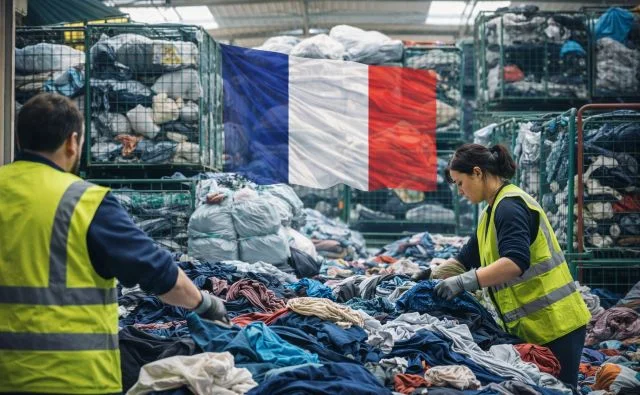
France has announced additional emergency funding to support its textile collection and sorting sector as authorities attempt to stabilize an industry struggling under rising waste volumes and weakening export markets.
The French government said it will increase exceptional financial support to €268 per tonne by 2026 for operators involved in the collection and sorting of textiles, household linen and footwear under the country’s Extended Producer Responsibility (EPR) scheme, known as REP TLC.

Officials said the move is intended to prevent bankruptcies and maintain critical sorting and collection capacity in a sector that has been under severe pressure for more than a year.
The textile recycling system in France has faced mounting challenges as clothing waste volumes continue to grow rapidly. Government officials linked part of the pressure to the rise of ultra-fast fashion, which has increased the number of low-cost garments entering the waste stream while reducing the value of second-hand exports.
Authorities said the REP TLC sector has been experiencing a crisis for more than 18 months, driven by rising collection volumes and declining international markets for used clothing.
Sorting operators play a crucial role in France’s circular fashion infrastructure, processing large volumes of discarded textiles each year and directing materials toward reuse, resale or recycling channels. Industry groups have warned that without emergency support, several operators could face financial collapse, threatening the country’s textile recovery system.
To address the issue, the government plans to introduce an amended regulatory order, which will be released for public consultation in the coming weeks.
France is also preparing a broader reform of the REP TLC system, with a new policy framework expected to be presented by the end of March 2026.
Also read: France Targets Ultra-Fast Fashion With New Eco Taxes
As part of the reform process, the government has tasked Refashion, the organization responsible for managing the textile EPR scheme, with developing an action plan to address penalties for ultra-fast fashion. The proposal is expected to be submitted by 15 March 2026.
France has been one of Europe’s most active countries in implementing policies aimed at reducing fashion waste and promoting circular textile systems. The EPR scheme requires fashion brands and retailers to contribute financially to the collection, sorting and recycling of products they place on the market.
However, the rapid growth of low-cost fashion and declining resale markets have placed new strain on the system, raising concerns about the long-term sustainability of textile waste management infrastructure.
The government said the increased support is intended as a temporary measure while broader reforms are developed to stabilize the sector and strengthen France’s textile circular economy.