
The global textile industry is showing early signs of stabilization after a prolonged downturn, though weak demand continues to weigh heavily on business conditions, according to the latest survey by the International Textile Manufacturers Federation.
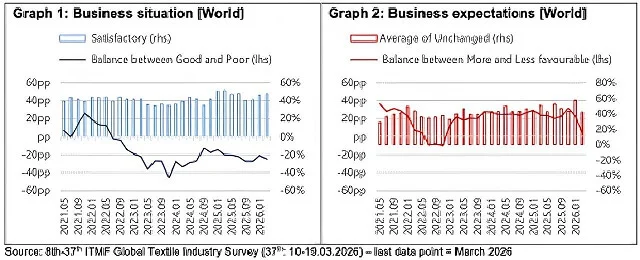
Findings from the 37th Global Textile Industry Survey indicate that overall business sentiment remains negative, extending a slump that has persisted since 2023. However, the rate of decline is slowing, suggesting the sector may be nearing the bottom of its cycle.

Demand remains the industry’s most pressing challenge, cited by a majority of respondents across all regions. Sluggish retail recovery, cautious consumer spending and lingering inventory imbalances from the post-pandemic boom continue to suppress new orders, the survey showed.
“Markets are still under pressure, but the situation is no longer deteriorating at the same pace,” an industry executive participating in the survey said, reflecting a cautiously improving outlook among manufacturers.
Also Read: Global Textile Chemicals Market to Reach $48 Billion by 2035
Order intake is gradually stabilizing, with average order backlogs hovering around two to two-and-a-half months. Capacity utilization remains moderate, indicating that while factories are not operating at full strength, activity levels are no longer in sharp decline.
The survey also highlights stark regional disparities. Africa and South America reported relatively stronger business conditions, while East Asia and parts of Europe continued to face significant headwinds from overcapacity and subdued demand. This divergence is increasingly influencing global sourcing strategies, as buyers reassess cost competitiveness and supply chain resilience.
Despite current challenges, expectations for the next six months have turned modestly positive, signaling cautious optimism across the industry. Many companies anticipate a gradual improvement in demand, although uncertainty tied to inflation, trade dynamics and geopolitical risks remains high.
For major exporting countries like Bangladesh, the findings underscore both risks and opportunities. Persistent demand weakness is likely to sustain pricing pressure, but improving order trends could support export volumes in the coming months, particularly as buyers diversify sourcing away from higher-cost regions.
The ITMF survey suggests the global textile sector has entered a transitional phase, moving from contraction toward stabilization. While a full recovery is not yet in sight, the data indicates that the worst of the downturn may have passed.