

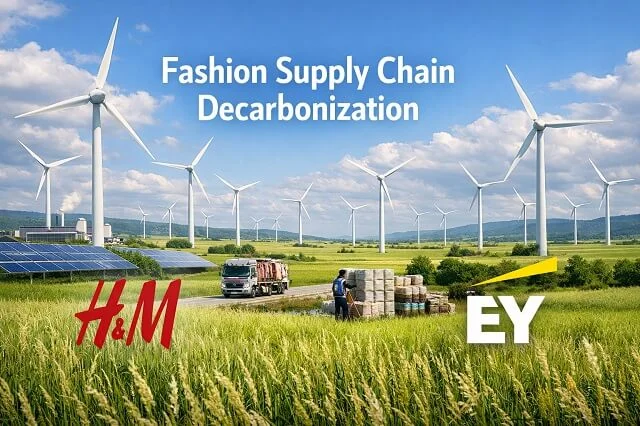
A new white paper jointly released by H&M Group and Ernst & Young (EY) argues that financing efforts to decarbonise global fashion supply chains can protect long‑term corporate value, strengthen resilience against climate‑related disruption and deliver measurable financial returns, marking sustainability as a strategic business priority rather than a cost burden.
Titled “Accelerating Fashion Decarbonisation – An Efficient Approach to Unlocking Corporate Value and Financing the Supply Chain Transition,” the report builds its case on insights from financial institutions including HSBC and the Apparel Impact Institute (Aii), highlighting that reducing emissions across complex supply chains should be central to risk management and strategic planning for fashion firms.

The authors, including Adam Karlsson, CFO of H&M Group, said the cost of inaction on climate change presents a material threat to business performance and resilience, urging chief financial officers and finance leaders to embed climate risk into capital allocation decisions. “Our role is not to debate whether sustainability targets should be met, but to ensure how they are delivered,” Karlsson said, underscoring the need to balance cost efficiency with value creation.
The paper stresses that most emissions in the fashion sector lie outside direct operations — in what analysts refer to as Scope 3 emissions — and that unlocking finance for suppliers, especially in emerging manufacturing hubs, is key to driving measurable reductions.
Also Read: Jeanologia Launches ‘Billy AI’ to Transform Denim Laser Design
Rather than prescribing one financing model, the framework offers guidance on governance tools, risk‑sharing structures and partnerships that can link corporate climate ambition with deployable investment pathways, helping brands convert sustainability goals into action.
According to the report, coordinated industry action — involving brands, suppliers, financial institutions, non‑government organisations and policymakers — is essential to scale renewable energy adoption, improve energy efficiency and stimulate collaborative finance mechanisms that support long‑term decarbonisation outcomes.
The white paper also cites examples where decarbonisation investments can reduce supply‑chain risk and raise competitiveness, aligning with broader industry trends where environmental, social and governance (ESG) strategies are increasingly linked to investor expectations and access to capital.
With global fashion facing mounting pressure from regulators and consumers to meet net zero targets, the report positions supply‑chain decarbonisation not just as an environmental imperative but as a business strategy that can future‑proof operations and preserve shareholder value.