
The European Union stopped granting special tariff preferences on most Indian products under its Generalised Scheme of Preferences (GSP) from January 1, 2026. This means Indian exporters now have to pay full import duties on goods such as textiles, garments, plastics, and industrial products when selling in the EU market. At the same time, on January 27, 2026, India and the EU completed negotiations on a major Free Trade Agreement (FTA), which will soon remove tariffs on about $33 billion worth of Indian exports, including giving zero-duty access to textiles and clothing. Together, these two developments mark a major change in how India and Europe trade with each other.
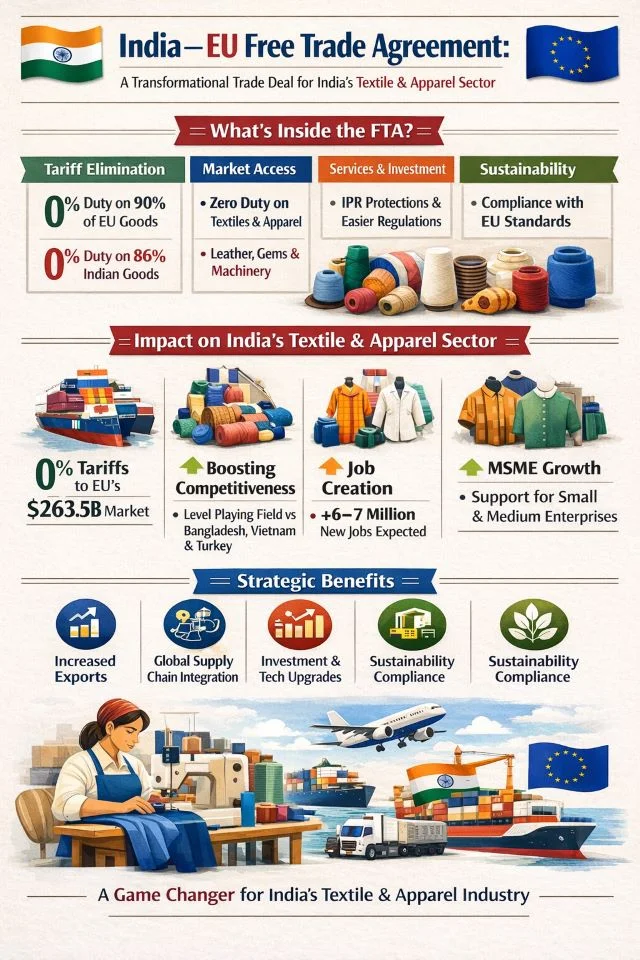
India–EU Free Trade Agreement is a transformative deal for India’s textile and apparel sector, under which tariffs will be eliminated on about 90% of EU goods and 86% of Indian goods, including zero-duty access for textiles and apparel as well as products such as leather, gems and machinery, alongside stronger intellectual property protection, easier regulations and compliance with EU sustainability standards. The agreement will give Indian exporters zero-tariff access to the EU’s USD 263.5 billion textile and apparel market, boost competitiveness by creating a level playing field, and is expected to create around 6–7 million new jobs. Strategically, it will increase exports, deepen global supply chain integration, attract investment and technology upgrades, and strengthen sustainability compliance, making it a game-changer for India’s textile and apparel industry.

Also read: India-EU Trade Deal Poses Challenge to Bangladesh’s Garment Exports
The GSP is a trade system where the EU gives developing countries lower import duties to help them grow their exports. For many years, India benefited from this system and was able to sell products to Europe at reduced tariffs. But under new EU rules, countries that become strong exporters in certain product categories lose these benefits. Since India has grown into a major exporter across multiple sectors, the EU removed these tariff discounts for most Indian goods starting in 2026 and lasting until 2028. Earlier, Indian exporters saved between 4% and 12% in duties, but now they must pay full tariffs, making their products more expensive in European markets.
Trade experts estimate that about 87% of Indian exports to the EU are affected by the GSP withdrawal, while the Indian government says the direct impact is smaller and will be balanced by the benefits coming from the new FTA. Regardless of the exact percentage, exporters in price-sensitive sectors such as garments, textiles, plastics, and engineering goods are facing short-term cost pressures as they adjust to higher duties.
At the same time, the India–EU Free Trade Agreement announced on January 27, 2026, represents a major long-term opportunity. The agreement will eliminate tariffs of up to 10% to 12% on nearly $33 billion worth of Indian exports and improve market access for more than 99% of India’s exports by value. Prime Minister Narendra Modi and European Commission President Ursula von der Leyen announced the deal at the 16th India–EU Summit in New Delhi, calling it a historic step that would create jobs, boost trade, and strengthen global supply chains.
Textiles and clothing are expected to benefit the most from the agreement. India currently exports about $7.2 billion worth of textiles and apparel to the EU, mainly ready-made garments, cotton textiles, man-made fibre products, home textiles, handicrafts, and carpets. Once the FTA enters into force, Indian textile and clothing exports will enter the EU at zero duty, removing tariffs of up to 12%. This will make Indian products more competitive compared to suppliers from countries such as Bangladesh, Pakistan, and Turkey, which already enjoy preferential access.
The agreement will also benefit many other Indian industries. Leather and footwear exports will gain zero-duty access, improving their competitiveness in high-value European markets. Engineering goods and automobiles will see duties reduced or eliminated, helping Indian manufacturers expand their presence in Europe. Gems and jewellery, marine products, handicrafts, and home décor will also benefit from lower tariffs and easier market entry. Services trade, including IT, digital services, and professional services, will receive improved access and clearer regulatory rules. The agreement also simplifies customs procedures, improves transparency, and reduces non-tariff barriers.
Alongside tariff changes, Indian exporters must also adjust to the EU’s Carbon Border Adjustment Mechanism, which applies to carbon-intensive products such as steel, cement, and aluminium. Under this system, exporters must report emissions and may need to pay carbon-related charges. India secured commitments from the EU under the FTA for technical cooperation, recognition of verifiers, and financial assistance to help exporters meet these climate requirements.
Trade between India and the EU is already large and growing. In the 2024–25 financial year, total bilateral trade in goods reached about $136.5 billion, with Indian exports worth around $75.85 billion and imports from the EU about $60.68 billion. With the FTA concluded, trade volumes are expected to rise further over the coming years.
The EU’s decision to suspend GSP benefits was based on regulatory rules rather than political punishment. The GSP system is meant to support developing countries, but once a country becomes a strong and competitive exporter, the EU withdraws those benefits. India’s strong export performance across many sectors meant it no longer qualified for special tariff treatment under this system.
For India, the FTA replaces the lost GSP benefits with a permanent and legally binding trade framework, boosts exports, supports manufacturing under the Make in India initiative, and helps Indian firms integrate into global value chains. For the EU, the agreement provides access to one of the world’s fastest-growing consumer markets, diversifies supply chains, and supports goals related to climate, digital trade and economic security.
The main difference between GSP and an FTA lies in their nature and stability. GSP is a unilateral system where the EU alone decides which countries receive tariff benefits and can withdraw them at any time. It does not require India to offer anything in return. An FTA, on the other hand, is a negotiated and legally binding agreement where both sides commit to lowering tariffs, improving market access, and following agreed rules. It is long-term, stable, and reciprocal.
India is moving from temporary trade benefits to a permanent trade partnership. Earlier, India relied on the EU’s goodwill under GSP. Now, India and the EU are trading as equal partners under a modern, rules-based agreement. In the short term, Indian exporters face higher tariffs due to the GSP withdrawal. In the medium term, those tariffs will fall to zero under the FTA concluded. In the long term, trade between India and the EU will become more stable, predictable, and stronger.
The EU ending GSP benefits and signing an FTA with India are not contradictory actions. They represent a single transition. India is no longer treated as a country needing special trade preferences. Instead, it is now recognised as a major global trading power entering into a comprehensive, legally binding partnership with Europe that will shape its economic relationship for decades.