
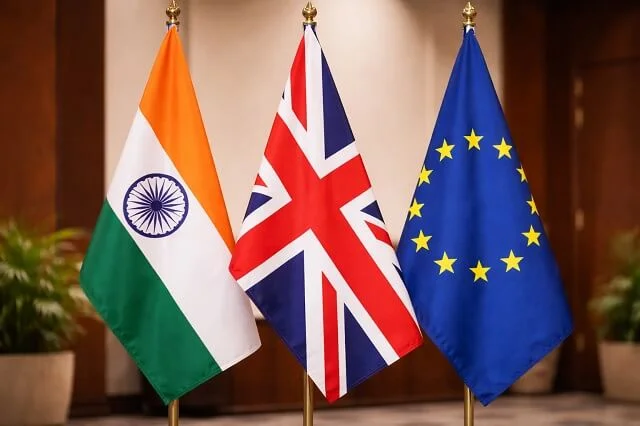
India’s free trade agreement with the United Kingdom is expected to come into force by 1 May, while a similar pact with the European Union could be finalised by the end of this year, according to industry representatives, signalling a potentially significant shift in the country’s export outlook across key manufacturing sectors.
Speaking after a business leaders’ meeting in Coimbatore attended by Union Commerce and Industry Minister Piyush Goyal, Ravi Sam, Vice Chairman of the Cotton Textiles Export Promotion Council of India, said both agreements are progressing steadily and remain on track within the expected timelines outlined by policymakers and trade stakeholders. Read Here

Sam indicated that the India–UK FTA is likely to be among the first major trade agreements to take effect in the current cycle of global trade negotiations. Industry participants see the deal as a crucial development for Indian exporters, particularly in the textiles and apparel segment, where tariff reduction and improved market access are expected to strengthen competitiveness in an already highly contested UK import market.
The Cotton Textiles Export Promotion Council of India, widely known as Texprocil, has been closely engaged in export promotion efforts and policy advocacy for the cotton textiles industry. The council represents a wide base of exporters dealing in yarn, fabrics, made-ups and home textiles, and regularly interacts with both government authorities and international buyers to support market expansion.
Also Read: India-UK Free Trade Deal: What It Means for Bangladesh and India in the UK Fashion Market
According to Sam, discussions around the European Union trade agreement have also gathered momentum after years of negotiations, with stakeholders increasingly optimistic that a political conclusion could be reached by the end of the year. However, he noted that the scale and complexity of the EU agreement make it a more extensive exercise compared to the UK pact, particularly given regulatory and compliance frameworks that extend beyond tariff liberalisation.
Trade analysts suggest that if both agreements are implemented within the expected timelines, India could see a structural improvement in export access to two of its largest developed markets. The UK deal is expected to provide an early boost, while the EU agreement could have a longer-term impact on trade flows, especially for labour-intensive sectors such as textiles, apparel, and allied manufacturing.
At the same time, experts caution that the benefits of tariff reductions will depend on how effectively exporters adapt to evolving standards, sustainability requirements, and non-tariff barriers that remain central to both UK and EU import regimes.
The developments come at a time when global supply chains continue to realign, with India positioning itself as a stronger alternative sourcing base for Western markets seeking diversification. If concluded as planned, the two FTAs could mark one of the most significant trade policy shifts for India in recent years, reshaping its export competitiveness in mature consumer markets.