
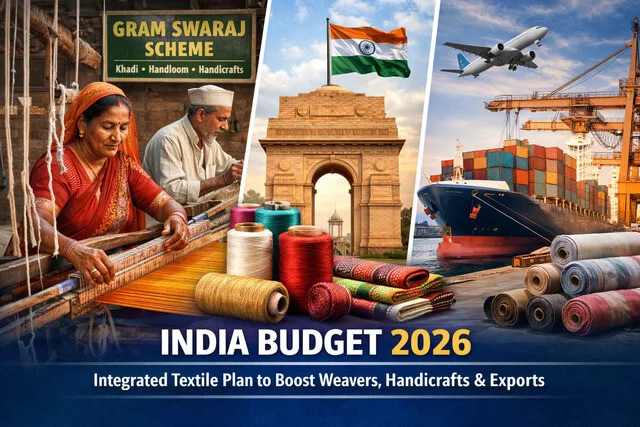
India’s Union Budget 2026 unveiled an integrated textile plan aimed at strengthening the country’s textile sector, modernising traditional crafts, and boosting global exports, the government announced on Thursday.
The plan places particular emphasis on the Gram Swaraj scheme, which is designed to empower rural weavers and artisans by providing training, quality enhancement, branding support, and access to international markets. The initiative is expected to increase income opportunities for handloom and handicraft communities while promoting India’s traditional textiles globally.

Finance Minister Nirmala Sitharaman highlighted a five-part strategy covering the entire textile value chain, from raw material production to export promotion. The strategy, dubbed “5F” — Farm, Fibre, Factory, Fashion, Foreign — aims to ensure self-sufficiency in natural and man-made fibres, modernise manufacturing units, support design and branding, and expand India’s presence in global markets.
A key component of the plan is the National Fibre Scheme, which will increase domestic production of cotton, silk, wool, jute, and other fibres while reducing import dependence. Another initiative, the Textile Expansion and Employment Scheme, will provide financial support for machinery upgrades, technology adoption, and shared testing and certification facilities, enhancing productivity and job creation across the sector.
Also Read: Pakistan Court Suspends GIDC Recovery from Textile Mills
The budget also emphasises skills development through Samarth 2.0, a programme designed to produce industry-ready talent by linking training institutes with textile manufacturers. Additionally, the government announced the creation of mega textile parks with a focus on technical textiles, aiming to attract investment and boost export competitiveness.
The integrated approach is expected to strengthen the traditional sector while supporting modernisation and sustainability, ultimately increasing employment opportunities and export earnings for India’s textile industry.
Industry experts welcomed the move, noting that a coordinated policy targeting weavers, handloom clusters, and export markets could improve the competitiveness of Indian textiles globally.
“By linking rural artisans to international markets and modernising production, India is positioning its textile sector for sustainable growth,” said Ramesh Kumar, a textile industry analyst in New Delhi.
The Union Budget 2026 signals the government’s intent to combine heritage and innovation, with the textile sector serving as a critical engine for rural employment, manufacturing growth, and export expansion.