

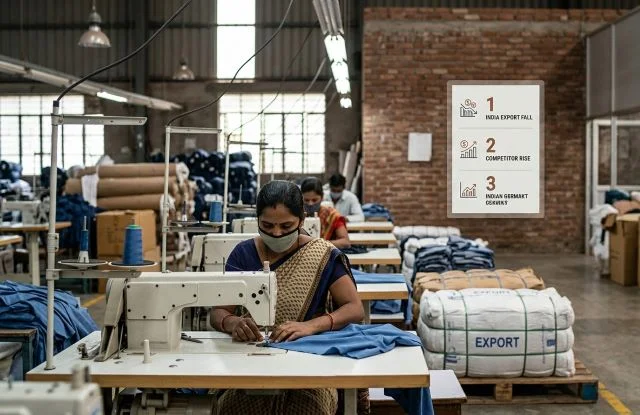
India’s textile and apparel exports to the United States plunged sharply in February, reflecting the lingering effects of tariff disruptions and subdued demand, even as some Asian competitors showed resilience.
Imports from India dropped 28.7% year-on-year, a steeper fall than Bangladesh’s 16.4% decline, while Vietnam managed to post a 5% increase, according to data from the Office of Textiles and Apparel. China recorded the sharpest contraction, with shipments to the US falling 45.2%, highlighting the uneven impact of trade measures across key sourcing hubs.

The latest figures underscore a growing concern among exporters that India is steadily losing market share in the US to regional rivals, particularly Bangladesh and Vietnam, which continue to attract buyers seeking stability and cost competitiveness.
Industry experts say the downturn reflects both cyclical demand weakness and structural shifts in global sourcing strategies. Buyers, wary of tariff volatility and supply chain risks, have diversified procurement away from traditional suppliers, a trend that appears to have accelerated over the past year.
“The US trade data shows India is losing share faster than Bangladesh, while Vietnam is consolidating gains,” said Chandrima Chatterjee, secretary general of the Confederation of Indian Textile Industries.
The decline comes despite a rollback of additional US tariffs in February 2026, suggesting that the policy shift has yet to translate into a meaningful recovery in orders. Exporters note that the textile trade operates on long lead times, typically ranging from 90 to 120 days, delaying the visible impact of policy changes on shipment data.
“A lot of US buyers have moved away from India to hedge their risks due to the high tariffs,” said Rajat Jaipuria, managing director of Rajalaxmi Cotton Mills. “We are struggling to get them back, and have recovered only about 40% of our US buyers so far.”
Exporters expect a gradual pickup in shipments from May or June, as new orders placed after the tariff rollback begin to flow through the supply chain. However, the pace of recovery remains uncertain amid weak consumer demand in the US.
Analysts say US textile imports overall were lower in 2025 compared with the previous year, as tariff-driven inflation eroded purchasing power and dampened retail demand. This has added further pressure on exporting nations already grappling with cost inflation and margin constraints.
“The decline is essentially the fallout of earlier tariff measures,” said Sanjay Jain of the Indian Chamber of Commerce. He added that the February data reflects shipments made before the tariff rollback took effect, suggesting that the sharp contraction may ease in coming months.
Still, industry bodies caution that the slowdown is not purely cyclical. Structural challenges, including higher production costs and limited scale advantages compared to competitors like Vietnam, have made it harder for Indian exporters to retain orders in a highly price-sensitive market.
Also Read: India–UK FTA Set for May Rollout, EU Deal Eyed by Year-End
The impact is already visible in corporate earnings. Companies with significant exposure to the US market have reported sharp declines in profitability, driven by underutilised capacity, high fixed costs, and limited ability to pass on rising expenses to buyers.
According to the Confederation of Indian Textile Industries, several listed apparel and home textile firms saw profit-after-tax growth drop by more than 50% in recent quarters, reflecting a combination of demand compression and margin pressures.
As global buyers continue to rebalance sourcing strategies, exporters are increasingly focusing on competitiveness, supply chain resilience, and diversification into alternative markets. While the tariff rollback offers some relief, industry executives warn that regaining lost ground in the US market will take time, particularly as competitors strengthen their foothold.
For now, the February data serves as a stark reminder of how quickly trade policy shifts can reshape global supply chains—and how difficult it can be for exporters to win back lost business.