

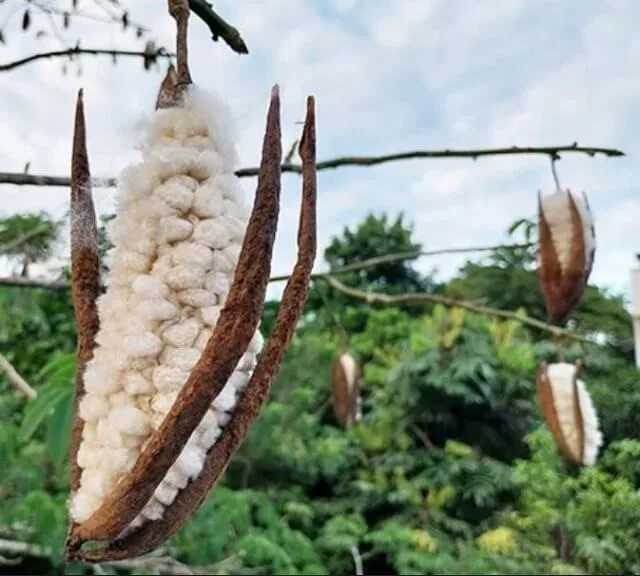
Kapok has a technical problem. It’s hard to spin, less elastic, and more breakable than hemp. It also has a reputation for being flammable. Can innovation overcome those issues to make this a viable fibre for circular clothing?
Kapok fibre is regional to South East Asia — a fluffy ball of fibre produced in the seed pods of kapok trees that grow, on average, 50m tall, with some reaching as much as 77m. The fibres are similar in appearance to cotton: very soft, highly breathable, and very water-resistant. When submerged in water, the fibres are even more buoyant than cork due to their internal honeycomb structure, which also makes them excellent for thermoregulation and maintaining a lofty fill. Traditionally, these fibres have been used as filling in toys and life preservers for these reasons, before the invention of synthetic wadding, which largely replaced them.

Kapok’s reputation for being more flammable than cotton comes from its greater surface area and loft — both factors contributing to more available fuel and airflow for a fire, rather than the fibre being inherently flammable in the same way fossil fuel-based oils are, for example. Moisture levels managed through patented innovations can help this fibre act more like cotton and less like dry wood.
Also Read: Sustainability Only Works When It’s Measurable
The main difficulty lies in spinning. The fibres are shorter than cotton, and their fragility compounds the challenge — making it clear why kapok hasn’t yet become widely adopted. Companies such as Flocus have developed patented sorting and spinning technologies to address these limitations. Their process involves sorting fibres to an average length of 10–20 mm and increasing moisture content to around 8–17%, making the fibres easier to spin and broadening their potential applications.
The smooth surface of the fibre gives it a soft handfeel, similar to the “buttery soft” texture popularised by Lululemon through viscose-based fabrics. However, this same smoothness creates difficulties in knitting. Using natural waxes instead of paraffin-based ones has been found to reduce fibre shedding during knitting.
That said, it’s a fibre that doesn’t find many applications in 100% compositions outside of wadding. One reason, beyond spinning challenges, is that it doesn’t have the marketing narrative that fibres like linen and hemp do. Instead, blends are where you will most likely find this fibre. It complements other natural fibres well, enhancing performance aspects in applications like sportswear. At present, it’s unlikely to replace viscose as a blend in sportswear, mainly due to price and scalability issues within the supply chain. Like viscose, the trees take years to mature, making supply and demand management difficult. This is not unlike the scalability challenges viscose faced in the early 2000s as it rose in popularity — a period that saw new feedstocks such as bamboo emerge to fill demand gaps that even the rise of eucalyptus-based Tencel couldn’t fully meet.
Also Read: Trump’s Tariffs and Beyond – Robert Antoshak on Trade, Tariffs and Transformation
Another reason that blends are preferable is that kapok is hydrophobic, making it challenging to dye — much like synthetic fibres. However, synthetics make up around 70% of global fibre production for apparel, and considerable investment over the last 70 years has improved their dyeability. In 2008, Shanghai University patented a rare-earth mineral mordant that improved colourfastness in both acid and reactive dyeing for kapok.
Why, given the challenges, would we want to use kapok fibre in apparel? Especially when there are other uses — such as its oil being used in soap manufacturing, and its flowers serving as a natural dye for wool products, lowering the carbon footprint of wool fabrics when fixed with a bio-mordant.
The fibre has a much lower chemical and energy footprint than viscose, which it could potentially replace in sportswear if pricing becomes comparable. The kapok tree is part of a regenerative rainforest ecosystem, protecting small trees and vegetation, supporting carbon sequestration, and helping prevent desertification — which in turn reduces the water footprint compared to fibres such as cotton.
As global warming changes weather patterns in ways we can’t fully predict, yields of natural fibres will shift accordingly. How trees adapt compared to agricultural crops remains to be seen. Interestingly, kapok trees have already adapted in unique ways: their flowers are pollinated not only by bees but also by bats, which can travel far greater distances. As climate change forces species to migrate — with trees estimated to need to move around five miles per year to survive, while currently migrating only about one — this pollination advantage could help kapok spread and improve its scalability. The downside is that kapok trees require well-drained soil, which may become increasingly scarce. Yet their contribution to biodiversity and climate resilience makes them a strong candidate for regenerative agricultural systems, provided soil health and water availability are maintained.
While it’s unlikely that kapok will become a mainstream apparel fibre within the next five years, its potential in blended fabrics could grow toward the middle of the century — especially if global temperatures rise beyond 2°C.
About the author

Samantha Taylor is a sustainability-driven expert in circular sportswear product development and sourcing. With extensive experience in the fashion and apparel industries, she helps brands rethink supply chains and integrate responsible materials and practices. Her insights and commentary have been featured in Vogue Business, Sourcing Journal and WTiN.








I learn something new from this article.