
The fashion industry’s path to decarbonization has reached a critical reality check. The Transformers Foundation released its latest deep-dive report, Unlocking Equity in Innovation: Balancing the Scales in Supply Chain Partnerships, arguing that the industry’s current innovation model is fundamentally broken because it expects suppliers to shoulder the majority of risk without the security of long-term commitment.
The report, draws on in-depth interviews with over 30 global stakeholders, identifies a massive disconnect between the ambitious sustainability targets set in corporate boardrooms and the operational hurdles faced by the global supply chain.

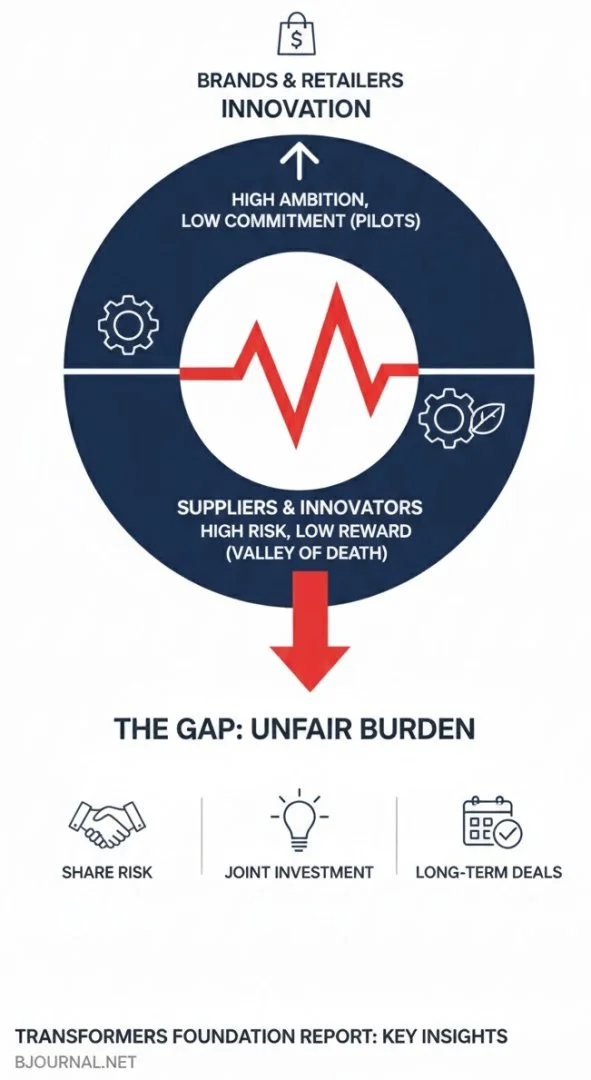
A central pillar of the findings is the Innovation Valley of Death. According to report, many climate-related technologies fail not because the science is faulty, but because they lack the financial bridge to scale from a pilot to commercial adoption.
The foundation notes that while brands are quick to announce innovative pilots, they are often hesitant to sign the multi-year off-take agreements that would give suppliers and investors the confidence to invest in necessary infrastructure. This gap between basic research and wide commercial adoption remains the largest hurdle for future-focused investments.
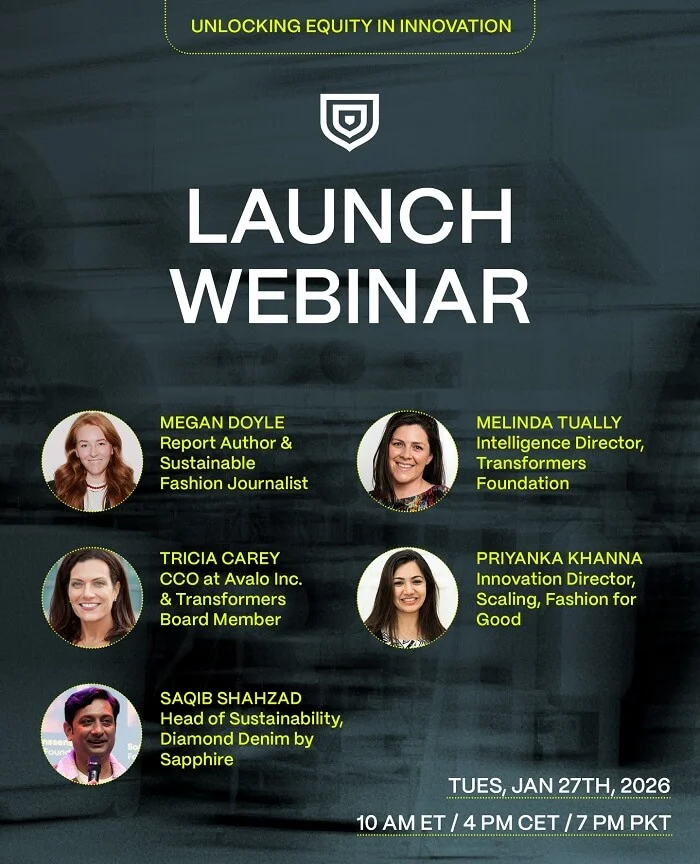
The report was published on a webinar that featured a panel of industry veterans who echoed the call for a systemic shift in how brands and suppliers interact. The discussion brought together voices from across the value chain, led by Melinda Tually, Intelligence Director at the Transformers Foundation.
She was joined by report author Megan Doyle, as well as Tricia Carey, CCO at Renewcell and Board Member of the Transformers Foundation, Priyanka Khanna, Innovation Director of Scaling at Fashion for Good, and Saqib Shahzad, Head of Sustainability at Diamond Denim by Sapphire. Together, they addressed the “inefficient brand commitment” that currently plagues the sector and leaves the linchpins of innovation in a precarious position.
“The future of fashion innovation will be defined by the strength of its relationships,” said Tricia Carey. “Equity, transparency, and long-term thinking aren’t optional, they’re the foundation of scalable climate solutions,” she added.
The report outlines several primary friction points stalling the green transition. Brands often lack a technical understanding of the true cost and time required to implement new solutions on a factory floor, leading to misaligned expectations.
Furthermore, despite being the primary value creators, suppliers are frequently excluded from early-stage development discussions. This isolation is compounded by a capital gap where small-to-medium suppliers cannot access the funding needed for green retrofitting without guaranteed orders from their brand partners.
The “Valley of Death” Problem
A central pillar of the findings is the “Innovation Valley of Death.” According to report author Megan Doyle, many climate-related technologies—from bio-based fibers to waterless dyeing—fail not because the science is faulty, but because they lack the financial bridge to scale from a pilot to commercial adoption.
The foundation notes that while brands are quick to announce “innovative pilots,” they are often hesitant to sign the multi-year off-take agreements that would give suppliers and investors the confidence to invest in the necessary infrastructure.
Key Barriers to Progress
The report outlines three primary friction points currently stalling the “green transition”:
✓ Misaligned Expectations: Brands often lack a technical understanding of the “true cost” and time required to implement new solutions on a factory floor.
✓ Undervalued Suppliers: Despite being the “linchpins of innovation,” suppliers are frequently excluded from early-stage development discussions.
✓ The Capital Gap: Small-to-medium suppliers often cannot access the capital needed for green retrofitting without guaranteed orders from their brand partners.
The Path Forward: Pre-Competitive Collaboration
To bridge these gaps, the Transformers Foundation released a series of Readiness Checklists designed to help brands, suppliers, and startups vet their partnerships before signing a contract.
“Sustainability credentials are not enough to move the needle,” the report states. “Innovators need to demonstrate a strong business case for brands and retailers… a shared opportunity for all stakeholders to develop.”
The consensus among the panelists was clear that if the industry wants to meet its 2030 and 2050 climate targets, the era of ‘pilot-itis’ must end, replaced by a model where risk is shared as equitably as the reward.