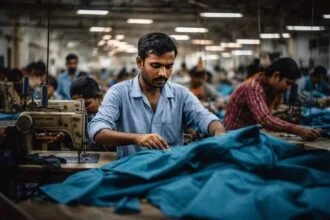


As Bangladesh’s export sectors brace for the amended Bangladesh Labour Ordinance 2025, anxiety is rising across the apparel and textile value chain. BGMEA, BKMEA and BTMA have jointly demanded its withdrawal, arguing the final version differs sharply from what was agreed in the Tripartite Consultative Committee (TCC). Industry leaders warn that drastic changes — especially the steep reduction in union-formation thresholds — could destabilise factories already battling global demand volatility, geopolitical pressures and post-LDC graduation challenges.
To examine the operational and strategic implications, Fashion Business Journal (FBJ) spoke with Md.Qamruzzaman, Director of Fun Factory Ltd and Functional Apparel Co. Ltd., Hong Kong, and Country Director of Logonet (Thailand) Co. Ltd. for Bangladesh, India and Pakistan. He shares a frank, experience-led perspective on union readiness, operational risks, LDC timing and buyer responsibility.

FBJ: How prepared is the industry for the sharply reduced union-formation thresholds?
Md.Qamruzzaman: No industry in Bangladesh — including garments — is prepared for this sudden drop in union-formation thresholds. This is not the right time for such a major step, especially one related to worker issues.
From my experience visiting factories in many countries, workers elsewhere understand what a union is and how it benefits them. They value their workplace and productivity, knowing that without production, a union cannot deliver bread and butter. Here, the first priority should be education: workers must understand what a union truly means. When that learning happens, responsible worker representation will naturally increase.
Also Read: ‘This Labour Law Reform Could Destabilise Factories’- Salauddin Chowdhury
FBJ: Will multiple unions inside a single factory create operational or negotiation problems?
Md.Qamruzzaman: Yes, multiple unions will create serious operational and negotiation complexity. Many of our workers are under-educated, which makes them vulnerable to being influenced by negative local practices. Some worker leaders are also linked to geopolitics through international NGOs, and certain lower-level political actors are involved in the sector for personal gain.
These issues directly hurt productivity and make daily resolution or management nearly impossible. In the long run, this kind of pressure can push factories toward financial crisis and potential closure.
FBJ: Does the timing of this reform align with industry realities, especially with LDC graduation approaching?
Md.Qamruzzaman: I have repeatedly urged the concerned authorities to delay LDC graduation. Even one year ago, I informed the government that Bangladesh is not ready. If LDC graduation proceeds now, the after-effects will be difficult for the country to absorb. So, the timing of this labour reform does not match the industry’s current reality.
LDC graduation depends on three criteria:
- Per capita income
- Human Development Index
- Economic Vulnerability Index
The third point gives Bangladesh room to explain that global financial instability has reduced consumer purchasing power worldwide, including at home. Bangladesh should request an additional 5 to 7 years of transition time for LDC graduation.
Also Read: “DPP will reshape the entire supply chain — we must be ready”
FBJ: What do you expect from global buyers under the new labour obligations?
Md.Qamruzzaman: To be honest, Bangladesh has the world’s highest number of green factories, yet global buyers never pay extra for that — even though these factories are fully compliant.
“DPP will reshape the entire supply chain — we must be ready”
Long-term sustainability with buyers is essential, but factory owners alone cannot achieve it. We need industry-friendly laws, a corruption-free export and import process and proper banking operations. After export, banks must collect payments correctly from bank to bank.
If these systems work properly, sustainability and compliance will follow. Then global buyers will naturally start paying the fair value of the product.