
Pakistan’s textile and apparel sector remained the backbone of the country’s exports in the first five months of fiscal year 2025–26, defying a broader contraction in national trade, but new data shows the recovery is fragile and increasingly threatened by structural cost pressures and policy uncertainty.
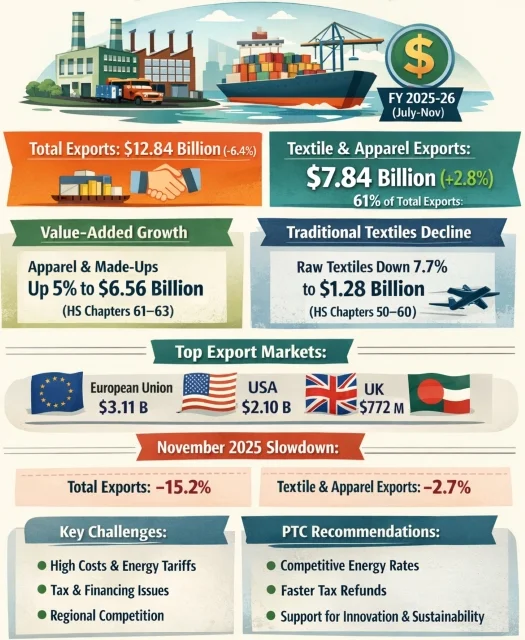
According to the Pakistan Textile Council’s (PTC) Export Data Analysis Report for July–November 2025, Pakistan’s overall exports fell 6.4% year on year to $12.84 billion, reflecting persistent macroeconomic stress and weak external demand. In contrast, textile and apparel exports rose 2.8% to $7.84 billion, accounting for around 61% of total exports and underlining the sector’s outsized role in sustaining foreign exchange earnings

The report shows that growth continues to be driven almost entirely by value-added segments, while traditional upstream textiles face a prolonged decline. Exports of apparel and made-up textiles, classified under HS Chapters 61–63, increased 5% to $6.56 billion during the July–November period. Knitwear, woven apparel and other made-up articles all posted gains, highlighting Pakistan’s gradual shift toward higher value products
Traditional textile exports under HS Chapters 50–60 fell 7.7% to $1.28 billion, extending a multi-year downward trend. Cotton, man-made filaments, knitted fabrics, and carpets all recorded double-digit declines, reflecting weaknesses in raw material productivity, cost competitiveness, and global demand for lower value inputs
Momentum weakened sharply in November 2025, signalling that the recovery may be losing steam. Total exports dropped 15.2% year on year and 15.8% month on month to $2.40 billion, while textile and apparel exports fell 2.7% from a year earlier and 11.7% from October levels. Value-added exports also slipped monthly, suggesting rising pressure from costs and slowing orders in key markets
Market-wise, the European Union remained Pakistan’s largest textile and apparel destination, with exports rising to $3.11 billion in the first five months of FY26. The United States followed at $2.10 billion, while the United Kingdom recorded exports of $772 million. Bangladesh and the United Arab Emirates rounded out the top five destinations, with exports of $277 million and $272 million, respectively.
Also read: Bangladesh Garment Exports to US Surge 15%
However, the report flags emerging weaknesses at the product level even within these core markets. Exports of key apparel lines such as cotton men’s ensembles, knitted T-shirts, gloves and certain home textile products declined in the EU, US and UK, raising concerns about Pakistan’s ability to defend market share amid intensifying regional competition
In Bangladesh, Pakistan’s exports remain heavily concentrated in raw materials such as cotton yarn and fabrics, limiting value capture and exposing exporters to price volatility. In the UAE, demand has been uneven across both apparel and fabric categories, adding another layer of uncertainty for exporters targeting the Middle East
PTC said the data points to a widening divergence within the textile value chain. While value-added exports continue to show resilience, structural domestic constraints are eroding competitiveness relative to regional peers, particularly Bangladesh and Vietnam. Uncompetitive energy tariffs, rigid labour cost structures, tax frictions, and limited access to affordable financing were identified as the main factors squeezing margins and discouraging long-term investment
The council warned that without urgent policy intervention, Pakistan risks losing the modest gains made in recent years. It called for regionally competitive and predictable energy pricing for export-oriented industries, faster and automated tax refunds to ease cash-flow pressures, and rationalisation of labour costs and overtime rules in line with benchmark competitors
To sustain momentum in value-added exports, PTC recommended targeted, time-bound incentives linked to incremental value addition and compliance with environmental, social, and governance standards. At the same time, it urged deep-rooted reforms to revive upstream segments, including improving cotton quality and productivity, and lowering operating costs for spinning and weaving units
Access to finance was also flagged as a critical bottleneck. The report called for strengthening export financing schemes, expanding long-term financing facilities, and scaling up support for innovation, renewable energy, and sustainability investments to help exporters meet rising compliance and decarbonisation requirements from global buyers
At a broader level, PTC stressed the need for policy continuity, recommending a legally protected five-year export and industrial policy framework to replace ad-hoc measures and restore investor confidence. Transparent monitoring and regular publication of performance indicators would be essential to rebuild credibility, the council said.
The findings underscore the central role of textiles and apparel in Pakistan’s economy, but also highlight how narrow and fragile the export base has become. With overall exports contracting and traditional textiles in decline, the sector’s ability to sustain growth will depend less on external demand and more on whether long-standing domestic constraints are finally addressed.