
Bangladesh’s ready-made garment (RMG) industry has grown into a global manufacturing powerhouse over the last three decades, yet its raw material ecosystem remains structurally imbalanced. Despite exporting billions of dollars’ worth of apparel annually, the country has failed to build a strong, self-sustaining yarn and textile value chain, leaving the sector heavily dependent on imported inputs and policy-driven privileges rather than industrial competitiveness.
Over the past 35 years, garment manufacturers have largely operated as OEM producers for foreign brands, focusing on volume-based exports instead of developing globally competitive Bangladeshi apparel brands or strengthening backward linkages. As a result, a significant share of value addition continues to leak abroad, particularly through yarn and fabric imports. Bangladesh now imports more than 12 million tonnes of yarn annually, with nearly 95 percent sourced from India, underscoring the depth of this dependency.

The bonded warehouse system, originally introduced to support export competitiveness, has played a central role in this imbalance. While duty-free access to imported yarn reduces immediate costs for exporters, weak monitoring and overly generous wastage allowances have created scope for misuse. Internationally accepted production wastage typically ranges between 8 and 12 percent, yet in Bangladesh allowances have gone as high as 32 percent in some cases. This gap has enabled bonded yarn and fabric, meant strictly for export production, to enter the domestic market, undermining local spinners and causing revenue losses for the state.
At the same time, domestic spinning mills face structural disadvantages that go beyond tariff policy. Although Bangladesh has a sizeable spinning capacity, chronic gas shortages, rising energy costs, reduced cash incentives, and low capacity utilization have made local yarn more expensive and less reliable than imports.
Many mills operate far below optimal production levels, eroding competitiveness and discouraging garment manufacturers from sourcing locally. The payment structure further exacerbates the problem, as imported yarn is often paid for at sight through letters of credit, while local suppliers are forced to accept delayed payments stretching up to ten or twelve months.
This growing reliance on imported yarn weakens the logic of value addition that underpins Bangladesh’s export-led growth model. While garment exports continue to rise, the increasing import bill for raw materials puts pressure on foreign exchange reserves and reduces the domestic economic multiplier. At the same time, demands from sections of the industry to avoid scrutiny on import-export ratios, value addition, or port-level verification run counter to global trade norms and risk institutionalizing opacity rather than efficiency.
The current debate over withdrawing bonded warehouse facilities for certain yarn categories reflects this broader tension. On one hand, garment exporters argue that higher duties will erode competitiveness in an already tight global market.
On the other, unrestricted bonded access without strict enforcement threatens the survival of local spinning mills and distorts fair competition. International experience shows that bonded systems exist in many exporting countries, but they are tightly linked to export performance and enforced with zero tolerance for domestic leakage—an area where Bangladesh remains weak.
Also read: Bangladesh Garment Exporters Demand Reversal of Bonded Import Change
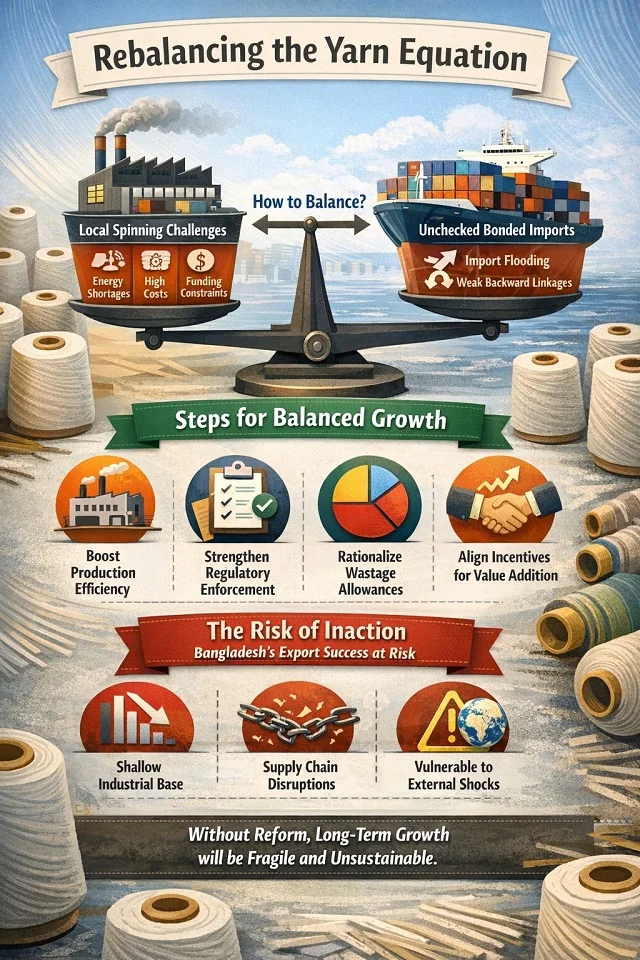
The real challenge, therefore, is not simply whether bonded facilities should exist, but how they are governed and complemented by industrial policy. Restricting imports without addressing energy shortages, cost inefficiencies, and financing constraints in local spinning will not make domestic yarn competitive. Conversely, allowing unchecked bonded imports risks hollowing out the country’s backward linkage industries altogether.
Rebalancing the yarn equation requires a coordinated approach that improves local production efficiency, restores confidence in regulatory enforcement, rationalizes wastage allowances based on actual data, and aligns incentives with genuine value addition. Without such reforms, Bangladesh risks sustaining export growth at the cost of long-term industrial depth, leaving its apparel success increasingly vulnerable to external shocks and supply-side disruptions.
Also, policymakers must recognize that Bangladesh is no longer a single-source destination for global buyers or investors. Brands are increasingly diversifying their sourcing across multiple countries, and low labour costs alone are no longer decisive. In this multi-country sourcing era, policy stability, reliability, energy security, and value addition will determine Bangladesh’s competitiveness.