
Bangladesh stands today not just as a nation of rich heritage, legacy, and history, but as an economic story of extraordinary resilience and transformation. From its independence to the present day, our country has evolved into a major developing mixed economy characterized by impressive growth and an unyielding spirit of enterprise. At the heart of this journey lies the ready-made garment (RMG) and textile sector, a powerhouse of national progress that has driven export success, socio-economic change, and global recognition.
Over the past four decades, Bangladesh’s RMG industry has grown from a fledgling export sector into the world’s second-largest apparel exporter, earning tens of billions of dollars in foreign exchange, contributing significantly to the country’s GDP, and employing millions of workers, many of whom are women from rural communities. This growth has not only boosted economic indicators but has also reshaped lives, lifted families out of poverty, and catalysed urban and rural development.

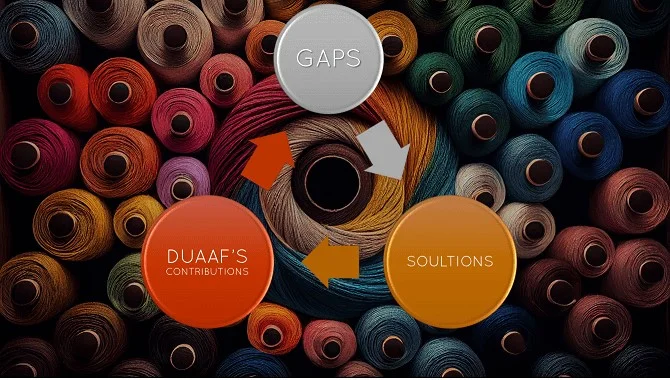
Yet, with great achievement comes the responsibility to address critical structural gaps that now define the crossroads at which our industry stands. As we strive to transition from a cost-driven model to a value-driven ecosystem, it is essential to confront these challenges honestly and strategically.
One of the most pressing systemic gaps is the leadership deficit within the sector. While the industry boasts operational excellence at scale, it often lacks strategic and visionary leadership at senior and mid-management levels — leadership capable of steering firms through global uncertainties, digital transformation, and stakeholder expectations. Alongside this, there is a noticeable weakness in negotiation capacity, limiting industry players’ ability to secure favourable contracts and long-term partnerships with global buyers, suppliers, and service providers.
Also Read: DUAAF Installs New Executive Committee
Cost management remains another core concern. Rising global costs — from energy to logistics — demand more rigorous financial discipline and innovative approaches to efficiency. Coupled with a fragmented value chain, where synergy between spinning, dyeing, finishing, manufacturing, and exporting remains sub-optimal, the ability to compete at higher value markets is constrained. Adoption of analytics and data-driven decision-making, better financial transparency, and industry-wide process innovation are no longer optional; they are prerequisites for sustainable growth.
Perhaps most critically, there is an ongoing dependency on imported specialized skills and expertise, which limits domestic capacity building. While international talent contributes to capacity expansion, over-reliance on it inhibits knowledge transfer and long-term self-reliance. Cultivating local talent with deep technical, managerial, and innovation competencies is essential for the next phase of development.
Addressing these gaps demands collective vision and action — not just within factories or boardrooms, but across networks of professionals who are committed to shaping the future of the apparel and textile ecosystem. It was with this understanding that we conceived the Dhaka University Apparel Alumni Foundation (DUAAF).
DUAAF was created to unite visionary alumni of Dhaka University who are actively shaping the global RMG and textile sectors. Our membership spans professionals and entrepreneurs across buying houses, manufacturing, accessories, merchandising, human resources, compliance, and commercial operations. Together, we bring a rich diversity of perspective and experience — a collective force capable of influencing industry transformation at scale.
Our core mission is to cultivate leadership, foster collaboration, and champion professional growth across the entire apparel value chain. We are driven by a clear vision: to connect, inspire, and elevate Dhaka University alumni in the apparel and textile sectors, anchored on pillars of leadership, knowledge advancement, and sustainable development.
In practical terms, DUAAF is committed to facilitating knowledge-sharing platforms, including conferences, webinars, and roundtables that foster continuous learning. We aim to support research and advisory work that offers evidence-based insights and policy recommendations, helping organisations to adapt and lead in a rapidly changing global landscape.
Our immediate priorities include building a unified network that enhances professional excellence, establishing DUAAF as a trusted resource hub for industry stakeholders, standardising leadership and managerial capacity, and advocating for sustainable business practices that align with global expectations.
Also Read: Brands Must Stop Passing the Burden
What sets DUAAF apart is not only our connection to a strong academic tradition but our relentless focus on industry relevance and impact. We recognise that the future of Bangladesh’s apparel and textile sectors requires leaders who are not only competent in operational execution but also visionary in addressing global trends such as digitalisation, sustainability, and market diversification.
In closing, the road to bridging industry gaps is both a challenge and an opportunity. By acknowledging where we must strengthen, and by cultivating a community that champions excellence, innovation, and shared purpose, we can ensure that Bangladesh’s RMG and textile sectors do not merely sustain their success — they redefine what is possible.