
The global employment landscape is undergoing a fundamental transformation. For decades, academic degrees, institutional reputations, and formal certifications were considered the primary gateways to professional success. Employers relied heavily on credentials as indicators of competence, discipline, and potential. However, this long-standing model is rapidly giving way to a new reality—one in which practical skills, adaptability, and real-world problem-solving abilities matter more than paper qualifications.
Across industries and geographies, organizations are increasingly recognizing that degrees alone do not guarantee job readiness or long-term performance. Instead, the ability to apply knowledge effectively, learn continuously, and deliver measurable outcomes has become the true currency of employability.

This shift toward skill-based hiring is not merely a trend; it reflects deeper changes in how work is structured, how technology evolves, and how businesses compete in a fast-moving global economy.
The Global Shift Toward Skill-Based Hiring
A recent opinion piece published in NewsDay Zimbabwe clearly captures this global transition. Writing on January 3, 2026, author Innocent Hadebe notes: “Companies that hire for skills over credentials will position themselves for growth.” He emphasizes that organizations prioritizing competencies rather than formal qualifications benefit from higher productivity, stronger innovation, and greater long-term stability. (NewsDay Zimbabwe, Jan 3, 2026)
Hadebe’s argument reflects a growing consensus among employers worldwide. When hiring decisions are based on demonstrable skills, companies are better able to match talent with actual job requirements. This reduces costly hiring mistakes, shortens onboarding periods, and improves overall workforce performance.
Also Read: Capturing High-Margin Fashion: Bangladesh’s Strategy
Global research further reinforces this perspective. According to Forbes (December 26, 2024), 90% of companies report better performance and fewer hiring errors when they focus on skills rather than academic degrees. This data highlights an important truth: degrees may indicate exposure to knowledge, but skills demonstrate the ability to use that knowledge effectively in real-world situations.
In a business environment shaped by digital transformation, automation, and artificial intelligence, roles evolve faster than traditional education systems can adapt. As a result, employers increasingly value candidates who can learn quickly, solve complex problems, and contribute immediately—regardless of where or how they acquired their skills.
Why This Shift Matters for Bangladesh
For Bangladesh, this global transition presents a significant and timely opportunity. The country has a large and growing population of educated young people, many of whom face intense competition in the domestic job market. Traditional pathways—government jobs, corporate positions, or degree-dependent roles—are limited and often oversaturated.
Skill-based hiring opens an alternative route. Bangladeshi professionals who develop strong, market-relevant skills can compete directly in the global labor market. Fields such as technology, software development, UI/UX design, data analysis, digital marketing, healthcare support services, customer experience management, and project coordination are increasingly open to international talent—especially through remote work arrangements.
The rise of freelancing, remote employment, and cross-border collaboration means that physical location is no longer a barrier. Skilled professionals in Bangladesh can now work with employers and clients in the United States, Europe, Canada, Japan, Singapore, and Australia without leaving the country. This has profound implications for income growth, career mobility, and national economic development.
The Role of Digital Platforms and Visibility
In a skills-first hiring environment, how candidates present their abilities matters as much as the abilities themselves. Unlike traditional resumes that focus on degrees and job titles, skill-based recruitment relies heavily on portfolios, project histories, and online visibility.
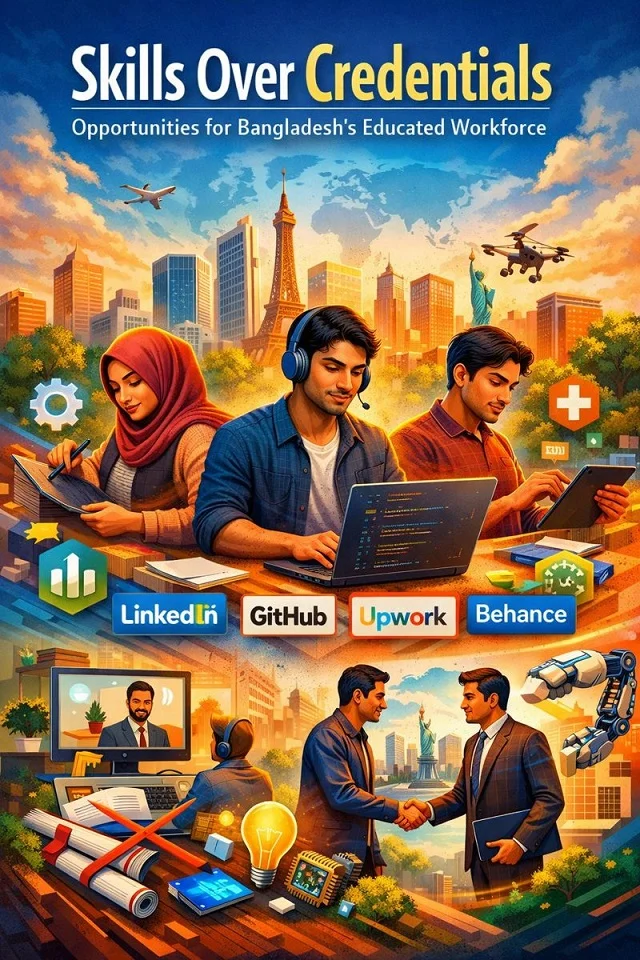
Bangladeshi job seekers can significantly improve their global competitiveness by building strong digital profiles. Platforms such as GitHub allow developers to showcase real code and contributions. Behance enables designers to display visual and creative work. Upwork and similar freelance marketplaces provide proof of client experience and performance. LinkedIn serves as a professional identity hub where skills, certifications, projects, and endorsements come together.
What matters most is evidence—completed projects, problem-solving examples, measurable outcomes, and continuous learning. Employers increasingly ask not “Where did you study?” but “What can you do?” and “What have you already done?”
Real Success Stories and Emerging Trends
There are already numerous examples of Bangladeshis achieving international success through skills rather than credentials. In sectors such as IT services, software engineering, graphic design, animation, digital marketing, and e-commerce support, many professionals have built global careers without relying on elite degrees.
These success stories demonstrate that talent, when paired with the right skills and exposure, can overcome traditional barriers. They also highlight the importance of self-learning, online courses, certifications, and hands-on experience in today’s job market.
Looking ahead, the rise of artificial intelligence and automation will further accelerate this shift. Routine, credential-based roles are more likely to be automated, while jobs requiring creativity, analytical thinking, emotional intelligence, and complex decision-making will grow in importance. In this context, degrees alone will not guarantee employment, but adaptable skills will.
Rethinking Education and Career Development
This does not mean that academic qualifications have lost all value. Degrees still provide foundational knowledge, critical thinking frameworks, and social credibility. However, they are no longer sufficient on their own.
For Bangladesh’s educated workforce, the key lies in complementing formal education with continuous skill development. Learning software tools, mastering industry-relevant technologies, gaining project-based experience, and staying updated with global standards are essential steps.
Educational institutions, policymakers, and employers also have a role to play by aligning curricula with market needs, encouraging internships and apprenticeships, and supporting skill-focused training programs.
A Strategic Opportunity for Bangladesh
The global move toward skills over credentials represents more than a hiring trend—it is a structural shift in how talent is valued. For Bangladesh, this shift offers a powerful opportunity to position its workforce on the global stage.
While academic degrees remain useful, it is practical skills, problem-solving ability, adaptability, and real-world experience that will increasingly determine career success. By investing in skill development and effectively showcasing competencies through global platforms, Bangladeshi professionals can access international opportunities, improve income prospects, and contribute to the country’s reputation as a hub of capable, future-ready talent.
In a skills-driven world, Bangladesh’s greatest asset may not be its degrees, but the untapped potential of its people.
About the Author
Md. Salauddin is Director of Reaz Garments Ltd, while also serving as an advisor to the Textiles and Garments Merchandise Blog Bunon, he actively contributes insights on sustainability, sourcing, and industry transformation. He is also Advisory Board Member of Fashion Business Journal.

He carries forward a remarkable legacy: his father, Mohammad Reazuddin, founder of Reaz Garments, is widely recognized as one of Bangladesh’s first ready-made garment exporters. In 1978, Reaz Garments shipped 10,000 shirts to France, a milestone that helped lay the foundation of Bangladesh’s RMG industry.
Building on this pioneering heritage, Salauddin combines deep industry knowledge with a commitment to innovation, knowledge sharing, and global competitiveness for Bangladesh’s apparel