

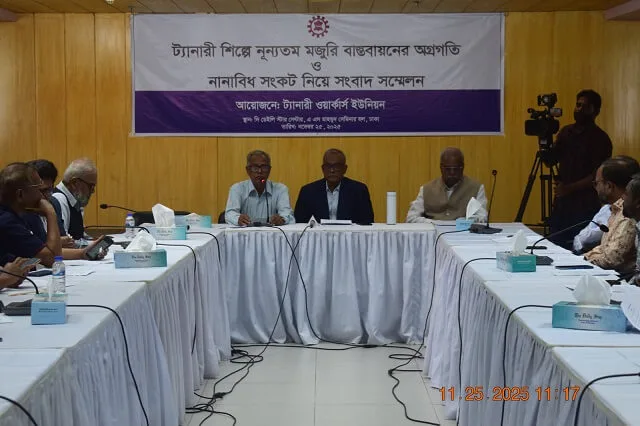
Thousands of tannery workers across Bangladesh are raising the alarm as the leather industry faces a deepening crisis marked by delayed minimum-wage implementation, alleged mass firings, and growing uncertainty triggered by proposed regulatory changes.
Speaking at a press conference in Dhaka on Tuesday, leaders of the Tannery Workers Union (TWU) condemned the failure of many factory owners to honour the government-declared minimum wage, which was gazetted more than a year ago.

Although the newly approved wage scale set the minimum monthly wage at roughly Tk 18,001, workers report they continue to earn far less — often as little as Tk 8,000–10,000 per month.
Also Read: New Labor Rules: What the Industry Fears Most
The union said repeated delays, “lengthy negotiations,” and stalling tactics by owners have left workers — many of whom have worked for years — in limbo. Long-serving employees are reportedly being reclassified as ‘temporary,’ a move that effectively denies them the government-mandated wage and other statutory benefits.
In addition to the wage issue, union leaders voiced concern over mass layoffs and the increasing use of informal contractors — a shift that undermines job security, weakens collective bargaining power, and leaves workers increasingly vulnerable.
Compounding the crisis is growing uncertainty over proposed regulatory changes — including bringing tanneries under stricter controls by classifying them under a different trade regime. The union warns such a move could further jeopardize the already precarious livelihoods of workers, and weaken union protections.
Advocates and labour experts say the industry’s struggles reflect deeper structural problems — including weak enforcement of labour laws, lack of social protection, and insufficient compliance with global labour-standards.
If unresolved, they warn the crisis could erode investor confidence, damage export potential, and hurt Bangladesh’s ambitions to turn its leather sector into a competitive export powerhouse.