
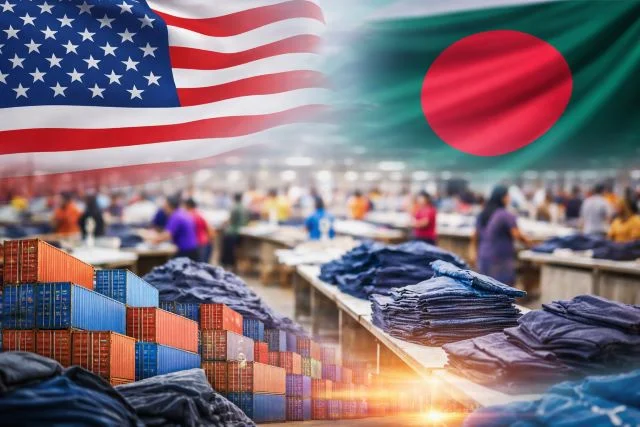
Major American apparel trade groups are pressing for the rapid refund of billions of dollars in import taxes following a landmark U.S. Supreme Court ruling that struck down sweeping tariffs imposed under the International Emergency Economic Powers Act (IEEPA). This move could ease costs for retailers and potentially boost orders for Bangladesh’s garment exporters.
The American Apparel and Footwear Association (AAFA) and the United States Fashion Industry Association (USFIA), which represent hundreds of fashion brands, retailers, and importers, welcomed the court’s decision and called for a streamlined refund mechanism to return tariff payments to businesses that had been collected under the disputed policy.

The Supreme Court ruled in a 6–3 decision that the IEEPA does not grant the U.S. president authority to impose broad tariffs, invalidating duties that had been applied to goods from multiple countries and sectors. The ruling opened the door for potentially massive refunds to companies that had paid the levies over the past year.
Subsequent legal developments have reinforced that outcome. A federal trade court has already indicated that companies could be entitled to refunds worth as much as $175 billion, while the U.S. Customs and Border Protection agency has been tasked with designing a system to process the claims.
For American fashion companies, which already face some of the highest import duties among consumer goods categories, the decision could significantly ease financial pressure.
AAFA President and CEO Steve Lamar said the organization expects the U.S. Customs and Border Protection agency to move quickly to guide on obtaining refunds. The group also urged policymakers to consult industry stakeholders before introducing any future tariff measures.
The AAFA represents companies across the apparel, footwear, and sewn-products sector that collectively generate more than $523 billion in annual retail sales in the United States.
The USFIA also welcomed the ruling, describing it as a major win for businesses and consumers.
USFIA President Julia Hughes said the decision would help reduce uncertainty in the fashion supply chain and improve affordability for American shoppers. She noted that apparel and footwear already face higher tariffs than most other consumer goods categories, making the removal of additional duties particularly significant.
Hughes called on the administration to implement an efficient and automatic refund system that would return more than $133 billion in tariffs collected under the IEEPA program.
The implications of the decision extend beyond the U.S. retail market and could ripple through global apparel supply chains.
Bangladesh, the world’s second-largest exporter of ready-made garments after China, is watching the developments closely. Industry leaders in the country say American buyers may increase sourcing if their financial position improves after receiving tariff refunds.
The United States remains Bangladesh’s largest single-country export market for garments. According to trade data, Bangladesh shipped about $8.2 billion worth of apparel to the U.S. last year, recording nearly 11.75 percent year-on-year growth despite a broader slowdown in American clothing imports.
Earlier data from the U.S. Office of Textiles and Apparel (OTEXA) also showed strong growth in Bangladeshi exports to the American market, with shipments increasing significantly in recent years as buyers diversified sourcing away from China.
Also read: US Eyes 15% Global Tariff Hike this Week
Shovon Islam, managing director of Bangladesh-based manufacturer Sparrow Group, said the court ruling could help improve buyers’ purchasing capacity.
“American buyers had reduced order volumes when tariffs increased because the added costs weakened consumer demand and forced them to adjust purchases within existing budgets,” Islam said.
If the tariffs paid by retailers are refunded, their financial position will improve and they may increase sourcing volumes again, he added.
Bangladeshi exporters also see an opportunity as global sourcing patterns shift. Rising trade tensions and higher tariffs on Chinese goods have prompted many fashion brands to diversify supply chains toward alternative manufacturing hubs in Asia.
Industry analysts say Bangladesh, Vietnam and several South Asian producers have benefited from this trend as buyers seek competitive costs and stable sourcing options.
Even during periods of tariff uncertainty, Bangladesh has managed to expand its share of the U.S. apparel market. In recent years, exports to the United States have posted double-digit growth despite fluctuations in global demand and shifting trade policies.
However, uncertainty still surrounds the future direction of U.S. trade policy. Although the Supreme Court ruling invalidated tariffs imposed under IEEPA, policymakers may explore alternative legal frameworks for imposing duties if they choose to pursue protectionist measures again.
Legal experts say the decision has created a complex environment for businesses, as companies now await detailed guidance on refund procedures while also preparing for potential new tariff regimes in the future.
For Bangladesh’s garment industry, which accounts for around 80 percent of the country’s export earnings and employs millions of workers, developments in U.S. trade policy carry major economic implications.
If American retailers receive large-scale tariff refunds and regain purchasing flexibility, exporters in Bangladesh hope it will translate into stronger order volumes in the months ahead.
For now, industry leaders remain cautiously optimistic that the ruling will bring relief to buyers and help restore momentum to the global apparel supply chain.