
The year 2026 marks a structural recalibration for the garment industry. We have officially moved past the “digital-first” panic of the early 2020s and into a period where growth is no longer a given—it is earned through Integrity-Driven Agility. As we stand at the threshold of Bangladesh’s LDC graduation, the baseline has shifted. Agility is no longer a competitive advantage; it is the minimum requirement for survival. We are now navigating a world where “humanity” is the most scarce and valuable commodity in the supply chain.
I. The Technological Frontier: From Tool to Teammate
AI Commerce: The Rise of the Autonomous Wardrobe
The industry has moved beyond Generative AI as a creative toy into the era of Agentic Commerce. In 2026, AI “agents” act as autonomous personal shoppers. According to the BoF-McKinsey State of Fashion 2026 report, 72% of fashion leaders now view scaling AI as their top business necessity.

- The Shift: These agents don’t just recommend; they negotiate. They monitor real-time factory capacity via Open-API supply chains.
- The Impact: For manufacturers, the message is stark: if your ERP (Enterprise Resource Planning) isn’t “machine-readable” for these autonomous agents, you are effectively invisible to the 2026 procurement logic.
Robotics: The Tactile Breakthrough in Limp Materials
The “Holy Grail” of garment automation—handling limp, non-rigid materials at high speed—has finally transitioned to the industrial floor.
- The High-Speed Reality: For decades, robots were too “clumsy” for soft textiles. However, breakthroughs in Electro-Adhesion and High-Frequency Machine Vision have changed the math. Industrial sewing robots, such as the Sewbots utilized by Tianyuan Garments (a major Adidas supplier), can now hem a T-shirt in roughly 22 seconds.
- The Tech Loop: These systems utilize 3D vision processing over 1,000 images per second, allowing a robotic arm to “feel” fabric tension and adjust for distortion in milliseconds. This high-throughput reality allows 21 production lines to produce 800,000 shirts a month with minimal human intervention, fundamentally challenging the traditional labor-cost models of the Global South.
Also Read: EU–India FTA: A Game Changer for Apparel Sourcing in Europe
II. Marketing’s “Humanity” Correction
Avoiding the “Uncanny Valley” Controversy
In 2026, the biggest marketing risk is the Uncanny Valley—the psychological revulsion consumers feel when AI-generated humans look almost real but remain slightly “off.” After high-profile AI advertising backfired in 2025, brands are pivoting.
- The Strategy: Major houses are now using “Certified Human Content” watermarks. They are hiring back human artisans to ensure campaigns celebrate “authentic imperfection”—natural skin textures and raw emotion—to differentiate from the robotic perfection of synthesized models.

Live Shows: The Content Factory
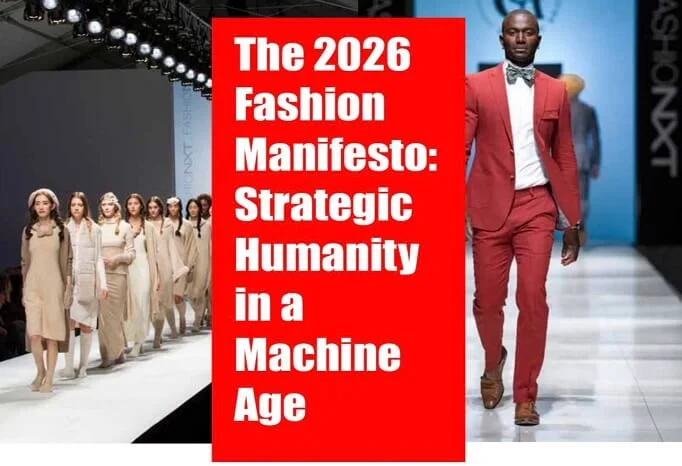
Contrary to digital-only predictions, Live Shows are Up. In an AI-saturated world, a physical event is the only “Source of Truth.” A 15-minute runway show provides the high-fidelity raw footage that fuels a brand’s entire digital ecosystem for months.
III. The Geopolitical Chessboard: The “Great Swap”
Stability is the New Consumer Confidence
Historically, we watched “Consumer Confidence” as our North Star. In 2026, Geopolitical Stability has taken its place. With 76% of executives citing tariffs as the number one hurdle, reliability and “Political Insulation” are now more valuable than price. Brands are no longer sourcing for the lowest cost; they are sourcing for the lowest risk.
The Sports-Fashion Nexus & “Skin-to-Shelf”
With the 2026 World Cup in North America, we see a total convergence of fashion and athletics. Simultaneously, the “Skin-to-Shelf” model has matured. This is a seamless pipeline where a digital outfit in a video game (like Fortnite or The Sims) is instantly available for physical purchase, allowing virtual influence to drive immediate manufacturing demand.
IV. Market Specifics: The US Renaissance
The Showrooming Revolution: Physical Retail’s Second Act
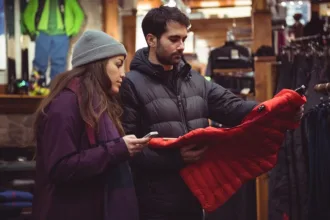
The “Retail Apocalypse” narrative has been rewritten. In 2026, US retail square footage is growing, but its purpose has shifted. The store is no longer an inventory warehouse; it is a Showroom. * The Strategy: Consumers visit physical locations to touch, feel, and try on garments, but the transaction is processed digitally for home delivery. This reduces overhead for retailers and allows manufacturers to shift to a “Push-to-Pull” inventory model, where production is triggered by showroom data rather than speculative seasonal buys.
The GLP-1 Effect and Wellness Fashion
The rise of oral GLP-1 weight-loss medications has triggered a massive sizing reshuffle in US retail. As noted in NRF’s 2026 Outlook, the fastest-growing category is Wellness Fashion. * The Tech: We are seeing the mainstreaming of Bio-Integrated Textiles. These garments use “E-Textile” sensors to track heart rate, sweat pH, and glucose levels directly through the fabric. This category is projected to grow at a CAGR of 25% through 2028, merging the boutique with the health-tech lab.
Also Read: The Triple Threat to Brand Profitability and Growth: What Boards Need to Know
V. THE BANGLADESH 2026 ROADMAP: NAVIGATING THE INFLECTION POINT
As Bangladesh officially graduates from LDC status on November 24, 2026, the industry faces a critical crossroads. The “Safety Net” of trade preferences is vanishing, and the competition is no longer just other nations, but the robotic micro-factories rising in the West.
Leveraging AI for People, Not Replacement
The primary fear in 2026 is that AI will render the Bangladeshi workforce obsolete. I argue the opposite: Bangladesh must use AI to augment the human worker. By integrating AI-driven defect detection, marker optimization, and predictive maintenance, factories can increase the “Value-per-Worker” exponentially. AI should be the tool that allows our workers to handle higher complexity with lower fatigue.
Navigating Regional Superpower Plays
The “Geopolitical Swap” means Bangladesh is often caught in the crossfire of trade wars between Western markets and regional giants like China and India. To survive, Bangladesh must reduce raw material dependence. The 2026 mandate is Vertical Integration. By developing internal capacity for Man-Made Fibers (MMF) and recycled textiles, the country can insulate its supply chain from the price volatility and political leverage of regional superpowers.
The Design Thinking Imperative
Bangladesh must move away from “Order Following” and embrace Design-as-a-Service. The industry needs a new talent pool rooted in original design thinking. Factories that offer 3D-prototyping, trend forecasting, and original silhouette development are the only ones securing premium margins. Investing in creative education that blends technical skill with Design Engineering is the only way to become indispensable.

Leveraging Industrial Nationalism as a Market Buffer
While the global industry faces volatility, Bangladesh possesses a strategic asset often overlooked by its own exporters: its domestic consumer base.
- The “Domestic-First” R&D Lab: Bangladesh is on track to become the 9th largest consumer market globally by 2030. With the Middle and Affluent Class (MAC) reaching 34 million people in 2026—growing at 10.5% annually—there is a massive, captive audience at home.
- Strategic Guidance: Bangladesh should utilize the domestic market as a high-speed testing ground. By launching original brands locally, factories can test “Design Thinking” and original silhouettes on a population that already trusts the “Made in Bangladesh” tag. This builds the brand-building muscles needed to compete in New York or Paris while providing a resilient safety net against Western order fluctuations.
Human-Centered Branding: Showcase the Maker
Finally, Bangladesh must take bold initiatives to showcase its industry in a humanity-centered way in Western markets. In the US and EU, Bangladeshi garment workers are often viewed through a lens of marginalization. To counter this, our branding must go beyond showing the product; it must showcase the makers.
By highlighting the artisans and their individual stories, Bangladesh can shift the narrative from “cheap labor” to “Skilled Craftsmanship.” We must present the worker as an empowered driver of global fashion innovation. Initiatives like “Meet the Maker” QR codes and video profiles of the factory floors will bridge the “Humanity Deficit” that Western consumers are currently feeling in the age of AI.
Accelerating Original Skillsets & Circularity
The era of the “Basic Tee” is closing. To combat the projected 12% tariff hike in post-graduation EU markets, Bangladesh must accelerate into High-Complexity Technical Wear. The Circular Mandate: By 2026, the EU’s Strategy for Sustainable and Circular Textiles is in full effect. Bangladesh must invest in Chemical Recycling and Fiber-to-Fiber technology. The factories that can prove their garments are “Designed for Circularity”—meaning they are easily disassembled and recycled—will be the only ones eligible for top-tier Western contracts.
Closing Thoughts
The 2026 executive knows that data is a commodity, but interpretation is the edge. Whether it is navigating the tariff cliffs of the West or the robotic labs of the East, we must use the machine to optimize the factory, but we must use the human to build the brand. The future of Bangladesh is not in the millions of pieces it can sew, but in the millions of lives it can represent with dignity, design, and defiance.
About the Author

Prasenjit Tito Chowdhury is a strategist and innovator standing at the intersection of Silicon Valley technology and the global fashion supply chain. A former Intel engineer and a US citizen for over twenty years, Chowdhury is the founder of FashioNXT, a premier fashion platform recognized by Forbes Magazine for its forward-thinking approach to the industry.
His career has been defined by bridging the gap between high-tech efficiency and high-touch human design. As a professional who grew up in Bangladesh, he provides a unique “dual-lens” perspective—interpreting how Western market shifts and technological leaps directly impact the strategic roadmap for the world’s most critical garment manufacturing hubs.