Bangladesh is the world’s second-largest ready-made garment exporter, contributing nearly 85% of the country’s $47 billion in total exports. Yet emerging financial pressures — from deferred payment cycles to buyer risk asymmetry — threaten to destabilise this global supply-chain powerhouse.
Recently, I received a business inquiry from Best & Less Australia, a well-established buying house known for handling large-volume orders. While high-volume buyers are attractive to manufacturers in Bangladesh, the payment terms proposed in this case raised serious concerns — concerns symptomatic of a much deeper, industry-wide structural problem.

The buyer proposed D/A 60 days — Documents Against Acceptance — meaning payment is due 60 days after shipping documents reach the buyer’s bank. Crucially, the supplier must release the original Bill of Lading, surrendering full control of the goods long before any payment is received.
At first glance, such terms may appear commercially standard in certain markets. However, when evaluated against the operational and financial realities of Bangladeshi manufacturers, the risks become alarmingly clear.
The Real Timeline: Where the Risk Lies
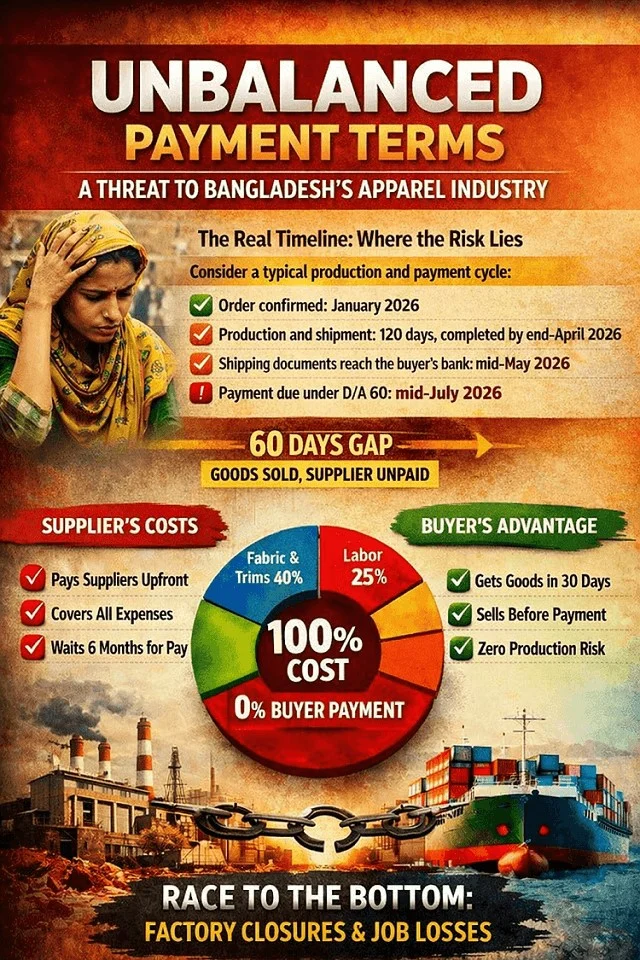
Consider a typical production and payment cycle:
- Order confirmed: January 2026
- Production and shipment: 120 days, completed by end-April 2026
- Shipping documents reach the buyer’s bank: mid-May 2026
- Payment due under D/A 60: mid-July 2026
In effect, the exporter waits nearly six months from order confirmation to receive payment.
During this period, the manufacturer must independently finance:
- Fabric and accessory suppliers
- Labor costs
- Overheads, compliance costs, utilities and financing charges
All without receiving a single dollar from the buyer.
Meanwhile, the goods:
- Reach Australia within 30 days
- Clear customs in another 7–10 days
- Enter the buyer’s sales cycle long before the supplier is paid
In practical terms, the supplier ends up financing not just production but also the buyer’s inventory and sales cycle.
Also Read: Brands Must Stop Passing the Burden: The Real Cost to Garment Workers
Industry Feedback: Trust but Verify
When these concerns were shared with industry peers, including senior factory management, the response was unsettling: “If you want to do business, you have to believe the buyer.” This raises a fundamental question — why is trust expected to flow in only one direction?
If a buyer truly believes in a supplier’s capability, compliance and commitment, why cannot financial risk be shared? In any fair commercial relationship, trust must be mutual — not unilateral.
Market Distortion and the Race to the Bottom
Bangladesh’s apparel sector has shown resilience, with export figures of $19.36 billion like in the first half of FY26, underscoring its role as the backbone of the national economy.
Yet systemic distortions are emerging. Factories willing to absorb excessive financial risk under onerous payment terms:
- Normalise unfair payment structures
- Push CM (Cost of Making) to unsustainable levels
- Force responsible factories into impossible competition
- Gradually weaken the sector’s overall supply base
The result is a market where smaller and mid-sized factories are squeezed out, quality and compliance suffer, and financial stress increases defaults, disputes and closures. This is not healthy competition — it’s systemic erosion.
This Is Not Charity — It’s Business
Bangladesh’s apparel industry has invested billions in:
- Compliance and sustainability
- Worker welfare and safety systems
- Environmental standards and green operations
Suppliers today are structured, audited and globally compliant enterprises — not informal workshops. Expecting them to serve as interest-free financiers for international buyers is neither ethical nor economically rational. We are manufacturers — not charities.
The Need for Institutional Intervention
Given the gravity of the issue, industry bodies such as BGMEA and BKMEA must take decisive action to protect suppliers and maintain Bangladesh’s competitive edge.
Key steps should include:
- Establishing minimum acceptable payment terms
- Discouraging open-ended D/A terms without bank guarantees
- Promoting structured, risk-sharing payment mechanisms
- Engaging with international trade bodies such as the Australian Chamber of Commerce
A 50/50 risk-sharing model — where both buyer and supplier invest and commit — is more equitable and sustainable than the current one-sided structure.
A Call for Balanced Partnerships
Bangladesh remains one of the world’s most reliable sourcing destinations, offering:
- Skilled labor at scale
- Competitive pricing
- Strong compliance and sustainability credentials
- High production capacity
What suppliers seek is simple – fair payment terms, mutual trust, and shared responsibility.
If this balance is not restored, the industry risks long-term damage — where only the largest players survive, innovation stalls, and ethical sourcing becomes a hollow promise.
True partnerships are built not on pressure, but on respect, transparency and fairness.