
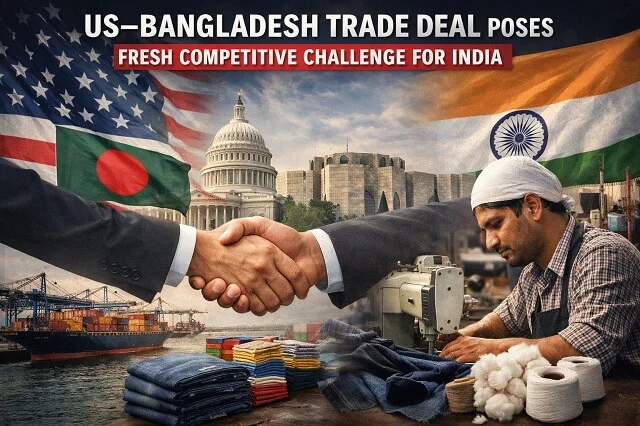
A recently signed trade agreement between the United States and Bangladesh is sending ripples through South Asia’s textile markets, with Indian industry groups expressing concern that Dhaka’s newly gained tariff advantages could weaken India’s competitive position in the crucial US apparel market.
Under the deal signed in Washington on February 9, the United States reduced reciprocal tariffs on Bangladeshi exports to 19% — down from earlier proposed rates — and agreed to zero-duty access for ready-made garments (RMGs) produced in Bangladesh that use American cotton or synthetic fibres.

This zero-tariff provision applies to a majority of Bangladesh’s garment exports — estimated at around 85–86% of total shipments — if the qualifying condition on US inputs is met.
Bangladesh Gains Price Advantage in US Market
Bangladesh’s garment industry, one of the world’s largest and a key driver of its export-dependent economy, is expected to benefit from this preferential access. Analysts say the exemption could make Bangladeshi textiles more price-competitive in the US, particularly in basic cotton and knitwear segments that are highly cost-sensitive.
Industry insiders note that Bangladesh already sources some amounts of US cotton, and expanded purchases of these inputs could unlock further zero-duty exports under the agreement.
Also Read: Indian Textile Stocks Fall as Bangladesh Gains US Zero Tariff
Indian Textile Sector Voices Concerns
While the overall tariff reduction is modest — Bangladesh’s broader rate is set at 19% versus India’s 18% under separate agreements with the United States — the zero-duty clause stands out as a potential game-changer for Bangladesh in supplying key apparel categories to the US.
Critics within India’s textile industry warn that the arrangement could:
• Erode India’s price competitiveness in garments and apparel exports to the US.
• Reduce demand for Indian cotton and yarn as Bangladesh’s incentive to import inputs from the US grows.
• Put pressure on major textile hubs such as Tirupur, Surat, and Panipat, which rely heavily on exports to Western markets.
India’s leading textile and spinning stocks also tumbled in domestic trading amid market concerns that the new tariff framework could tilt buyer preferences towards Bangladesh.
Some opposition politicians and industry representatives have labelled the deal “bad news for India”, arguing that it strengthens a regional competitor at a time when global buyers are already exploring alternatives to traditional sourcing hubs.
Balanced Views and Industry Response
Not all commentators believe the impact will be severe. Some economists and trade experts suggest that India’s diversified textile ecosystem — with strengths in cotton processing, yarn production and technical textiles — may insulate it from major disruption.
Others point out that Bangladesh’s zero-duty access requires the use of US inputs, which could entail higher raw material costs compared with sourcing from South Asian suppliers, potentially offsetting some competitive gains.