
Bangladesh’s cotton import outlook has been revised downward as weaker activity in the country’s textile and garment sector reduces demand for the key raw material used in yarn and fabric production.
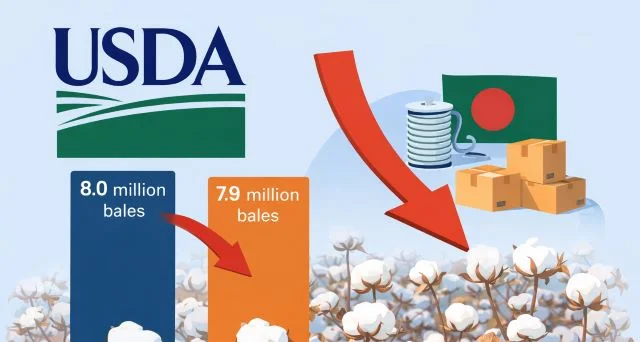
The United States Department of Agriculture (USDA) said Bangladesh is now expected to import about 7.9 million bales of cotton during the August–July marketing year 2025–26, slightly lower than its earlier projection of 8.0 million bales released a month ago.

The agency also adjusted its forecast for domestic cotton consumption, estimating usage at around 8.0 million bales for the same marketing year, compared with its previous estimate of 8.1 million bales.
The revision reflects a slowdown in spinning and textile operations linked to softer demand from global apparel buyers. Bangladesh’s garment sector, which relies heavily on imported cotton to produce yarn and fabric, has recently faced weaker export orders from major international markets.
Bangladesh is among the world’s largest cotton importers because the country produces only a limited amount of the fiber domestically. Most of the cotton imported by local spinning mills is processed into yarn that is later used by garment manufacturers producing apparel for global brands.
The ready-made garment industry remains Bangladesh’s most important export sector, accounting for more than four-fifths of the country’s foreign exchange earnings and employing several million workers across factories and related industries.
However, export performance during the current fiscal year indicates that the sector is experiencing a period of slower growth.
Official trade figures show that Bangladesh’s apparel exports totaled $25.79 billion between July and February of fiscal year 2025–26, marking a decline of about 3.7 percent compared with the same period a year earlier.
The slowdown has affected both major product categories in the industry. Knitwear exports fell by about 4.5 percent to $14.34 billion, while woven garment shipments declined by nearly 3 percent to $12.45 billion during the same period.
Also read: Bangladesh Posts Strong Growth in Slowing US Market
Industry leaders say reduced retail demand in key Western markets has been a major factor behind the weaker export performance. The European Union and the United States remain Bangladesh’s largest apparel export destinations and play a significant role in shaping production trends across the country’s textile supply chain.
Mohiuddin Rubel, additional managing director of Denim Expert Ltd, said global economic uncertainty and slower consumer spending have reduced the volume of new orders placed by international buyers.
“When international demand weakens, apparel manufacturers reduce their production schedules, which in turn lowers demand for yarn from spinning mills,” he said.
Rubel added that the slowdown has resulted in a significant buildup of yarn inventories within Bangladesh’s textile sector.
According to industry estimates, local spinning mills are currently holding unsold yarn stocks valued at around Tk 12,000 crore, equivalent to roughly $1 billion.
The accumulation of unsold inventory has created additional pressure on spinning mills, many of which are already dealing with rising operational costs and energy supply challenges.
Bangladesh’s textile industry has faced recurring shortages of natural gas and electricity, forcing many factories to reduce production capacity. Industry officials say some mills are operating at only 40 to 70 percent of their installed capacity due to energy constraints.
Despite the lower operating levels, weaker demand from garment manufacturers has meant that inventory continues to accumulate across the sector.
Bangladesh sources cotton from a variety of global suppliers, including the United States, India, Brazil and several African countries. Because the country relies almost entirely on imports to meet its cotton requirements, fluctuations in global supply and demand directly affect its textile industry.
The USDA’s latest report also included updates on global cotton market conditions.
According to the agency, global cotton production is expected to increase by more than 1.1 million bales, bringing total output to about 121 million bales. The increase is largely attributed to improved harvest prospects in Brazil and China.
These larger crops are expected to offset reduced production in Argentina.
At the same time, the USDA slightly reduced its forecast for global cotton consumption. Worldwide usage is now expected to decline by more than 100,000 bales to around 118 million bales.
Lower demand in several textile manufacturing countries—including Pakistan, Bangladesh, Mexico and Vietnam, contributed to the downward adjustment.
Market analysts say global cotton demand often moves in line with broader trends in apparel manufacturing and retail sales. When consumer spending slows in major clothing markets, textile producers typically reduce output, leading to lower demand for cotton.
For Bangladesh, maintaining strong export demand remains essential for sustaining activity across the textile and garment supply chain.
Industry stakeholders say improving energy availability, stabilizing raw material costs and strengthening global retail demand will be important for restoring growth in the sector over the coming months.
Despite the current slowdown, Bangladesh continues to play a major role in global apparel manufacturing and remains a key supplier for international clothing brands sourcing products from South Asia.