
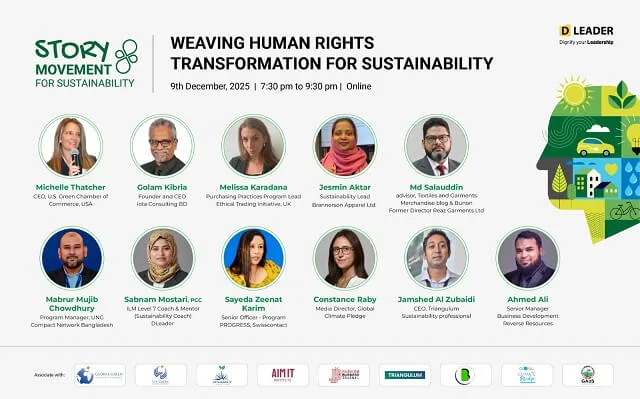
The global webinar titled Weaving Human Rights Transformation for Sustainability was organized on 9 December 2025 with a powerful exchange of ideas, insights, and forward-looking strategies from international experts, industry leaders, sustainability professionals, and human rights advocates.
It highlighted the deepening intersection between human rights, responsible business conduct, and sustainable supply chains, the two-hour session brought together a diverse panel of speakers who examined the urgent transformations needed across global industries.

Also Read: Diversifying Beyond Oil: Azerbaijan’s Cotton Challenge
A Thoughtful Beginning
The event opened with Sabnam Mostari, CEO, D Leader, who delivered an inspiring inauguration note. She underscored the responsibility of businesses to embed human rights into every layer of their operations, setting the tone for a meaningful and solution-oriented discussion.

Key Voices & Insights
Michelle Thatcher, CEO, U.S. Green Chamber of Commerce (USA), presented the Panama Story and reiterated the founding goal- to fill degraded land with life again.
She emphasized that this ethos drives the vision of Generation Forest Invest. Drawing on the metaphor of the lone wolf, she noted that just as a wolf stays persistent and focused, investors and environmental stewards must commit to long-term missions—building ‘forever forests’ that restore ecosystems, benefit communities, and generate lasting value.
She explained how, under the leadership of Andreas Eke, Generation Forest Invest is redefining forestry as a regenerative asset class. Its model transforms degraded tropical land, notably in Panama, into biodiverse, multi-species forests that mimic natural rainforest systems.
Michelle urged stakeholders to embrace ‘wolf-like persistence’, align capital with climate resilience, prioritize biodiversity, and invest in intergenerational value.
Md Salauddin, Advisor, Textiles & Garments Merchandise Blog & Bunon, addressed a critical and uncomfortable reality. Global consumers are buying more and wasting more than at any time in history. This pattern is accelerating resource depletion, environmental degradation, and social exploitation across supply chains.
Also Read: How China’s T2 Textile Mills Showcase the Future of Sustainable Manufacturing
He stressed that this cycle must stop. According to him, the world urgently needs a unified path toward ‘buy less but buy better’ — a consumption model rooted in durability, responsibility, and long-term value rather than fast, disposable trends. Choosing better products is not only an environmental obligation but also a matter of public health and human rights.
Higher-quality goods require safer materials, fair labor conditions, and transparent production systems, which collectively uplift workers, reduce pollution, and decrease waste.
Salauddin emphasized that shifting toward quality over quantity is essential for protecting the planet’s ecosystems, safeguarding the well-being of communities involved in production, and building a sustainable future where responsible consumption becomes the norm rather than the exception.
Other speakers—including Golam Kibria – Founder & CEO, iota Consulting BD; Jesmin Aktar – Sustainability Lead, Brannersson Apparel Ltd.; Mabrur Mujib Chowdhury – Program Manager, United Nations Global Compact Network Bangladesh; Ahmed Ali – Senior Manager, Business Development, Reverse Resources; Sayeda Zeenat Karim – Senior Officer, Program, PROGRESS, Swisscontact; Jamshed Al Zubaidi – CEO, Triangulum; Tay Zar Phyo Naing – Global Sustainability Associate–also shared their own sustainability stories and movements. Each of them contributed examples from their fields, highlighting data-driven approaches, rights-based production practices, circularity, labour inclusivity, ethical governance, and the rising global demand for transparency and responsible sourcing.
A Step Toward a More Responsible Future
Across two hours of rich and diverse discussion, the webinar successfully brought together global and local perspectives on one shared platform. The collective message was clear- human rights and sustainability are inseparable. Industries that embrace this transformation today will have the resilience, credibility, and ethical foundations needed to lead in a rapidly changing global landscape.