
Bangladesh’s apparel sector continued to demonstrate resilience and global relevance in 2025. Amid shifting sourcing patterns, rising costs in other markets, and increasing sustainability demands, the country leveraged its scale, efficiency, and compliance leadership to maintain its position as a top destination for international apparel sourcing. This article explores the key factors behind its performance and the strategic priorities shaping 2026.
Global Sourcing Shift

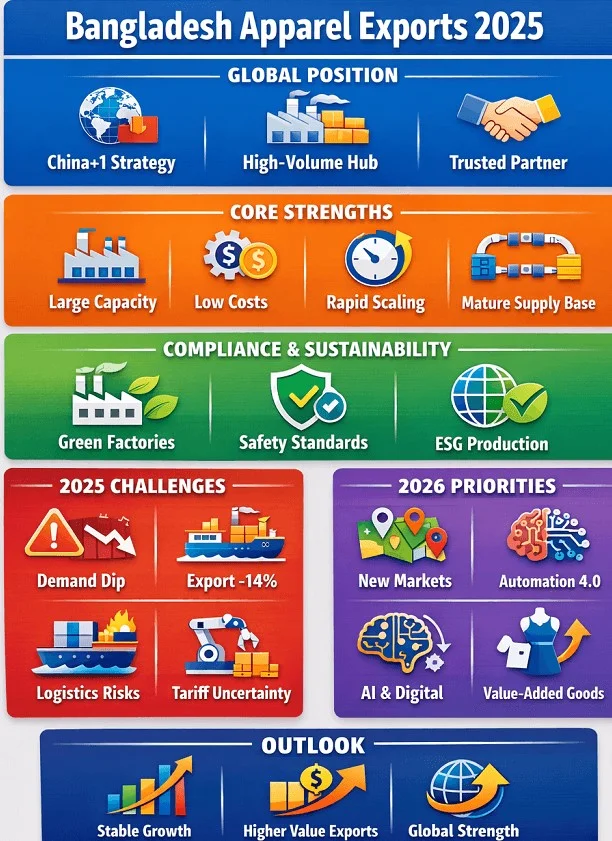
In 2025, global apparel sourcing continued to recalibrate as brands accelerated diversification away from China in response to geopolitical risk, rising production costs, and compliance scrutiny. Bangladesh emerged as one of the primary beneficiaries of this shift. Leveraging its deep supplier base of more than 4,500 export-oriented garment factories and long-standing relationships with major global brands, the country absorbed increased order volumes, particularly in basic, mid-value, and volume-driven categories such as knitwear, denim, and casualwear. Buyers prioritized Bangladesh not only for cost, but also for its proven ability to execute large-scale programs with consistency, making it a cornerstone of multi-country sourcing strategies.
Cost Efficiency with Scalable Capacity
Despite inflationary pressures on energy, wages, and raw materials, Bangladesh maintained a significant cost advantage over competing hubs in South and Southeast Asia. Competitive labor productivity, vertically integrated knit supply chains, and strong backward linkages helped offset rising input costs. More importantly, factories demonstrated an ability to ramp production rapidly during peak buying seasons—an increasingly critical factor as brands shortened lead times and reduced inventory risk. While countries such as Vietnam and Indonesia faced capacity constraints and higher compliance-related costs, Bangladesh’s scale enabled it to remain a preferred destination for both replenishment and long-run programs.
Stronger Compliance and Quality
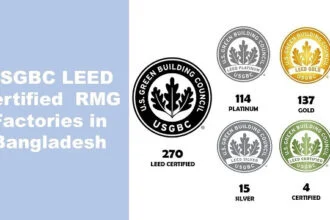
Compliance continued to evolve from a requirement into a strategic asset. In 2025, Bangladesh further consolidated its position as a global leader in sustainable manufacturing, hosting the highest number of LEED-certified green garment factories worldwide. Investments in workplace safety, digital compliance systems, wastewater treatment, and renewable energy strengthened buyer confidence, particularly among European and North American brands under pressure to meet ESG targets. Parallel improvements in quality assurance, process control, and product consistency supported a gradual shift toward more complex styles and higher-value orders.
Challenges Along the Way
Growth in 2025 was uneven and marked by volatility. Global inflation, cautious consumer spending, and inventory corrections in key retail markets led to fluctuating order flows throughout the year. According to Export Promotion Bureau (EPB) data, apparel exports declined by approximately 14% year-on-year in December 2025, reflecting seasonal softness and deferred buying decisions. Operational disruptions—most notably logistics challenges such as the Dhaka airport cargo fire—highlighted vulnerabilities in critical infrastructure. At the same time, evolving tariff regimes, preferential market access uncertainties, and currency fluctuations underscored the importance of proactive trade diplomacy and risk diversification.
Strategic Priorities for 2026
Market Diversification
Reducing overreliance on the US and EU will be essential. Strategic expansion into Asia-Pacific, the Middle East, and Latin America—where apparel demand is growing alongside rising middle-class consumption—can help stabilize export earnings and unlock new growth corridors.
Digital & Industry 4.0 Adoption
Wider adoption of automation, AI-enabled quality inspection, ERP-driven production planning, and data-led forecasting will be critical to improving efficiency. Digital transformation can help factories reduce lead times, control costs, and meet increasingly complex buyer requirements.
Sustainability as Advantage
Bangladesh’s leadership in green manufacturing presents an opportunity to move beyond compliance toward value creation. By positioning sustainability as a differentiator, suppliers can attract premium orders, longer-term commitments, and strategic partnerships with global brands.
Move Up the Value Chain
To strengthen margins and resilience, the industry must accelerate its shift toward fashion-led products, man-made fibers, performance wear, and design-supported manufacturing. Enhancing product development and innovation capabilities will be key to capturing higher-value segments.
Policy & Infrastructure Support
Continued investment in port efficiency, customs modernization, bonded warehouse reforms, and multimodal logistics will be essential. Stronger public–private collaboration can help address structural bottlenecks and improve overall export competitiveness.
In fine, in 2025, Bangladesh’s apparel sector demonstrated resilience, operational depth, and strategic adaptability amid a challenging global environment. While short-term volatility persists, the fundamentals – scale, compliance leadership, and manufacturing capability – remain strong. With focused execution on diversification, digitalization, sustainability, and value addition, Bangladesh is well positioned not only to defend its global standing in 2026 but to transition toward a more resilient, higher-value growth trajectory in the years ahead.