
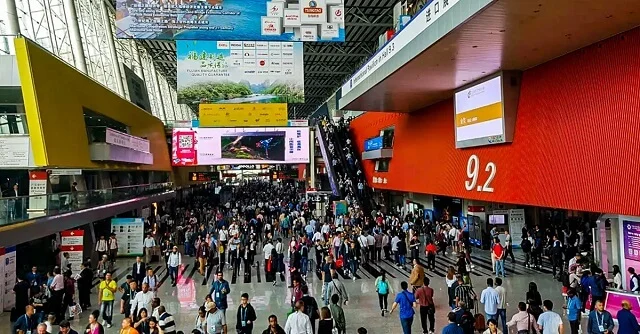
China’s textile industry is accelerating a shift toward higher-value, technology-driven fabrics and faster-response manufacturing models, according to product showcases and exhibitor activity at the Canton Fair Phase 3, which concludes on May 5.
The world’s largest trade fair for manufactured goods has seen strong activity in apparel, fabrics and home textiles, with Chinese suppliers increasingly positioning themselves beyond basic garment production and toward functional, design-led and performance-oriented textile categories.

Industry participants at the fair said demand from global buyers is increasingly centred on speed, flexibility and functional innovation rather than purely low-cost sourcing, prompting Chinese manufacturers to adjust product strategies across denim, knitwear and man-made fibers (MMF).
In denim, exhibitors highlighted a clear pivot away from heavy, rigid fabrics and toward lightweight, stretch-enhanced and comfort-oriented materials. Suppliers showcased denim blends designed for warmer climates, improved mobility and faster production cycles, reflecting demand from fast-fashion and e-commerce brands. Eco-focused production methods, including reduced-water washing and recycled cotton blends, were also promoted, although industry participants noted that cost competitiveness remains a dominant factor in sustainability adoption.
Knitwear production, meanwhile, has been shaped by a growing emphasis on speed-to-market capabilities. Chinese manufacturers showcased rapid sampling systems and small-batch production models aimed at serving fast fashion and online retail supply chains. Seamless knit structures, soft-touch fabrics and elastic blends featuring modal and viscose were widely displayed, alongside functional innovations such as antibacterial and cooling yarn technologies. The sector’s direction reflects rising demand for comfortable, multi-use apparel spanning loungewear, athleisure and everyday basics.
The most significant developments were observed in MMF-based textiles, where China continues to hold a structural advantage due to its integrated polyester supply chain. Exhibitors highlighted large-scale production of recycled polyester, microfiber-based performance textiles and high-density functional fabrics offering quick-dry, waterproof and wind-resistant properties. These materials are increasingly targeted at sportswear, outdoor apparel and technical garment segments, where performance characteristics are becoming as important as cost.
Across all categories, hybrid fabric development emerged as a dominant theme. Suppliers showcased cotton-polyester blends, knit-woven hybrids and multi-functional textiles designed to combine comfort, durability and affordability. Industry executives said such materials are increasingly being positioned as “all-in-one” solutions for global buyers seeking simplified sourcing and faster product development cycles.
Also Read: Denimsandjeans India Expo 2026 puts denim’s green shift in focus
Another notable trend at the fair is the gradual transformation of China’s textile export model from raw material supply toward full-package manufacturing. Several exhibitors presented integrated offerings that combine fabric development, garment design, sampling and bulk production. This shift effectively allows buyers to source complete product lines rather than individual textile components, streamlining procurement for global brands and retailers.
Analysts and sourcing agents attending the fair said the changes reflect China’s broader strategy to move up the textile value chain amid rising regional competition from lower-cost manufacturing hubs. Rather than competing solely on price, Chinese suppliers are increasingly emphasizing responsiveness, product innovation and technical capability.
At the same time, the fair underscored ongoing pressure in the global textile supply chain. Buyers continue to diversify sourcing bases across Asia, while Chinese manufacturers face tighter margins and higher input costs. However, the scale, integration and production speed of China’s textile ecosystem remain key competitive advantages.
The developments at the Canton Fair suggest that global textile sourcing is entering a new phase, where functionality, speed and supply chain integration are becoming as critical as cost efficiency. For many buyers, China remains central to that transition, even as the industry gradually fragments across competing manufacturing hubs.
As the fair concludes, contract negotiations and order placements are expected to continue beyond the exhibition floor, shaping production schedules for the upcoming 2026–2027 retail cycles.