
Bangladesh’s garment industry, one of the largest in the world, is taking steady steps toward a circular economy as global brands and local manufacturers work to turn textile waste into valuable raw materials through the Circular Fashion Partnership (CFP).
Led by the Global Fashion Agenda (GFA), the initiative was first launched in Bangladesh in 2020 and has since grown into a multi-country platform spanning Asia and Europe. The partnership focuses on building textile-to-textile recycling systems by capturing post-industrial waste known locally as jhut and feeding it back into the fashion supply chain.

For Bangladesh, where apparel exports account for more than 80% of total export earnings, the shift toward circular fashion is no longer optional. Rising raw material costs, tightening environmental rules in key markets such as the European Union, and growing pressure from international buyers are pushing the industry to rethink how it manages waste.
Turning Textile Waste into Circular Fashion
Bangladesh produces hundreds of thousands of tons of textile waste every year, much of it high-quality cotton scraps generated during garment production. While some of this waste has traditionally been exported or downcycled into low-value products, CFP aims to keep more of it within the country and transform it into recycled yarn and fabric.
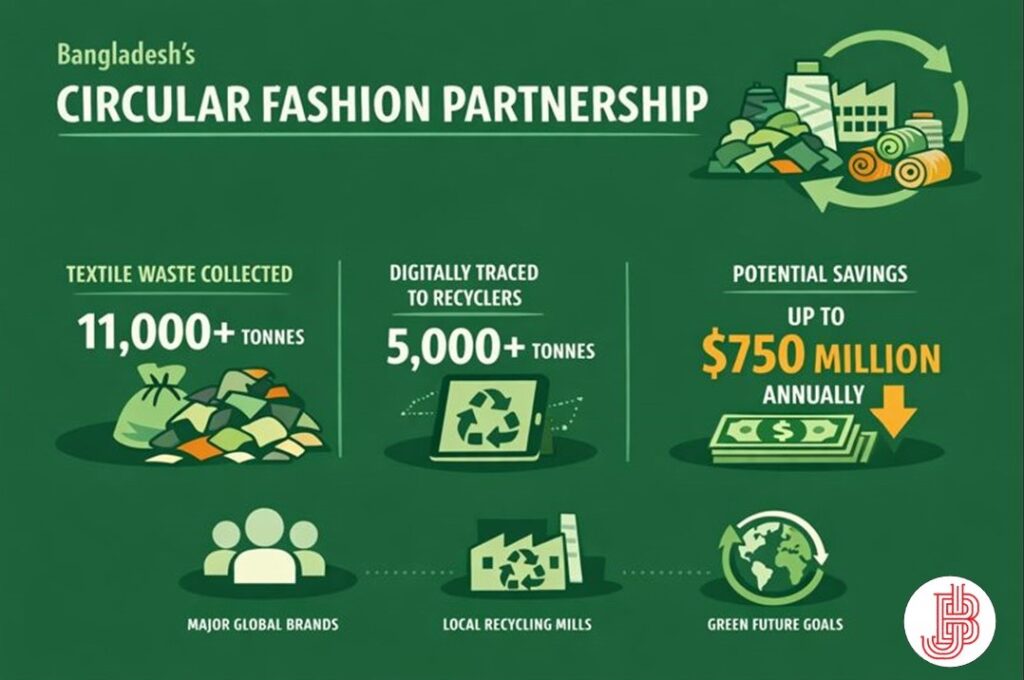
By late 2024, the Bangladesh pilot under CFP had segregated more than 11,000 tons of post-industrial textile waste, with over 5,000 tons digitally traced to approved recyclers. The tracking is done through the Reverse Resources digital platform, which maps waste flows from factories to recyclers and ensures transparency across the supply chain.
Industry experts say the impact could be significant. According to sector estimates, if Bangladesh recycled all of its cotton waste domestically, the country could save up to $750 million a year by reducing imports of virgin cotton. Bangladesh currently imports most of its cotton, exposing manufacturers to volatile global prices and supply disruptions.
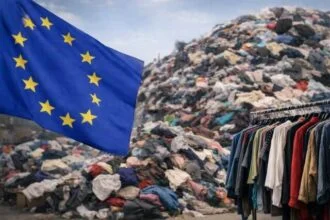
The timing of the initiative is critical. Global fashion brands are preparing for stricter sustainability regulations, including the European Union’s upcoming Digital Product Passport (DPP), which will require detailed data on material sourcing, recycling, and environmental impact. “Circularity is becoming a business requirement, not just a sustainability goal,” said industry officials involved in the partnership. Brands sourcing from Bangladesh are increasingly asking suppliers to demonstrate waste traceability and recycled content in finished products.
Major international brands participating in CFP include H&M Group, Inditex, Bestseller, Marks & Spencer, and Target Australia, all of which source large volumes of garments from Bangladesh. Their involvement has helped create demand for recycled fibers and encouraged factories to adopt better waste segregation practices.
BGMEA’s Support on Circular Fashion
The initiative is supported locally by the Bangladesh Garment Manufacturers and Exporters Association (BGMEA), which has played a key role in engaging factories, recyclers, and policymakers. In 2025, BGMEA led a trade mission to the Netherlands to explore advanced recycling technologies and investment opportunities, aiming to align Bangladesh’s textile sector with European circular economy standards. Around the same time, industry dialogues were held with support from the United Nations Industrial Development Organization (UNIDO) to identify gaps in skills, infrastructure, and policy.
Also Read: Türkiye joins global push for circular fashion with new initiative
Several recycling projects are already under construction in Bangladesh, with total investments estimated at around $40 million. Once operational, these facilities are expected to add roughly 100 tonnes per day of recycled yarn production capacity, reducing dependence on imported raw materials.
Despite progress, scaling circular fashion in Bangladesh remains challenging. Much of the textile waste trade still operates informally, making traceability difficult. Advanced recycling technologies are expensive, and there is a shortage of skilled workers trained in fiber-to-fiber recycling. Policy barriers also persist. Export Processing Zones (EPZs) have complex rules governing waste movement, and the country lacks a comprehensive national framework for textile recycling. Industry leaders say clearer regulations, fiscal incentives, and access to green financing will be essential to unlock large-scale investment. Analysts also warn that without faster progress, Bangladesh could face risks in key export markets. A recent international assessment noted that countries failing to improve recycling capacity may struggle to meet future sustainability requirements imposed by global buyers and regulators.
Regional Expansion of Circular Fashion
Bangladesh’s experience has helped shape CFP’s expansion into other major manufacturing hubs. In Cambodia, the partnership was launched in March 2025 and plans to support up to 80 factories with waste assessments and standardized systems. Indonesia completed its first year of implementation in late 2025, involving factories across Java. In Türkiye, a new CFP chapter was launched in December 2025, focusing on scaling recycling close to European markets. These expansions reflect a growing recognition that circular fashion must be built collaboratively across borders, with shared standards and transparent data systems.