
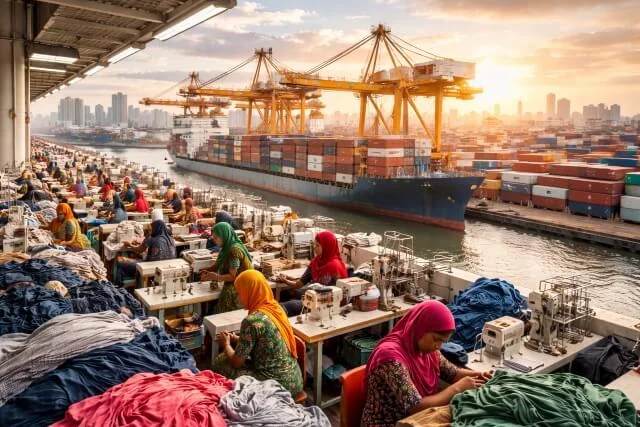
Bangladesh’s export sector is showing steady resilience despite a challenging global trade environment, with garments and textiles continuing to anchor overall performance. Recent figures released by the Export Promotion Bureau (EPB) for November and December 2025 highlight a consistent month-on-month rise in export earnings, even as year-on-year comparisons reflect weaker global demand and growing trade pressures.
Bangladesh recorded small sequential gains in export earnings toward the end of 2025, offering short-term relief for exporters. However, official data show that year-on-year exports continued to decline, keeping cumulative export earnings for July–December FY2025–26 in negative territory and highlighting the gap between short-term momentum and broader structural challenges.

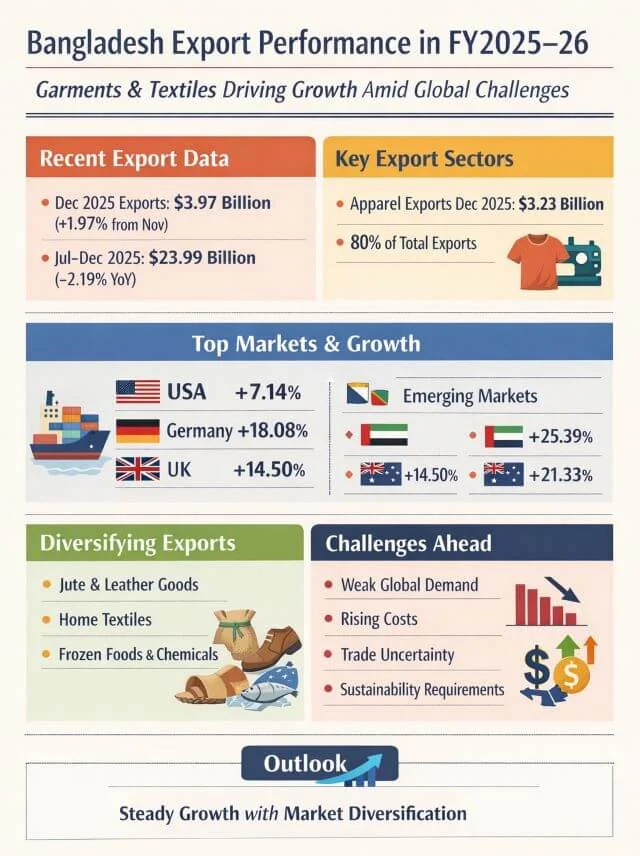
In December 2025, Bangladesh earned USD 3.97 billion from exports, marking a 1.97 percent increase over November. Export earnings in November stood at USD 3.89 billion, up 1.77 percent from the previous month. These gains suggest that export-oriented industries are managing to maintain momentum through operational efficiency and market adaptation, particularly within the apparel sector.
Looking at the first half of FY2025–26 (July–December), total exports reached USD 23.99 billion. This represents a 2.19 percent decline compared to the same period last year. While exports during July – November posted modest year-on-year growth, the sharper decline recorded in December signals increasing pressure from slowing demand in key international markets.
The ready-made garments (RMG) and textile sector continues to dominate Bangladesh’s export landscape, contributing more than 80 percent of total export earnings. In December 2025, apparel exports generated USD 3.23 billion, nearly 2 percent higher than in November. Both knitwear and woven garments played a central role in sustaining this growth, supported by Bangladesh’s large production capacity, experienced workforce, and strong compliance standards.
In November, apparel exports totaled USD 3.14 billion, confirming the sector’s steady monthly contribution. Exporters have adjusted to a tougher global market by improving efficiency, managing costs more carefully, and working closely with buyers facing lower retail demand and inventory adjustments.
However, year-on-year figures paint a more cautious picture. Apparel exports declined by 5.54 percent in November and by 14.25 percent in December compared to the same months in 2024. High inflation in major consumer markets, cautious spending by retailers, and intense price competition have reduced order volumes. At the same time, rising costs for energy, logistics, and compliance have narrowed profit margins for manufacturers.
Also Read: Bangladesh’s new Export Challenges with India’s $504.6 million MASS
Key Markets and Expanding Global Export
Bangladesh’s traditional export markets continued to provide stability during this period. In December 2025, the United States, Germany, and the United Kingdom remained the top three destinations for Bangladeshi exports, posting growth rates of 7.14 percent, 18.08 percent, and 14.50 percent, respectively. These results show that Bangladesh remains competitive in its core apparel markets despite growing regional competition.
Encouragingly, exports to emerging and strategic markets are expanding. Strong growth was recorded in destinations such as the United Arab Emirates, Australia, and Canada in December. In November, exports to China, Poland, Saudi Arabia, and Spain also increased significantly. This widening market base is particularly important for the garments and textiles sector, helping reduce dependence on a small number of traditional markets.
At the same time, competition is intensifying. China is strengthening its presence in markets where Bangladesh has traditionally performed well, while changes in trade policies, including reciprocal tariffs imposed by the United States, are reshaping global sourcing patterns. These shifts require Bangladeshi exporters to remain flexible and competitive.
Growing Export Support from Non-RMG Sectors
While garments dominate exports, several non-RMG sectors also showed positive momentum. Jute and jute goods, specialized and home textiles, leather and leather goods, frozen and live fish, vegetables, chemicals, rubber products, bicycles, pharmaceuticals, ships, shrimp, and light engineering products all contributed to recent export growth.
Within the textile sector, the rise of home textiles and specialized fabrics points to opportunities to move into higher-value segments. Investment in technical textiles, recycled materials, and sustainable production can help Bangladesh meet changing buyer expectations while improving long-term competitiveness.
Despite steady monthly growth, Bangladesh’s export sector faces ongoing challenges. Global demand remains weak, production costs are rising, and trade uncertainties persist. For garments and textiles, increasing requirements related to sustainability, carbon reduction, and traceability are adding to operational complexity and costs.
To sustain growth, Bangladesh will need to focus on productivity, energy efficiency, and technological upgrades across the textile and apparel value chain. Strengthening backward linkages, expanding man-made fiber production, and improving access to finance will be key. Supportive policies on trade facilitation, infrastructure, and currency stability can also help exporters remain competitive.