
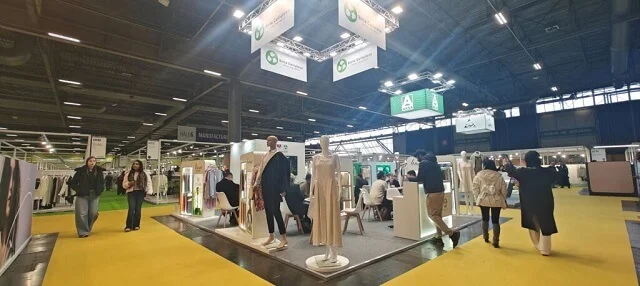
Birla Cellulose, the pulp and fibre business of India’s diversified conglomerate Aditya Birla Group, showcased its latest sustainable material developments at Première Vision Paris, underscoring its push to scale circular solutions for the global fashion industry.
Headquartered in Mumbai, the Aditya Birla Group operates across metals, cement, telecom, financial services and textiles, with a presence in more than 40 countries. Within the group, Birla Cellulose has emerged as one of the world’s largest producers of man-made cellulosic fibre (MMCF), supplying viscose and other regenerated fibres to fashion and textile manufacturers worldwide. The company has increasingly positioned itself as a sustainability-driven materials supplier as brands intensify efforts to decarbonize and reduce textile waste.

At the Paris sourcing event, Birla Cellulose highlighted innovations focused on textile-to-textile recycling, collaborative material development and resource-efficient fibre production. The showcase comes as European fashion brands tighten environmental requirements across their supply chains, placing new expectations on upstream fibre producers.
A central feature of the presentation was the company’s collaboration with Dutch recycling innovator SaXcell. Founded in the Netherlands, SaXcell has developed a proprietary process that converts post-consumer cotton textile waste into a dissolving pulp suitable for spinning into new regenerated fibres. The technology is designed to enable high-quality fibre production from discarded garments, addressing one of the fashion industry’s most persistent circularity challenges.
The partnership integrates SaXcell’s textile-waste pulping technology with Birla Cellulose’s industrial wet-spinning capabilities. By combining upstream recycling innovation with large-scale fibre manufacturing, the companies aim to bring recycled man-made cellulosic fibres closer to commercial volumes.
Company representatives have emphasized that cross-value-chain collaboration is essential if the textile sector is to transition away from the traditional linear “take-make-dispose” model toward a circular system. Demonstrating commercially scalable recycled fibres at Première Vision Paris is intended to accelerate adoption among premium fashion brands, spinners and mills that attend the influential trade fair.
The initiative addresses a mounting environmental issue. Global textile waste continues to rise sharply, with millions of tonnes of used garments ending up in landfill or incineration annually. Mechanical recycling methods often struggle to maintain fibre quality, particularly for blended textiles, creating growing interest in chemical and pulp-based recycling technologies such as the SaXcell process.
Also Read: AMA Herbal Wins Second Patent for Scalable Natural Rope Dyeing Technology
According to industry insights shared around the event, the SaXcell method can significantly reduce reliance on virgin raw materials while lowering water and chemical consumption compared with conventional fibre production. When paired with Birla Cellulose’s manufacturing scale and global supply network, the collaboration is positioned as a pathway toward meaningful volumes of recycled MMCF — an area where the industry has historically faced commercialization hurdles.
Beyond the SaXcell partnership, Birla Cellulose used the Paris platform to present an expanded portfolio of sustainable materials aimed at fashion and lifestyle applications. These included circular denim concepts designed for improved recyclability, bamboo-based viscose variants positioned as renewable alternatives, and advanced yarn blends engineered to enhance traceability and environmental performance across the value chain.
The broader message from the company reflects a strategic shift underway in the MMCF sector. Fibre producers are increasingly being evaluated not only on cost and quality but also on transparency, circularity and environmental metrics. Birla Cellulose has been investing heavily in closed-loop manufacturing technologies, responsible forestry sourcing and collaborative innovation platforms to strengthen its position in this evolving landscape.
Its continued presence at Première Vision Paris — widely regarded as one of the most influential global textile sourcing events — forms part of a longer-term strategy to deepen engagement with European brands and sustainability stakeholders. The European market remains particularly significant due to tightening regulatory frameworks around textile waste, eco-design and extended producer responsibility.
Market observers say the company’s emphasis on scalable recycling partnerships reflects a broader industry pivot. While numerous next-generation fibre technologies have emerged in recent years, relatively few have demonstrated the ability to integrate into existing industrial spinning infrastructure at meaningful volumes. By leveraging its established manufacturing base, Birla Cellulose is attempting to bridge the gap between innovation and commercial reality.
As major apparel brands set ambitious recycled content and climate targets for 2030 and beyond, suppliers capable of delivering verified low-impact materials at scale are expected to gain competitive advantage. Birla Cellulose’s latest showcase in Paris suggests the company is positioning itself to play a central role in the next phase of the fashion industry’s material transition.