
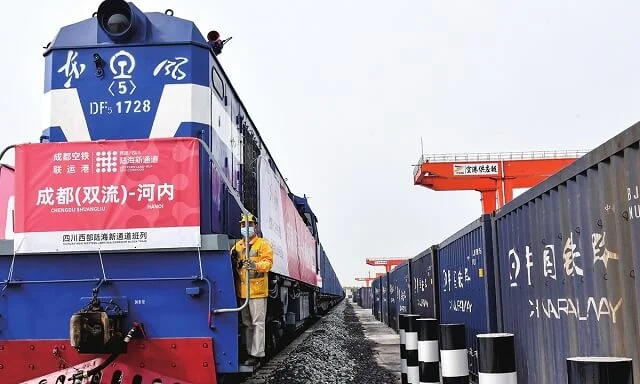
China–Vietnam cross-border rail freight volumes hit a record high in 2025, highlighting the fast-growing role of rail logistics in bilateral trade. Trains operating from China’s Guangxi Zhuang Autonomous Region to Vietnam transported around 37,000 twenty-foot equivalent units (TEUs) during the year—an 86 per cent year-on-year increase, according to the Nanning Railway Logistics Centre.
This Rail freight contains a rail corridor which has become increasingly attractive for exporters, particularly those shipping less-than-container-load (LCL) cargo, as it offers stable transit times, reliable capacity and cost-efficient logistics support.

Also Read : China Leather Footwear Market to Grow Despite Falling Imports
Rail freight rising importance is reflected in market share gains: the route accounted for about 73 per cent of total rail-exported cargo from China to Vietnam and 86 per cent of containerised rail shipments, both higher than in 2024, underscoring rail’s expanding footprint in cross-border supply chains.
Growing demand has also led to greater cargo diversification. The number of commodity categories moved between the two countries surged from 262 to 455 within a year, signalling broader trade participation across manufacturing, agriculture and consumer goods sectors.
To manage higher volumes, China’s railway authorities upgraded operations on the Pingxiang–Dong Dang cross-border rail route. Train towing capacity was raised from 1,000 tonnes to 1,300 tonnes, boosting customs clearance capacity at the Pingxiang railway border gate by around 30 per cent. At the same time, weekly train services were expanded sharply—from three to fourteen per week—significantly improving service frequency, reliability and overall freight throughput.
These upgrades further strengthen rail’s role as a key logistics channel supporting the rapid expansion of China–Vietnam trade.